
On Sunday, October 5th — as a rich, amber sun was beginning to set on an unseasonably warm fall afternoon — I had the chance to attend an Evensong service at St. Matthew’s Anglican Church at 217 First Avenue, in the Glebe. St. Matthew’s takes a high church approach to liturgy, which made Evensong — a sung service of early evening prayers and contemplation — a perfect fit. “The busy world is hushed, the fever of the day is done” are words often associated with Evensong. It’s a tradition of the Church of England and includes an order of service based on hymns, Scripture readings (often referred to as lessons), the Creed, prayers and responses from the faithful, as well as collect prayers.
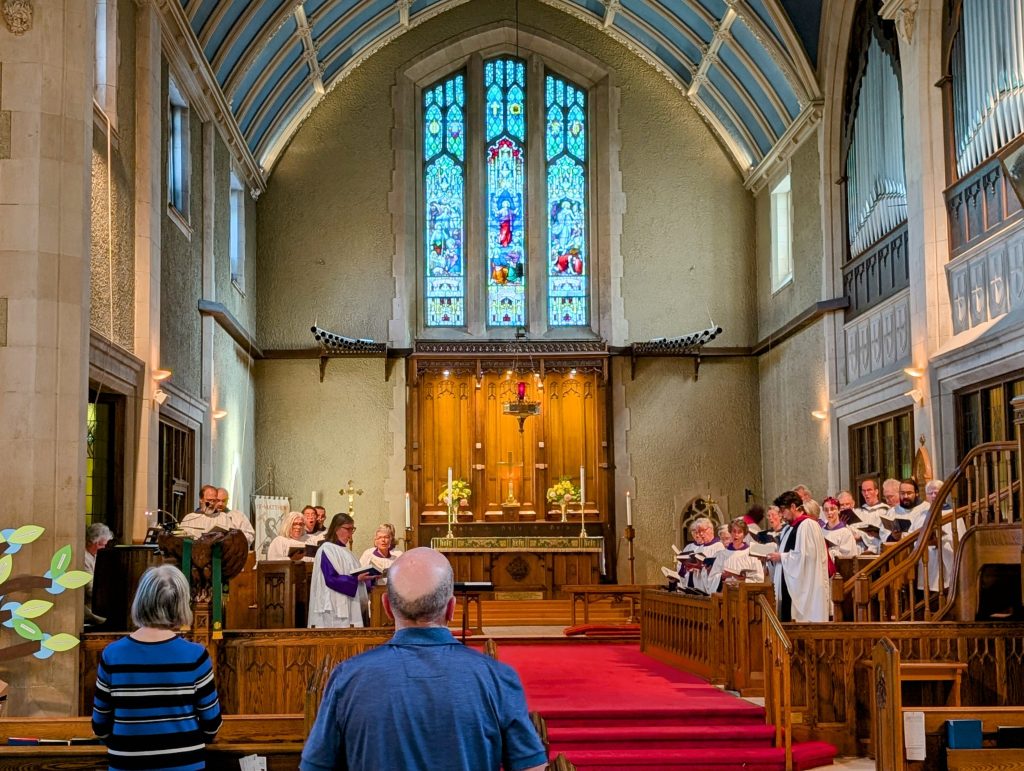
With guest organist Matthew Larkin and a choir numbering nearly two dozen, we were also treated to an organ Prelude and Postlude. The latter was Louis Vierne’s “Hymne au Soleil” which, living up to its name, filled the church with riveting bursts of energy just as the late afternoon sun beamed in through the stained glass windows on the west side. “Greater Love hath no man” by John Ireland rang through the church’s nave as well.
The parish’s incumbent, Reverend Geoffrey Chapman, presided at the service and also participated as a very capable chorister. Rev. Chapman led us in prayers for the Congo, Gaza and Ukraine — all areas of the world devastated by war — as well as prayers for teachers and students, many of whom prepare to write mid-terms, and for people suffering from anxiety. Rev. Chapman also prayed that the Commonwealth may be a witness to God’s glory.
Following the service, all those present were invited to participate in a reception held in the church’s entrance area. The dry sherry served had a rich amber hue, nearly matching the colour of the early evening setting sun. St. Matthew’s is a landmark and an architectural gem in the Glebe. While Anglicans have worshipped on this site since 1898, the current English Gothic Revival church, built with limestone, was completed in 1930. When the parish was first founded at the end of the nineteenth century, Ottawa’s population was less than 60,000. It was still a backwater, even as it had aspirations to grow into a fledgling nation’s worthy capital. Approximately 4,000 people lived in the Glebe, which was connected to the city centre by tram — an essential mode of transport for the bulk of Glebe residents who were civil servants.
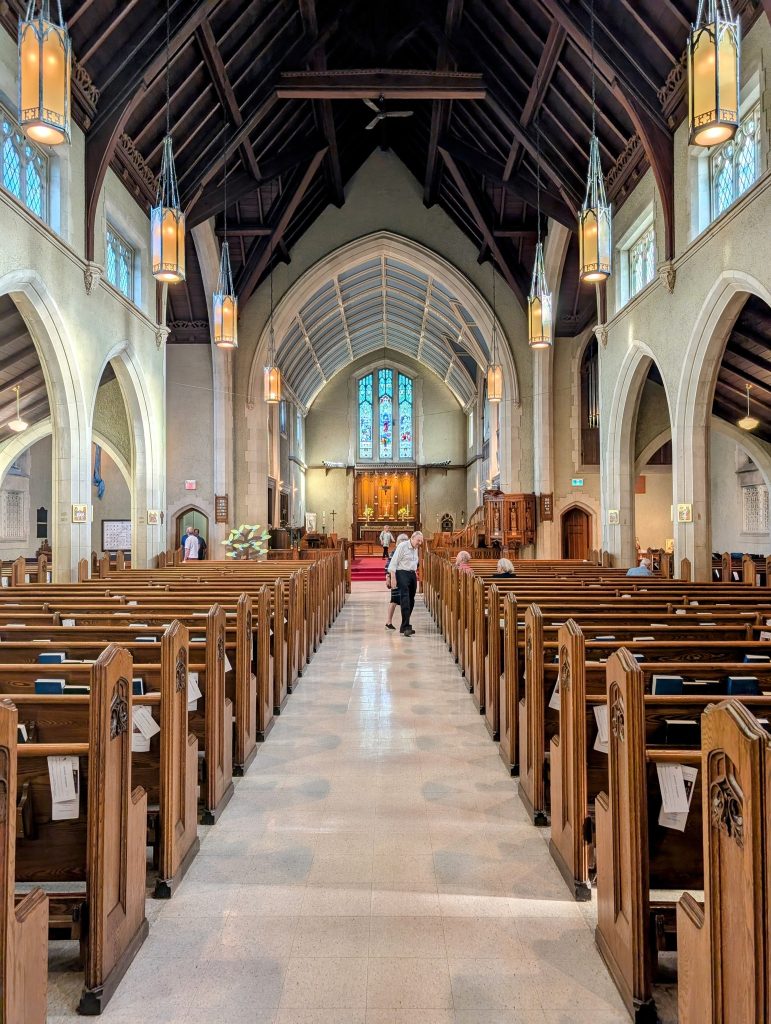
The newly constructed church was built to accommodate up to 1,100 parishioners — a genuine act of faith, given St. Matthew’s was built at the very height of the Great Depression! Today the parish is known throughout the city for the quality of its choral and organ music. Two in-person Sunday services are celebrated: a said or spoken service at 8:00 am and a sung service at 10:30 am. During the summer months, the two services are merged into a single liturgy held at 9:30 am. St. Matthew’s is an example of a parish that draws people to this historic place of worship through the quality of its music.

Born in Montreal, Christopher Adam has called Ottawa home for the past twenty years. He received his MA from Carleton University, with a thesis focusing on twentieth century European church history, and a PhD in History from the University of Ottawa. Over the years, he has published widely and works in the faith-based charitable sector in Ottawa.