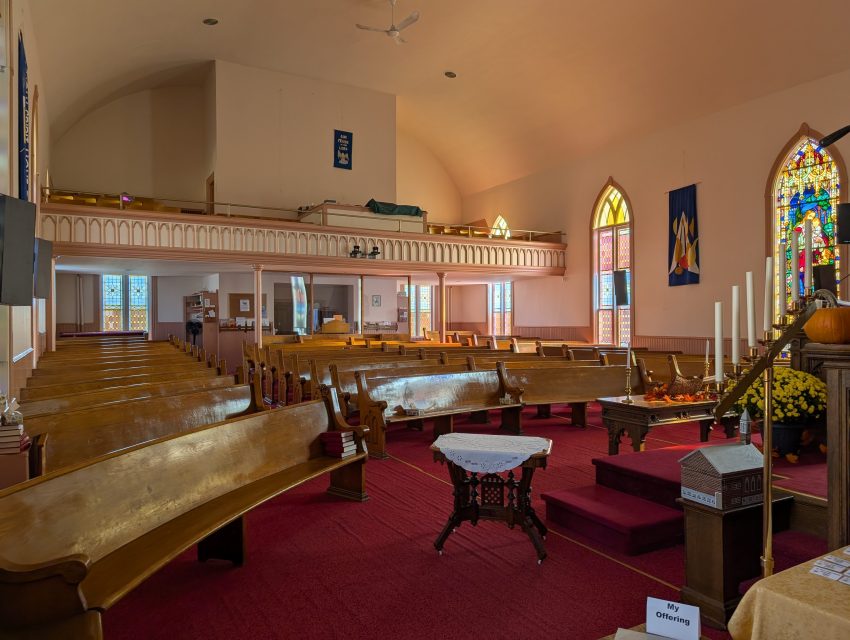
I will never look at pretzels the same way after my visit to St. John’s United Church in Kemptville on October 19 — an unseasonably warm day that was as bright as the mood of this cheerful congregation. Built in 1869 to serve as the spiritual home of local Methodists, a fire in 1888 destroyed the interior, leaving portions of the exterior brick structure intact. Today, the redbrick heritage church, rebuilt in 1888 and incorporating the surviving parts of the original house of worship’s exterior, is a Kemptville landmark. The interior combines intricate stained glass windows and rich woodwork in the sanctuary, with the plainer design of a church that had been renovated in phases during the twentieth century. There are signs, however, of this church’s Methodist origins. This is most evident in the rounded pews — one would be unlikely to find those in an old Presbyterian church, the other denomination that formed what would become the United Church of Canada in 1925.

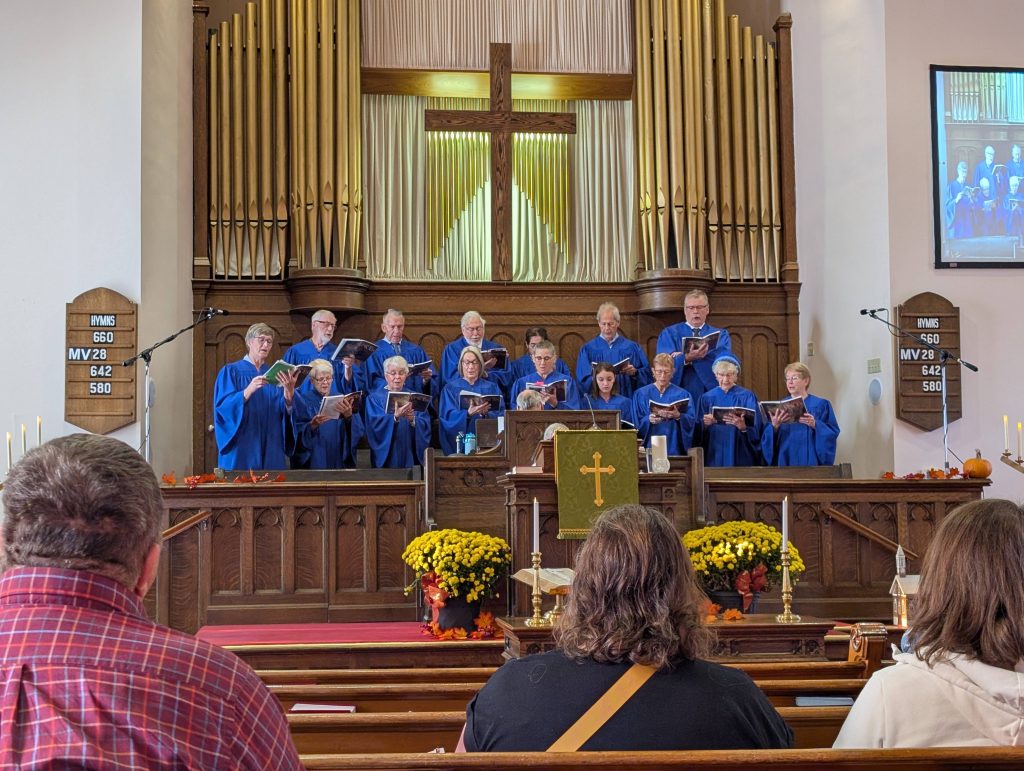
The service on Sunday, October 19 opened with sixteen choristers offering “Veni Sancte Spiritus” as the prelude — an ecumenical moment, given the song’s Taizé roots. The United Church has incorporated this into its repertoire, with the sequence appearing in the hymnal More Voices.
St. John’s United is a robust congregation — there were around 70 people in attendance with every generation represented, including some children for whom Reverend Michelle Robichaud offered a special reflection near the start of the service. She appeared with a small bowl of tasty pretzels and explained that this savoury snack’s history stretches all the way back to seventh century Europe, when a young Italian monk prepared the twisted, unleavened bread to appear like hands and arms folded in prayer, all coming together in the shape of a heart. It was to help remind children of the power of prayer and to reward them with this snack when they prayed.
Rev. Robichaud continued with her main reflection, in which she told the Holocaust story of a Jewish family who had been saved by the kindness of strangers. They had been given refuge in a private home, despite the risk that hiding Jews posed to the homeowner. The hope and persistence of this Jewish family, even during the darkest days of persecution, and their capacity to see miracles even in the seemingly smallest of graces runs through the story. One of the most important qualities needed by Jesus’ disciples in spades was persistence. She focused on the theme of persistence, which runs through Luke 18, the Parable of the Persistent Widow. The widow is the victim of an unnamed injustice and an arrogant, uncaring judge refuses to give her justice. Rev. Robichaud observed that because the injustice is unnamed, we can substitute any injustice we may experience into the story, making it relevant to our lives. It’s the widow’s perseverance that ultimately gets her justice — not because the judge has a change of heart, but simply due to her successfully exhausting him with her persistence.
Jesus tells his parable, Rev. Robichaud observes, to show how even people who are unjust may change their tune when faced with persistence. Jesus also contrasts the judge with God, who will bring about Justice simply because God is good. “Will we persist in keeping the faith until Christ comes again or will we, like leaves on an autumn day, fall away and be nowhere to be found,” Rev. Robichaud asked.

Rev. Robichaud noted that keeping the faith in today’s world can be difficult. She shared how a number of people she has encountered are outright hostile towards Christianity. Rev. Robichaud simply listens, smiles, and lets them talk, putting into practice that fundamental principle of pastoral care. Near the end, she’ll thank them for their perspective, adding that her faith is one of respect and love. The tone of the conversation often shifts considerably. “I persist in reaching out, because I feel called to be open and curious about others,” she added.
The choir’s anthem for this service was “Larger than Our Creeds and Customs,” from the 2025 publication Then Let Us sing, followed by the hymn “God of the Bible” from More Voices. Reflecting on perseverance in the shadow of suffering, we sang:
God in our struggles,
God in our hunger
suffering with us,
taking our part
still you empow’r us,
mothering Spirit,
feeding, sustaining,
from your own heart.Fresh as the morning,
sure as the sunrise,
God always faithful,
You do not change.
The choir also led the congregation in the traditional Irish hymn “Be Thou My Vision,” as well as “Faith of Our Fathers,” offering a diverse musical repertoire. As the service came to a close, we all filed past the cheerful Reverend. She offered everyone a pretzel on our way to the church hall for coffee hour, where a generous spread of baked goods, cheese and snacks awaited.
Christopher Adam

Born in Montreal, Christopher Adam has called Ottawa home for the past twenty years. He received his MA from Carleton University, with a thesis focusing on twentieth century European church history, and a PhD in History from the University of Ottawa. Over the years, he has published widely and works in the faith-based charitable sector in Ottawa.
The term “Reverend” used repeatedly as a generic term for the clergy is really not appropriate. It is not used by clergy to describe themselves and it is a form of address, not a job title. Various denominations use different terms, but clergy would not say “I’m a Reverend.” Better to use what is customary in each church.
Don’t nitpick. Doctors say “I am a doctor” blah blah. Why not just enjoy Christopher’s visit to what sounds like a welcoming community of folk?
Sounds like a very welcoming service and good message in today’s world