Sixty years ago, new churches were springing up like wildflowers in the sprawling suburbs of metropolitan Ottawa. On April 4, 1964, an Ottawa Citizen article by J.A. Hume on this church boom gives a sense of the energy that surrounded bustling and growing faith communities in the sixties, especially in the case of the United Church of Canada. By the mid-sixties, the United Church — which celebrated its hundredth anniversary this summer — counted 1.1 million members, or about 6 percent of Canada’s population of 18 million. It was the country’s largest Protestant denomination and certainly enjoyed the most political clout, as it remained closely intertwined with the Canadian nation-building project. In the sixties, church attendance was woven into the fabric of personal and community life for most Canadians.
In the early sixties, the Ottawa United Church Presbytery supported the construction of seven new churches in suburban Ottawa at a cost of over $2.2 million. A church extension fund existed, to which individual congregations and the faithful contributed and pledged financial support. By 1964, the United Church had also pledged to build an additional three new churches in suburban Ottawa within the decade, notably in Orleans, Crystal Bay and Heart’s Desire (Barrhaven). The seven new places of worship in this United Church boom (and the respective cost of building these Ottawa churches) were: Woodroffe United Church ($427,000), Rideau Park United Church ($362,000), Trinity United on Maitland ($280,000), Carleton Memorial United ($134,000), Rothwell United ($105,000), Emmanuel United ($190,000) and Eastbrook United ($90,000).
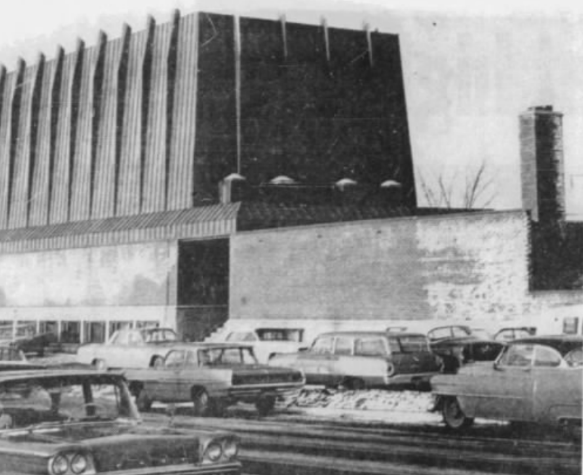
Of these seven churches, six still exist today. Eastbrook United, located at 272 Donald Street in the city’s east-end, amalgamated with Emmanuel in 1998. Trinity United, at 1099 Maitland, is an imposing mid-century landmark that’s hard to miss amidst the bungalows dating back to the same era. The church’s first minister, Rev. M.J.D. Carson, was a military chaplain. The Citizen piece from April 4, 1964 featured an image of Trinity United, which also attests to the proud automobile culture of that era. Of the newly built churches, the one at 207 Woodroffe had the largest congregation, counting 600 families and 800 children enrolled in its Sunday school. Those numbers are nearly unfathomable for most mainline Protestant congregations in 2025. In today’s context, that would just about qualify as a mega-church! In the sixties, Woodroffe’s Sunday school was so popular with families, that classes were held at the public school next door.
While the sixties represented a period when the United Church’s footprint expanded alongside the exponential growth of suburbia, the denomination made headlines for other reasons, too. The United Church adopted a viewpoint on divorce that was more liberal than that of mainstream Canadian society. It also recognized that God and His redemptive mercy were at work in the lives of all people, including those of different religions — an outlook that, on the Catholic front, would also form part of the heritage of the Second Vatican Council in those same years. Historian Phyllis Airhart offers an excellent overview of United Church history and it’s current trajectory in Broadview.
As the denomination celebrates its centennial and comes out of an era of many church closures and dwindling congregations, the Ottawa Citizen article from 1964 is a reminder of a period of great expansion and growth not too long ago.

Born in Montreal, Christopher Adam has called Ottawa home for the past twenty years. He received his MA from Carleton University, with a thesis focusing on twentieth century European church history, and a PhD in History from the University of Ottawa. Over the years, he has published widely and works in the faith-based charitable sector in Ottawa.