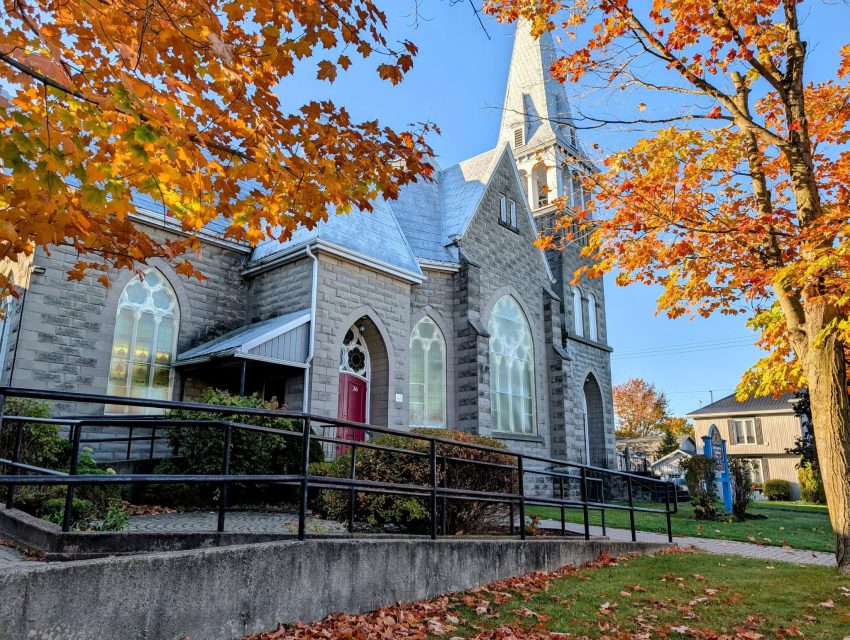
Alexandria United Church in North Glengarry is precisely what this publication is all about: discovering historic churches about which there is very little information online, and encouraging our readers to explore these hidden gems for themselves. I visited Alexandria United Church on Thanksgiving Sunday and attended their 9:00 AM service. A plaque next to the main entrance commemorating the community’s centennial indicates that the church was built in 1912. It began its life as a Presbyterian church. Presbyterian clergy arriving from Ottawa and Lancaster assisted with the dedication services on August 4 and August 11, 1912. The local community’s celebration of the opening of their new church continued with musical programming on August 5, 1912. I discovered that Alexandria United is colloquially known as the “Church on the Hill.”
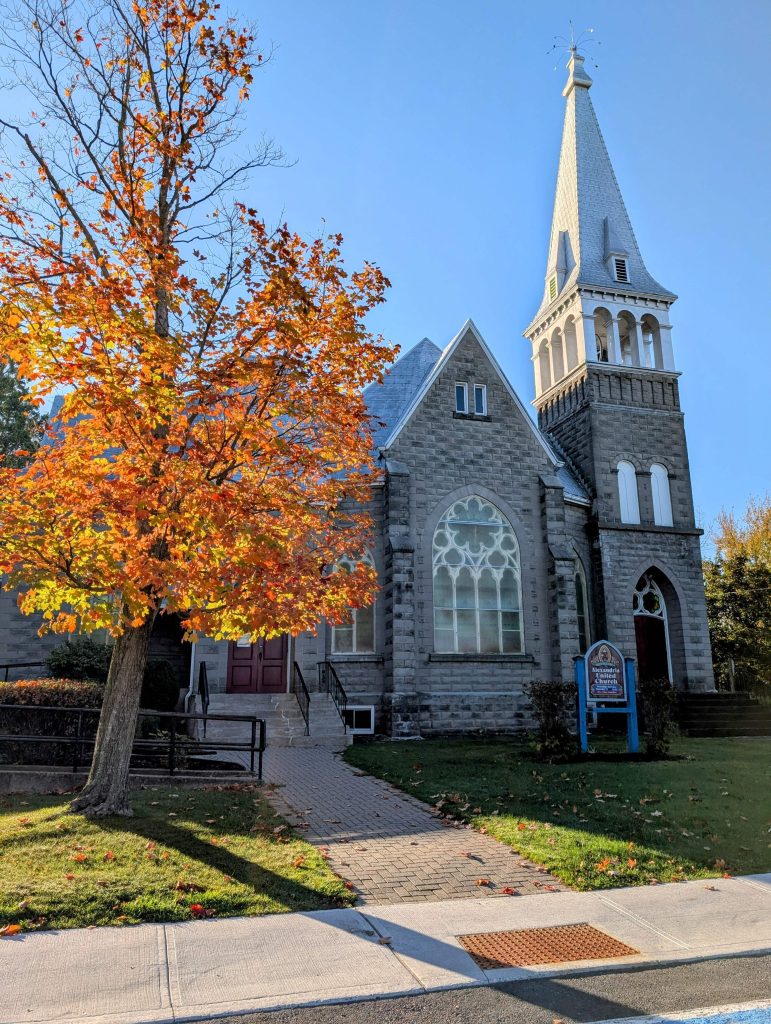
Upon entering the church on this bright, brisk Thanksgiving Sunday, I was immediately welcomed by a smiling gentleman. I later learned that he was a local country and bluegrass singer, by the name of Bob Cleary. He shook my hand, gave me an order of service and asked me to sign the church’s guestbook. Located near Highway 417 that connects Ottawa to Montreal, Alexandria United isn’t hard to visit for those passing through the region on a Sunday morning. The names of other recent visitors appeared in the guestbook.
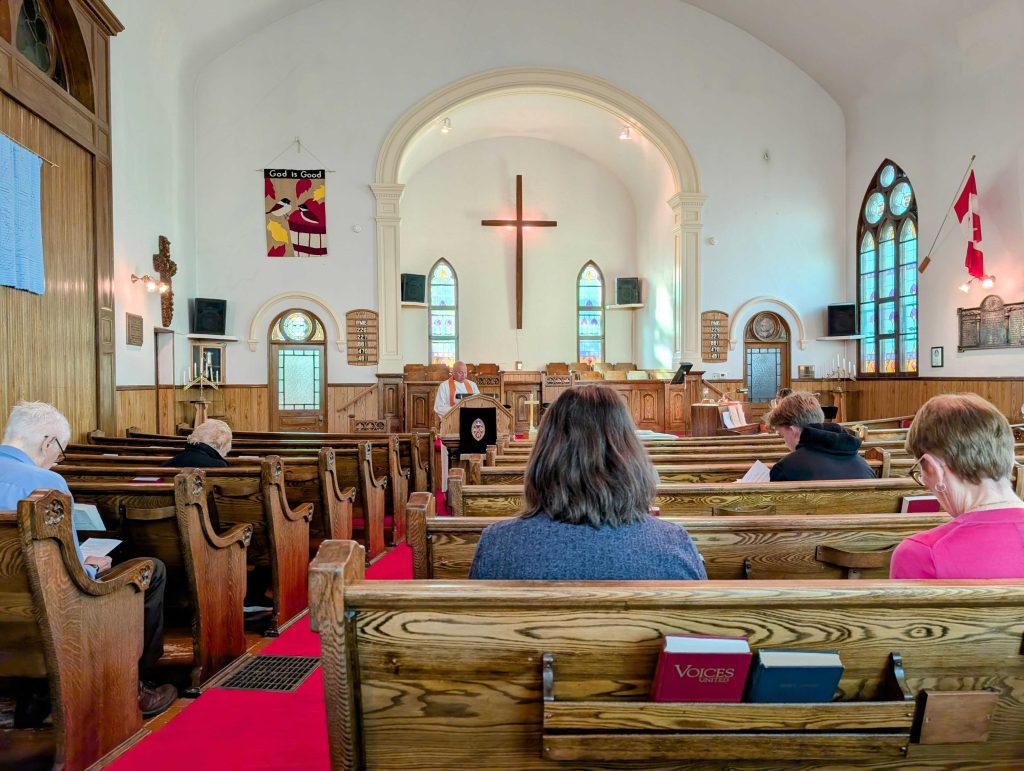
There were 20 people present at the service, led by Reverend John Noordhof. He was vested in an alb and wore an orange stole, matching the radiant autumn leaves on the front lawn. Reverend Noordhof drives to Alexandria from Lancaster and he ministers in several other congregations in this corner of Eastern Ontario. He began his reflection by asking: where’s the hope and joy this Thanksgiving? Sunday had closed off a week of death for him. He had ministered at two funerals and at a burial. Globally, we know that habitat loss and environmental degradation continue at pace. So, is there reason to be joyful amidst the troubles?
Reflecting on the readings from Isaiah 35, Rev. Noordhof observed that Isaiah came from desperate times as well. Yet the reading gives us reason to hope. What we see in the story is a great reversal. At first, we’re faced with the consequences of neglecting Creation and of not showing love to our neighbour. The land becomes barren and people are sent into exile. But God comes to their rescue, bringing wholeness to both the people and to the land. We have this extraordinary image of the desert blossoming and of water flowing. The desert becomes a sea of vibrant colour.
When the desert blooms, it does so abundantly. If that blossoming can take place in a barren desert, it can take place anywhere, Rev. Noordhof reflects. Despite this summer’s drought in eastern Ontario, we can still enjoy a harvest this fall. We nearly made the beaver extinct due to our fur trade, yet the beaver has made a comeback and is one of Canada’s national symbols. Rev. Noordhof gave thanks for the fall colours on this bright Sunday, and for his ability to enjoy them on the drive from Lancaster to Alexandria.
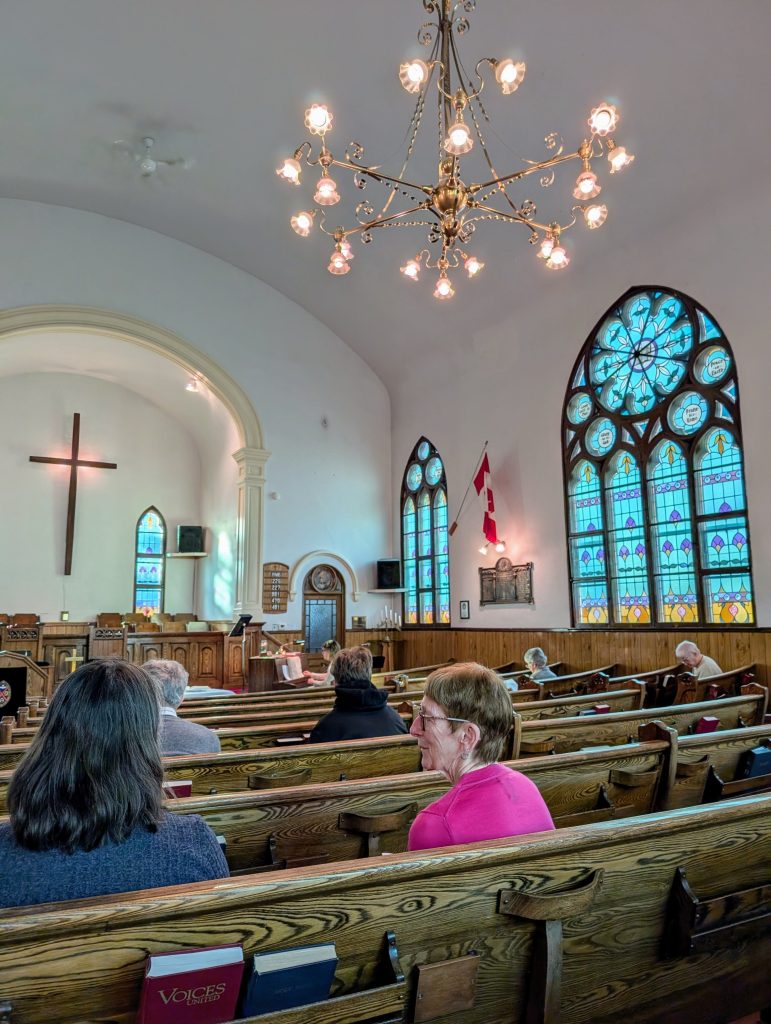
The reverend proved to be an excellent singer, joining the congregation’s pianist in hymns and serving as a de facto cantor. Among the hymns we sang, “For the Fruits of All Creation” stood out as particularly apt for our celebration of the harvest. This Sunday also included Communion, with a volunteer coming through the pews to distribute bread and sweet grape juice in little glass communion cups, around the size of thimbles. After professing the mystery of the Christian faith — that Christ has died, Christ has risen and that Christ will come again — we shared in this communal act of remembrance of Jesus’ sacrifice.
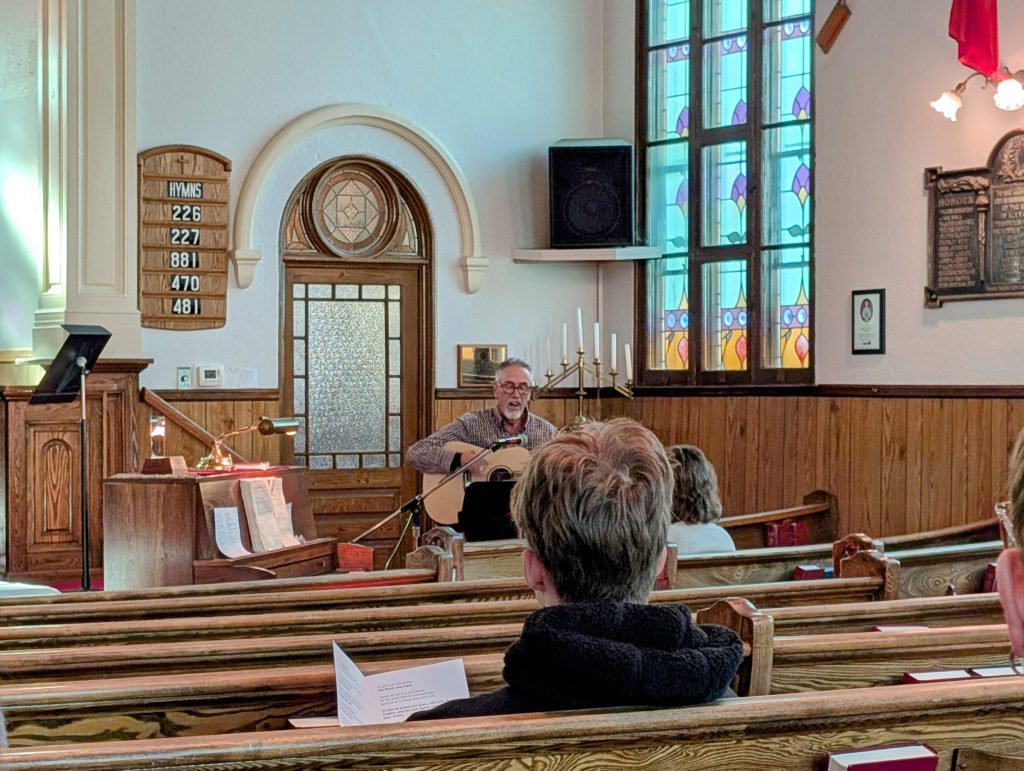
The service included Bob Cleary performing a 1971 song from Dolly Parton entitled “Yes I see God” from her Album Letter to Heaven. The soft, country melody — with the lyrics encouraging the listener to see God in the everyday — was a perfect fit for this friendly congregation in small-town Ontario.