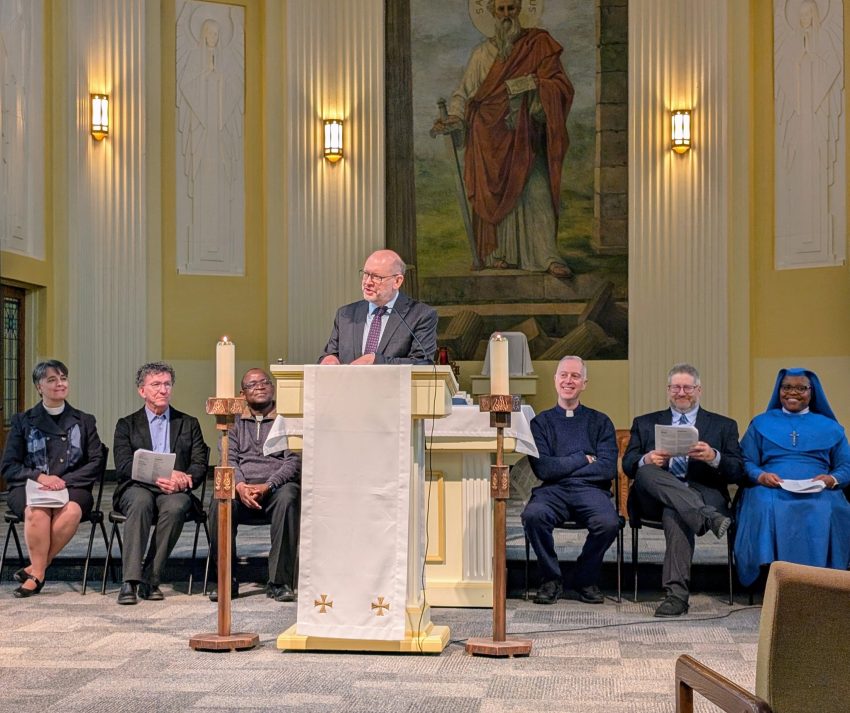
A portrait of St. Paul towered over the clergy and laity that gathered at de Mazenod Chapel on January 22 for an ecumenical liturgy marking the Week of Prayer for Christian Unity in Ottawa. Hosted by Saint Paul University’s Pastoral Services and the Christian Council of the Capital Area, the liturgy — which drew around 60 participants — included music, Scripture readings, a reflection and prayers. Reverend Margo Whittaker, an Anglican priest and a chaplain at Saint Paul University, welcomed every guest on arrival and offered an introduction to the gathering. We learned that the prayers for this liturgy had been prepared by the faithful of the Armenian community. As a reflection of this, one of the prayers at the service touched on the longstanding conflict between Armenia and Azerbaijan.
In addition to Rev. Whittaker, the clergy, religious and laity assisting at this liturgy and in the planning included Rev. Catherine Ascah (Anglican), Pastor Andy Brubacher Kaethler (Mennonite), Fr. Matthew Brunet (Roman Catholic), Rev. Tom Hubschmid (Anglican), Fr. John Malazdrewich, OMI (Roman Catholic), Sr. Mary Linda Onuoha, IHM (Roman Catholic), Rev. John C. Perkin (Baptist), Fr. William Serge Bationo (Roman Catholic), Fr. Erik Sorensen, SJ (Roman Catholic), as well as Lise Gavin from the Church Council of Canada and Andrew Garfield Mills, Charlie Scromeda and Mykayla Turner from Saint Paul University.

The readings included Ephesians 4, John 12 and Psalm 97, in both English and French translations. The organizers projected the words of all readings, prayers and songs in both official languages on screens. Rev. John C. Perkin of First Baptist Church offered a philosophically-oriented reflection, incorporating into it both the personal, as well as the broader ethos and hope that underpins the Christian experience. He shared:
“As a minister with a demanding and sometimes stress-filled work, which has taken me to court, correctional facility, hospital, psychiatric ward, and morgue, not to mention into the innermost places of the human heart and soul, sometimes when I attend worship I don’t want to be challenged to do more, to do better, to do greater. I just want the quiet assurance I have done all I can do, and to be restored by the love and grace and mercy of God transmitted through the congregation of God’s people, to be able to go out and do it again for another week…
We come as those in touch with the thin places of life where we encounter God in our weakness, hurts, sorrows, struggles, and to connect with others in the world who are weak, hurting, sorrowful, struggling. We come to be mended, restored, prepared, to take on the world once more. As existentialist Albert Camus writes, ‘in the midst of winter, I finally learned that there was in me an invincible summer.’ We come in our winters of discontent to discover the fruitful, extravagant summer supplied by God’s grace and love deep within us. And that is part of the role of the church in all its shapes and forms, in all its varied communities…”
Four musicians, including a pianist-cantor, a guitarist and two flutists, elevated the liturgical experience with their music. The service opened with the contemplative “Trinity Song,” offering all those present several minutes of reflection, with lyrics speaking of all being bound together in God’s love. We heard: “Holy Father, Son, and Spirit / Holy communion, Three in One / Come with Your peace, with Your invitation / Bind us together in holy love.” We sang “Christ, Be Our Light” as well, but perhaps most memorable for me was hearing and singing the Irish hymn “Be Thou My Vision” in French.
The liturgy served as a reminder of how much we have in common, especially liturgically. It was an expression of Christian hope that always surpasses every denominational difference and divide.
Christopher Adam
Thank you for attending this event. It is particularly important in a time of increased polarization of perspectives that the larger church in all its forms gather together, and be seen to gather together. All we hold in common — our faith and commitment to service — far outweighs our differences in theology, practice and structure.