
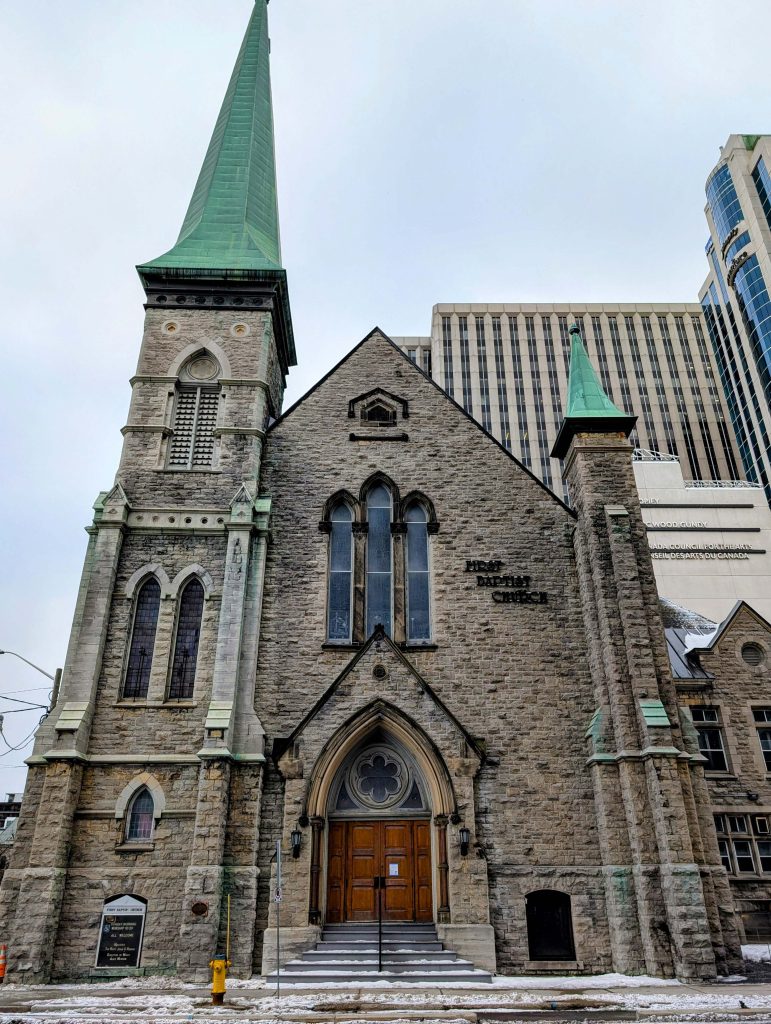
First Baptist Church, at 140 Laurier Avenue West, is one of Ottawa’s religious landmarks and a fine example of Gothic Revival architecture. In 1877, Prime Minister Alexander Mackenzie, a Baptist convert, laid the building’s cornerstone. I visited the church on the Fourth Sunday of Advent and found a liturgical community that places a keen focus on quality music.
In the minutes before the service was to start, the Reverend John C. Perkin greeted me in my pew with a handshake. He’s an amicable presence and conversational in tone. This service featured a wide range of traditional Christmas music, in the form of antiphons, hymns and songs. The music ministry is led by Alex Merpaw, who accompanied the choir on the pipe organ. The faithful in the pews numbered just over 50, while a sizeable choir sang from the organ loft. They led the congregation in singing “God Rest You Merry Gentleman,” “Angels We Have Heard on High,” and several hymns, including “The Hands that First Held Mary’s Child.” The Scripture Antiphon, “Hope is a Star” was particularly beautiful, especially the verse: “Love is a flame that burns in our heart, Jesus has come and will never depart. When God is a child, there’s joy in our song. The last shall be first, and the weak shall be strong, and none shall be afraid.” Equally moving was “In the Bleak Midwinter,” of which we sang the verse: “What can I give him, poor as I am? If I were a shepherd, I would bring a lamb; If I were a Wise Man. I would do my part. Yet what I can I give him, give my heart.”
The service included the lighting of the fourth Advent candle, with the words: “We light the Fourth Advent candle, the light of love. The light shines in the darkness, and the darkness does not overcome it.” The congregation responded with: “God is love, and if we live in love then we live in God, and God lives in us.” The community’s Associate Minister, Ema Prince, invited a handful of children to gather around a Christmas tree in the sanctuary, where she offered a brief children’s reflection. Reverends Prince and Perkin, alongside the congregation’s youth, proceeded to add stars to the Christmas tree.
The Scripture readings came from the King James Version of the Bible, with all of the lyricism that so often defines it. Reverend Perkin began his sermon with the image of World War I soldiers, weary and facing death each day in the trenches, coming together nonetheless with their enemies to celebrate Christmas in no-man’s land. It was a brief and unofficial ceasefire between the Allied and Central Powers. It was also an act that reaffirmed their humanity amidst the inhumanity of the gruesome conflict.
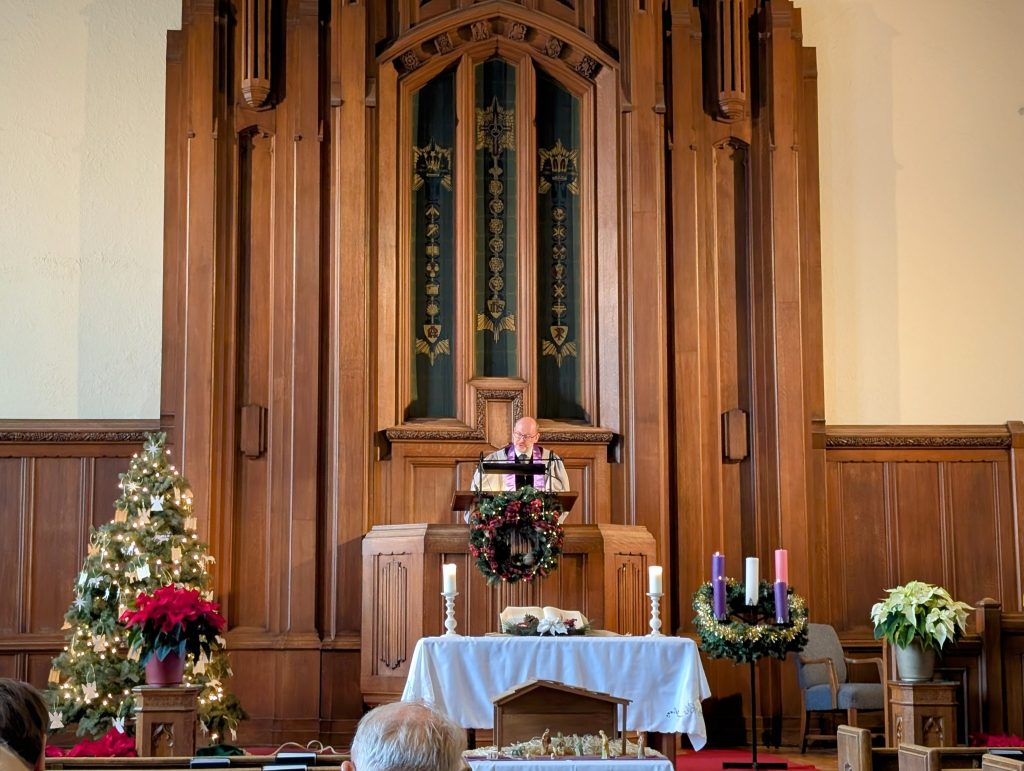
Using words that spoke to the personal, but not a privatized salvation offered through the Incarnation, Reverend Perkin said:
Mary’s song of praise, a traditional Christmas text, calls for this sense of humanity to last. It rejoices in the humanity of all people, and Mary sings, in highly charged political terms, of the Messiah whom she will bear. This is not an image of individualized salvation so that those who believe the right way will gain access to eternal life, but an image of a world changed so that those who abuse power are brought down, a world where the hungry are fed, a world of equality and justice for all. This is not about the triumph of Christian nationalism, nor about the success of market capitalism; instead, the coming of the Messiah opens us to the possibilities of a new world that functions in a different way. Instead of a world that expends its energies in the search for affluence and independence, for security and power, it is the realm of God marked by generosity and community, by openness and service. Mary’s song of praise is for this realm, and is a call for us not just to celebrate the Messiah’s birth in romantic myths, but a call to take up Christ’s mission and to make it ours, to raise the marginal and free the oppressed, to challenge the powers and to make peace.
The liturgical rhythm and nature of the service, making it a recognizable church experience for other mainline Protestants and Roman Catholics, as well as the emphasis on community and justice in the sermon, served as a reminder to me of the diversity that exists among Baptist congregations. During the Prayers of the People, Reverend Perkin walked down the main aisle as he prayed, providing the congregation with a more immersive experience. With each step, he made clear the fact that these prayers arise directly from the concerns of the faithful.
Christopher Adam

Born in Montreal, Christopher Adam has called Ottawa home for the past twenty years. He received his MA from Carleton University, with a thesis focusing on twentieth century European church history, and a PhD in History from the University of Ottawa. Over the years, he has published widely and works in the faith-based charitable sector in Ottawa.
We at First Baptist offer thanks your visit, and even more your gracious and generous commentary on our worship (as on all the places you visit). We are a bit of an atypical Baptist church in many ways, and rejoice in the great diversity of people — ethnically, theologically, linguistically — who shape our community. Worship is at the very heart of who we are and what we do, and your clear understanding of our worship in all its aspects is appreciated.