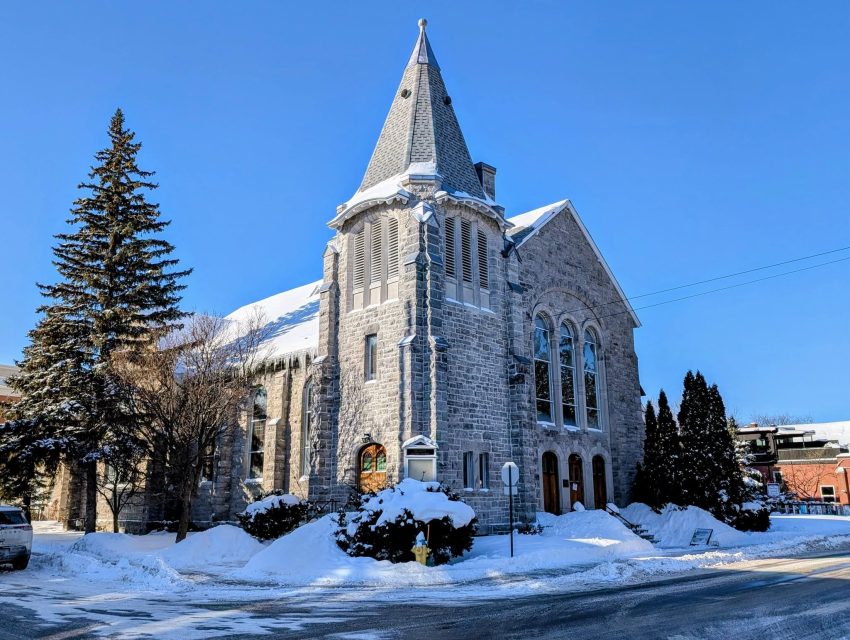
Built in 1909, MacKay United Church at 39 Dufferin Road is a Romanesque Revival architectural jewel. I visited the church on February 8 for their 10:30 am service, alongside around 50 members of the congregation who gathered in person, with several more following a live-stream remotely. I found a crisp, bright interior and a multi-generational community firmly grounded in an experiential, contemplative Christian faith that is accessible to each individual, wherever they may be on their faith journey.
Originally known as New Edinburgh Presbyterian Church when it was established in 1875, the current church replaced the previous one in 1909. The cornerstone was laid and consecrated on May 29, 1909, with the completed church dedicated in March 1910. The March 7, 1910 issue of The Ottawa Evening Journal carried the story of the dedication and of the spirited preaching. Among those present was Governor General Earl Grey, along with his wife Lady Evelyn Grey. The Journal observed that the pastor, Reverend P.W. Anderson, was very well regarded by the faithful. During the dedication of the church, Reverend Anderson shared, with lyrical skill: “Let us now reverently invoke upon [this church] His abiding blessing to the end that a pure apostolic doctrine and order may ever be maintained therein, and that the Holy Spirit may here ever give effect to His own ordinances. And in so doing, let us reverently set it apart with prayer and invocation of the Holy Ghost, so that this house may hereafter be put solely to sacred uses and preserved from all other associations whatsoever.”
Reverend Alfred Gandier of Toronto gave an impassioned sermon during the dedication service. With the service including three baptisms, Reverend Gandier directed much of his sermon to the youth: “You are at a time in your life when you are thoughtless and light-headed. I would not put old heads on you, but in your lightest hours, never think lightly of sin, whether it be in yourself or in others. Sin is too deadly to be played with. Fools do that, and only fools…Don’t be satisfied with a little butterfly brilliancy and a bit of fun. Do a little for this poor world. Have an ambition to do your full share of life’s work, using every faculty God has given you.”
In 1925, this community was among the majority of Presbyterian congregations to come together with Methodists and Congregationalists in establishing the United Church of Canada.
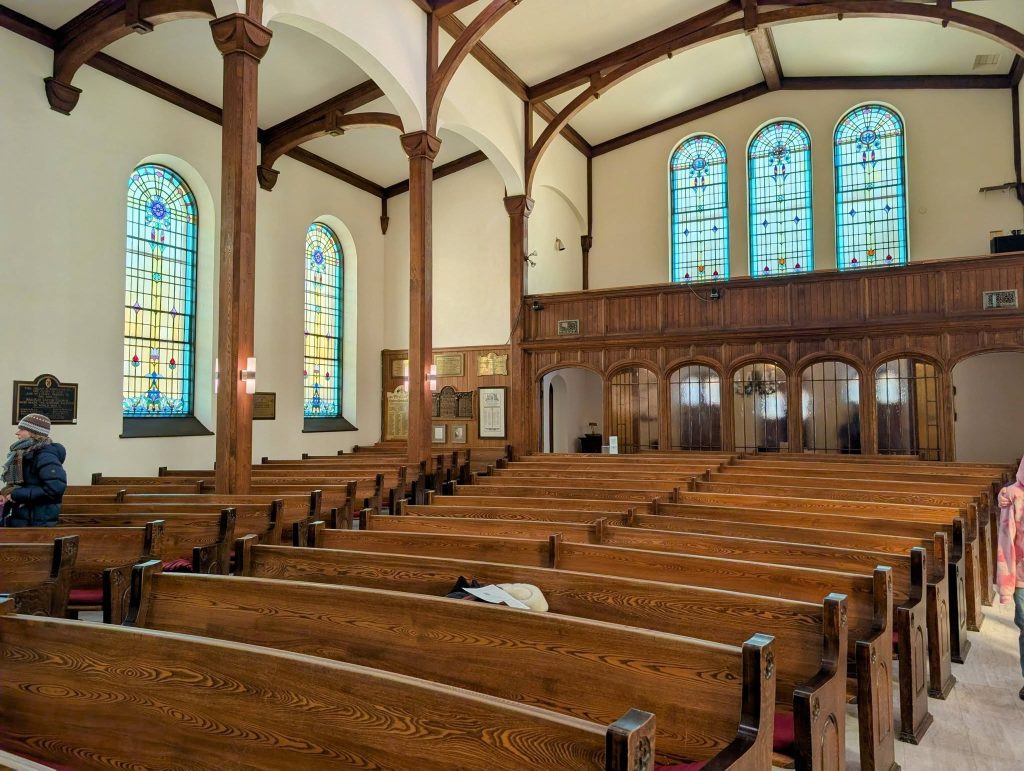
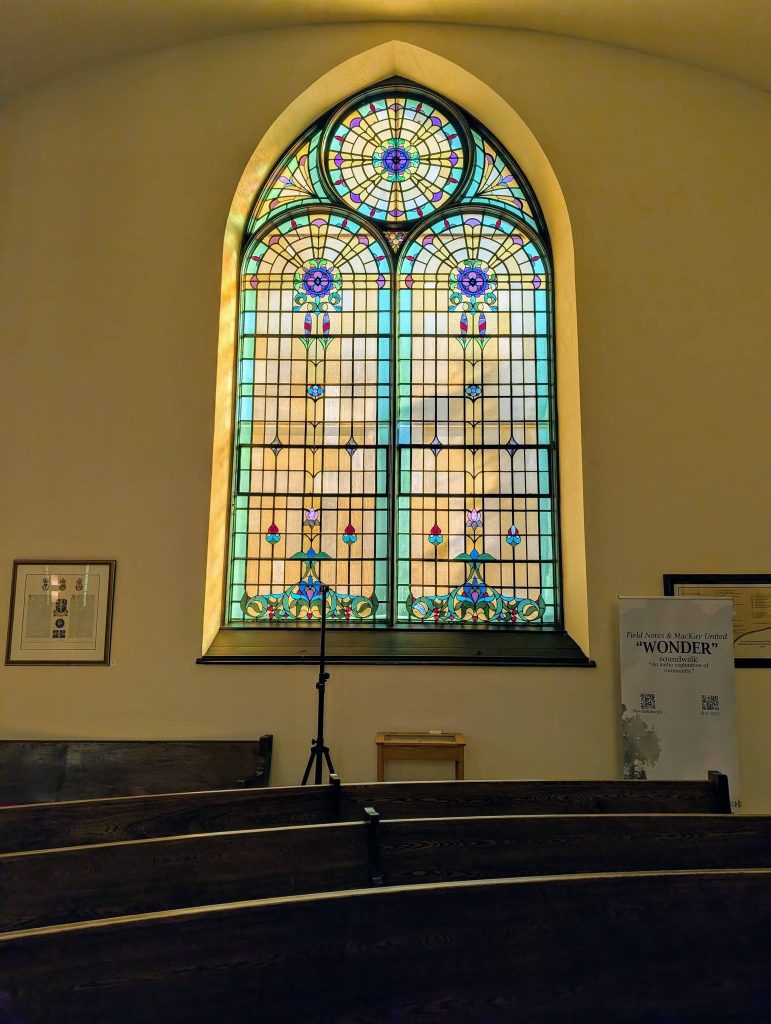
When I arrived on February 8, I was welcomed warmly in the entrance by a greeter. The interior of MacKay United is a bright, clean and inviting space. Soon after taking my place in a pew, a smiling gentleman introduced himself and told me that the church’s interior had been restored a couple of years ago. It was a major undertaking and required many weeks of scaffolding. He pointed to one stained glass window in particular, suggesting that I watch the winter sun shine through it.
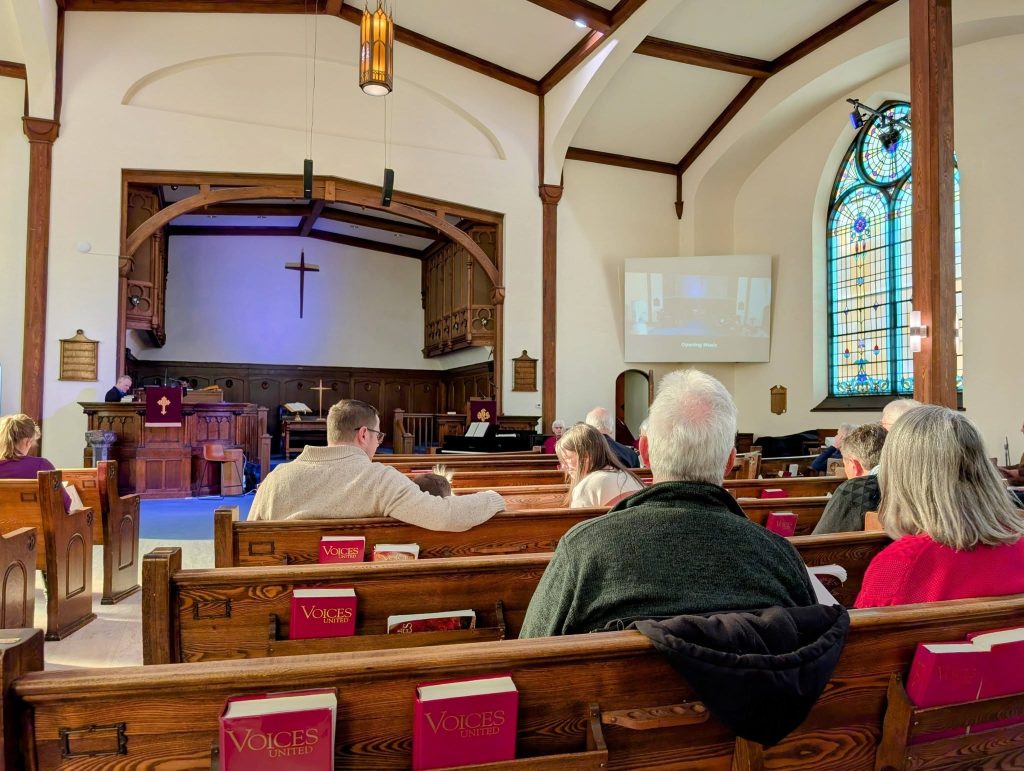
The concept of wisdom stood at the heart of the Sunday service, and it was encapsulated in a quote from the late African American theologian Howard Thurman: “Don’t ask what the world needs. Ask what makes you come alive and go do it. Because what the world needs is more people who have come alive.” The spirit of that quote was present in the dynamism and interactive nature of the service. Reverend Peter Woods, the congregation’s minister, invited the faithful to share their own sources of wisdom. These sources included life experience, teachers or mentors, a Smudging ceremony, and even the wait staff at a favourite coffee shop.
Reverend Woods’ reflection — framed within the context of the struggle for Civil Rights and Black History Month, and conversational in tone — was oriented to the here and now. But it avoided the pitfalls of a sermon focused on only temporal action by also emphasizing the importance of personal contemplation — connecting with the Transcendent and with the wisdom that flows through our world. In his sermon, Reverend Woods noted that in light of the distressing news from the US and given how we find ourselves safeguarding our own Canadian sovereignty, we should be wary of the temptation to turn away from inspiring American thinkers and leaders. “We start from a place of such kinship,” Reverend Woods noted in relation to the longstanding friendship between Canada and the US — even while it has been tested as of late. Reflecting on 1 Corinthians 2:1-5, Reverend Woods contemplated how one can integrate God’s spirit and wisdom with this world. And some of the sources that provided insight were American, including Howard Thurman, the Dean of the Chapel at Howard University. He was also a lecturer, writer and a mystic. Martin Luther King Jr. credited Thurman with being one of his great mentors.
Speaking to the congregation, Reverend Woods added: “When I heard you speaking of sources of wisdom, I realized these were all places where God showed up.”
The music was led by a pianist, Nick Gummeson, who also shared a hymn on the recently restored organ. He accompanied four choristers. The music included hymns from both Voices United and More Voices, as well as a beautiful improvised piece intended to accompany a moment of contemplation. “How Brightly Beams the Morning Star” served as the Introit. During the lighting of the Christ Candle, Reverend Woods invited the youth of the congregation to join him in the sanctuary, while we sang “Will You Come and See the Light” from Voices United. My favourite moment was the musical meditation, an improvisation on the piano entitled “What the World Needs.” Those much-needed minutes of peace, a time to close one’s eyes in silent prayer or meditation, are few and far between in our bustling world. At one point, Reverend Woods referred to the “quiet spaces around the edges of Sunday services.” He added: “We trust that there is wisdom in the room. And we want that wisdom to breathe, or settle or emerge. God’s wisdom is already here. God’s wisdom is alive.”
Following the service, all present were invited to gather for coffee and cookies in the Memorial Hall — a bright, spacious facility and a mid-century extension to the church. Coffee is a Sunday church tradition that never gets old!
Christopher Adam