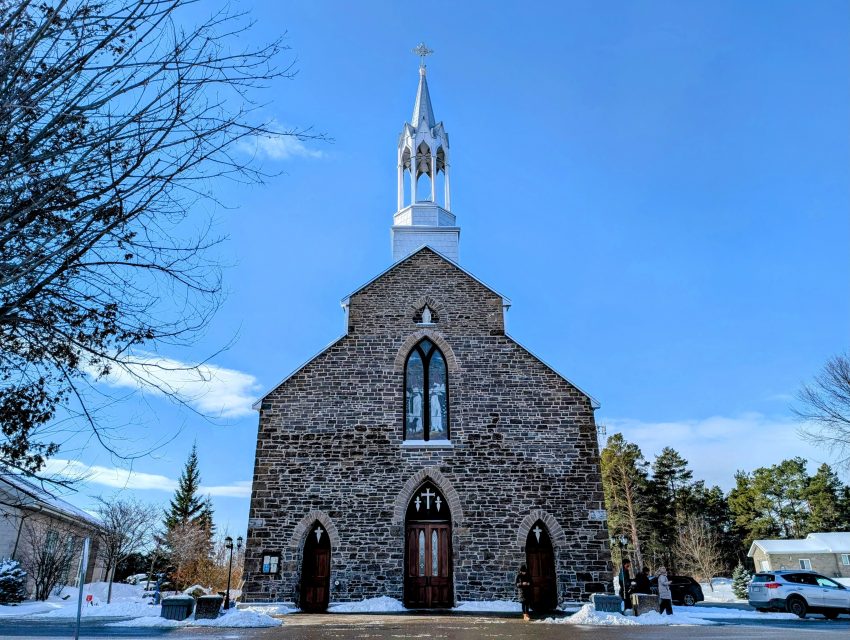
More than 200 parishioners filled the pews of a beautifully preserved church older than Canadian Confederation itself, and heard a homily from a joyful priest committed to ecumenical dialogue and compassion. On January 18 at 11:00 AM, on the Sunday opening the Week of Prayer for Christian Unity, I attended Mass at Our Lady of the Visitation Parish. Built and blessed in 1852, with the steeple added two years later, the church located at 5338 Bank Street in Ottawa’s far-flung south-end was built mostly by resilient and determined Irish immigrants. The quarried grey-stone church has a warm interior, with cream-coloured walls, mixed with amber and tan, a soaring and intricately vaulted nave, and a decorative Gothic-style altarpiece. In the minutes after Mass started, the pews in the nave had largely filled with parishioners, and more gathered upstairs, in the loft.

Preserving Our Lady of the Visitation, a volunteer-driven effort, isn’t about keeping the church firmly frozen in the past. It’s about enhancements that treat the past with respect. This is evident in a recent and on-going project to add stained glass windows to the church, all of which honour women saints. Launched in 2025, with several panes of decorative stained glass already added, the project continues in the coming months. Signs mark windows that will soon depict St. Kateri Tekakwitha, the first Indigenous woman in North America to be canonized, as well as St. Josephine Bakhita of Sudan’s Darfur region. She had been sold into slavery by Arabic slave traders at just seven years of age. Saints that are already honoured with stained glass include St. Thérèse of Lisieux, St. Brigid of Kildare, St. Rose of Lima, among others.

The community, in its initial years, was originally served by priests of the Missionary Oblates of Mary Immaculate, born mostly in France, Belgium and Ireland. For much of the nineteenth century, this South Gloucester church’s clergy hailed from Europe. Since 2023, Fr. Matthew Brunet has served as pastor. Smiling and soft-spoken with a gentle voice, Fr. Matthew is a priest who seems joyful and comfortable in his role. He’s also an exceptional homilist, both in terms of message and delivery. As the Archdiocese of Ottawa-Cornwall’s clergy representative in matters of ecumenism and the Week of Prayer for Christian Unity, he focused his homily on how Christian oneness doesn’t mean uniformity, and how differences and belonging can co-exist.
Fr. Matthew referenced the words of Paul from 1 Corinthians 12, where he speaks of how the body of Christ has many parts. And while each part is different, each is also necessary. If the body is healthy, it moves as one.

In his homily, Fr. Matthew shared:
“Unity in a Christian sense is not about sameness. It’s about belonging. Christian unity is not accidental — it requires intention. People have to choose it…This message of unity is something we need to hear more than ever, because we are living in an age when difference is often treated with hostility. This can harden into impenetrable walls that become higher. And if we’re honest, those very same walls can sometimes find their way into our own Church. That’s why we have to be vigilant. The Gospel urges us always to avoid building walls, but instead to build bridges. The Gospel invites all Christians to work together, amidst our differences, in the pursuit of one common goal: to love Jesus and to serve Him in one another, regardless of our different practices and even denominations.”
Fr. Matthew mentioned the World Central Kitchen, founded by Chef José Andrés, as as grassroots, collaborative response to hunger and the food insecurity crisis in so many parts of the world. “Whenever crisis strikes, whether it’s Ukraine, Haiti, Gaza or anywhere else, World Central Kitchen rolls up its sleeves and gets to work,” Fr. Matthew said. “It doesn’t rely on a single group of people who all think alike; it includes peoples of all religions, nations and worldviews. They get together because of one common truth: people are hungry. These very different people work side-by-side sharing kitchens, all in pursuit of one common good — that of alleviating hunger.” What unites such different people is not ideology, but rather compassion.
Our Lady of the Visitation has a robust music ministry, with eight members bringing their gifts to this Sunday liturgy. The music included a pianist, guitarist, violinist, a flutist, and a cantor. The music at this Mass and the manner in which the hymns or songs were played could broadly be described as Catholic folk. It included “Make Me A Channel of Your Peace,” “Gift of Finest Wheat,” and “Whatsoever You Do (To the Least of My Brothers).” The musical selection also included “Here I am Lord,” a piece often sung at Mass. The lyrics will be familiar to most Catholics in North America:
I, the Lord of sea and sky,
I have heard my people cry.
All who dwell in dark and sin
My hand will save.
I, who made the stars of night,
I will make their darkness bright.
Who will bear my light to them?
Whom shall I send?Here I am, Lord.
Is it I, Lord?
I have heard you calling in the night.
I will go, Lord,
if you lead me.
I will hold your people in my heart.
Once Mass concluded, Fr. Matthew was present for an extended period of time in the church’s entrance area, speaking with his parishioners, listening to them and greeting as many of the faithful as possible.
Christopher Adam
We at Our Lady of the Visitation are truly blessed having Fr. Matthew as our parish priest.
Hope he never has to leave here.
Fr. Matthew married us almost three years ago and we are truly grateful for the light he brings us.