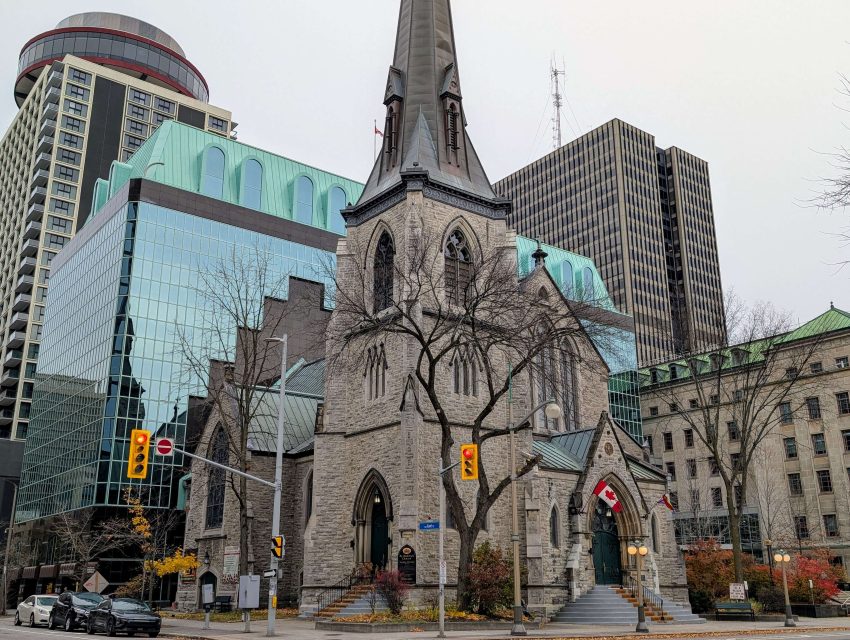
Extraordinary music, both in its quality and diversity, and this congregation’s living connection to its Scottish heritage are what struck me the most during my visit to St. Andrew’s Presbyterian Church on Remembrance Sunday. Built in 1872, St. Andrew’s — located on Parliament Hill — is Ottawa’s flagship Presbyterian church. The Gothic Revival church is set against the backdrop of a glass and steel high-rise office building known as St. Andrew’s Tower, completed in 1988 on the site of the congregation’s former school. St. Andrew’s occupies offices and meeting space in one corner of the tower, while most of the building is home to the Department of Justice Canada.

The 10:30 AM service on November 9 was dedicated to the memory of members of the congregation who sacrificed their lives in the First and Second World War. Two members of the St. Andrew’s community read aloud the names of soldiers and veterans, and this solemn moment was followed by trumpeter Nick Cochrane and a lament by piper Brad Hampson. The robust church choir led the congregation in singing God Save the King, followed by O Canada. The service also featured the hymn “My Soul, There is a Country,” with words by Hubert Perry. The lyrics included:
My soul there is a country
Far beyond the stars,
Where stands a winged sentry
All skillful in the wars;There above the noise and danger,
Sweet Peace sits crown’d with smiles
And One born in a manger
Commands the beauteous files.He is thy gracious Friend,
And – O, my soul, awake! –
Did in pure love descend
To die here for thy sake.If thou canst get but thither,
There grows the flower of peace,
The Rose that cannot whither,
Thy fortress, and thy ease.
In the dark, damp terror of the trenches and on the blood-soaked, mined fields of Europe, that central Christian image of the Prince of Peace must have had special salience.

A striking part of the church’s architecture also recalls World War I and memorializes local Presbyterians who never came home from the trenches of northern Europe. The Memorial Window was unveiled one hundred years ago in 1925 by Governor General of Canada Julian Byng, 1st Viscount Byng of Vimy, himself a World War I veteran. The stained glass includes the words “And There Shall Be No More Death,” as well as the image of the risen Christ.

Organist Matthew Larkin conducted the St. Andrew’s talented, youthful choir from the organ loft. It quickly became apparent that this downtown church has an exceptional music ministry. The St. Andrew’s Ringers, a hand-bell ensemble, elevated the musical experience even further. Under the direction of Dominique Moreau, the Ringers performed the hymn “As the Deer Panteth for the Water.” The delicate, meditative sounds of the hand-bells reminded me of the first snow falling gently over a quiet forest. My humble recording is available here.
If quality music and hymnody have the potential to draw people back to the church after many years away, or to draw in a younger generation seeking ritual and the Transcendent for the first time, then St. Andrew’s Church is particularly well placed to achieve this. The apex of the choral music, at least for me, was “I Vow to Thee, My Country,” with words by Cecil Spring-Rice. These included:
And there’s another country, I’ve heard of long ago,
Most dear to them that love her, most great to them that know;
We may not count her armies, we may not see her King;
Her fortress is a faithful heart, her pride is suffering;
And soul by soul and silently her shining bounds increase,
And her ways are ways of gentleness, and all her paths are peace.
This last verse speaks of a vision of Heaven, where strength isn’t measured by the brute force of armies and where all roads lead to a biblical peace — the concept of complete well-being.

Reverend Karen Dimock, originally from Scotland, presided at the service. In her sermon entitled “On the Lookout for God,” she explored the Gospel reading from Luke 19, where Zacchaeus, the tax collector, climbs a tree to get a glimpse of Jesus as he enters Jerusalem. When Jesus sees Zacchaeus, he tells him to come down from the tree and to let him stay at his house. It shocked the crowd, as tax collectors were among the most hated people in society. Zacchaeus, this reviled sinner, welcomes Jesus with open arms.
Reverend Dimock also spoke to the promise that God knows each of us by name. This promise struck her the most when she saw so many graves of unknown soldiers during her travels in France and Belgium. She asked the question posed many times in Scripture, including by Habakkuk: how long until we know God’s justice? How long is the wait? “There’s something about who God is and His promises that Habakkuk doesn’t let go,” Reverend Dimock observed. “What’s the faith we need to wait through the world we live in,” she asked. “We are called to remain committed to a larger vision of God’s justice, even in circumstances that appear to contradict their truth,” Reverend Dimock added. That challenge remained with me, as I exited the church into the first frigid gusts of what would become Ottawa’s first snowstorm of the season.
St. Andrew’s Church is an architectural jewel in downtown Ottawa. It’s also home to some of the best choral and organ music in the city, as well as to intentional, challenging preaching and to a rich liturgical tradition.
Christopher Adam
Thank you so much for writing so generously of your visit to St. Andrew’s. While none of us are in this for the validation, it’s so encouraging to read an impression such as yours. I very much appreciate it, and will pass your article on to our musicians.