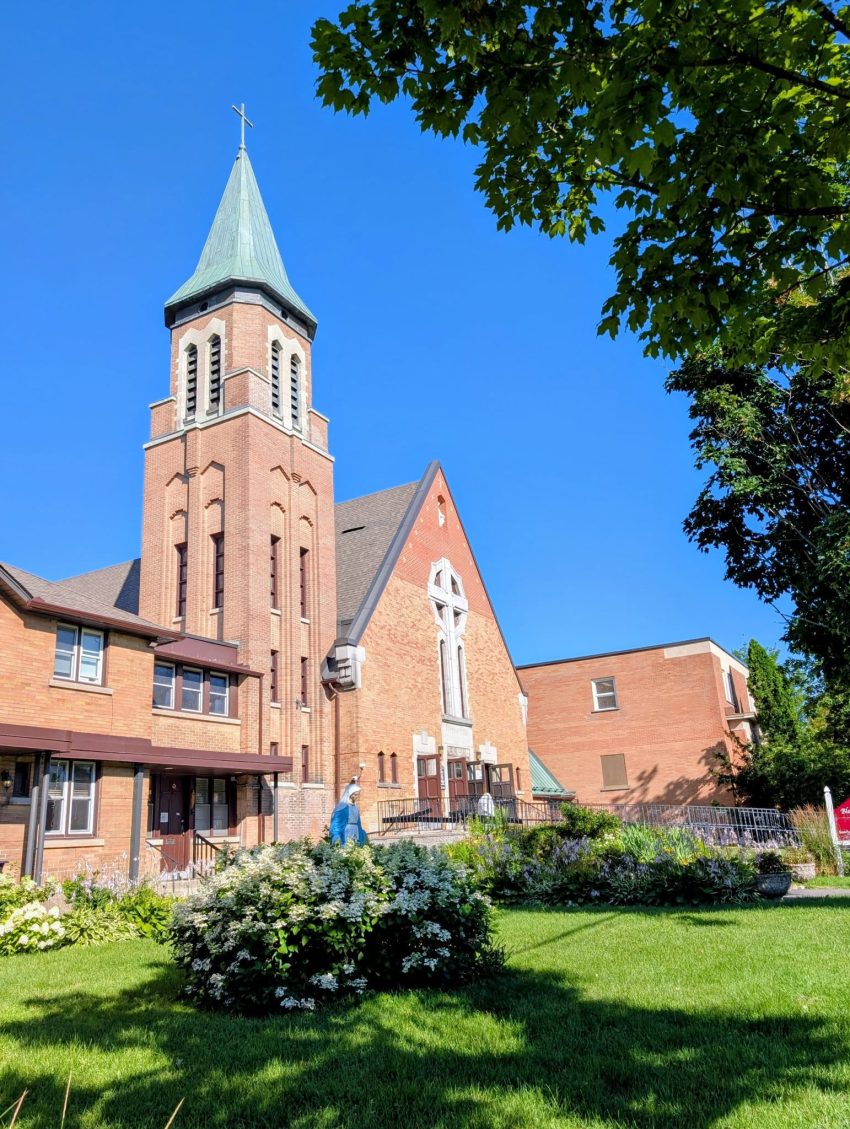
On July 19, I joined 100 parishioners of the Assumption of the Blessed Virgin Mary Parish, at 320 Olmstead Street in Vanier, for 9:30 AM Mass. The parish’s history originates in the 1920s, when the area’s English-speaking Catholics gathered as a house church in a parishioner’s home. The current church was completed in 1940, in what was then an independent town called Eastview, to become the City of Vanier in 1969. When the doors of the new parish church opened on December 22, 1940, Archbishop Alexandre Vachon presided at what The Ottawa Citizen reported were “solemnly impressive” ceremonies. Fr. Austin Stanton served as the community’s parish priest from 1938 to 1941 and assisted the Archbishop at the first Masses.
The new church, designed by Gaston Gagnier of Montreal, was built with a seating capacity of up to 560 people. In an article from December 23, 1940, the Citizen noted that the church’s architecture was “a little off the Gothic and Roman styles, showing a return to simplicity and functionalism with just enough Canadian tradition to give a special character to the building.” That seems to me a particularly apt description of the church’s architecture. While it has elements of Gothic Revival, fundamentally it is a great example of early to mid-twentieth century Canadian church architecture. This style carries a heavy, robust geometry and clean, bold lines — abundantly evident in this church. The modern building materials included buff brick and reinforced concrete, built at a cost of $60,000.
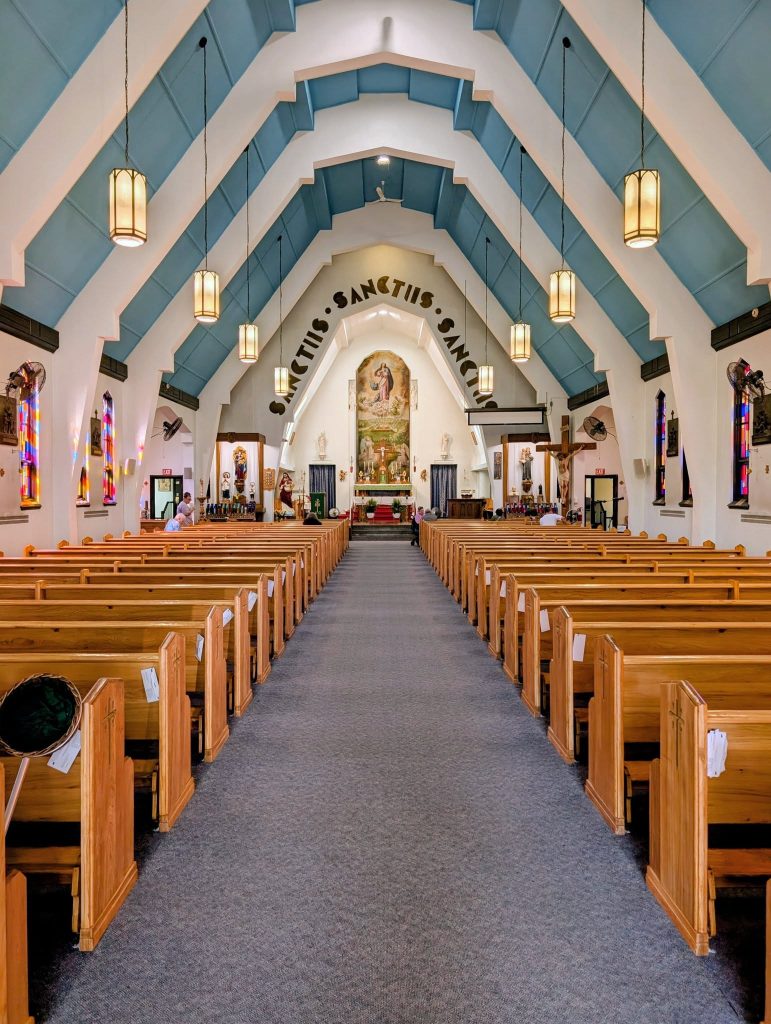
When I arrived around 20 minutes before the start of Mass, a handful of parishioners gathered in the front pews near the sanctuary to pray the rosary together. Many Filipinos have made this parish their home and they played a particularly active role in the parish’s music ministry. Following the shuttering of St. Brigid’s Church in Lowertown, a large number of St. Brigid’s Filipino parishioners followed the former pastor of that church, Fr. Pedro Arana, once he was reassigned to Vanier. Today, Fr. Victor Mateo, OFM Conv., a member of the Franciscan Friars Conventual, serves as Pastor. He lives in the Franciscan Friary established in the rectory and his congregation provides pastoral ministry to both this parish, as well as to St. Ignatius the Martyr on nearby Donald Street.
Mathew 13: 24-43, the Parable of the Weeds, served as the Gospel reading for July 19, the Sixteenth Sunday in Ordinary Time. In his homily, Fr. Victor spoke of how the Kingdom of God is here and is present in our lives. “When we speak of the Kingdom, it is the promised eternal life, but it is not just that. It is the Kingdom of God, the seed of goodness present in our lives. As sons and daughters of God, we are asked to bear fruit from that seed of goodness that is given,” he said.
God is patient with us and His justice is an expression of His mercy. And yet we are faced with the eternal question: why do evil people seem to thrive? God is patient with all of us who are not saints and not angels. “God’s patience is His exercise of power. God is not threatened by our weakness. God is serene in His power and His authority over all creation. Accordingly, as we profess, God is love, God is patient with His people. He gives us an opportunity to repent,” Fr. Victor shared.
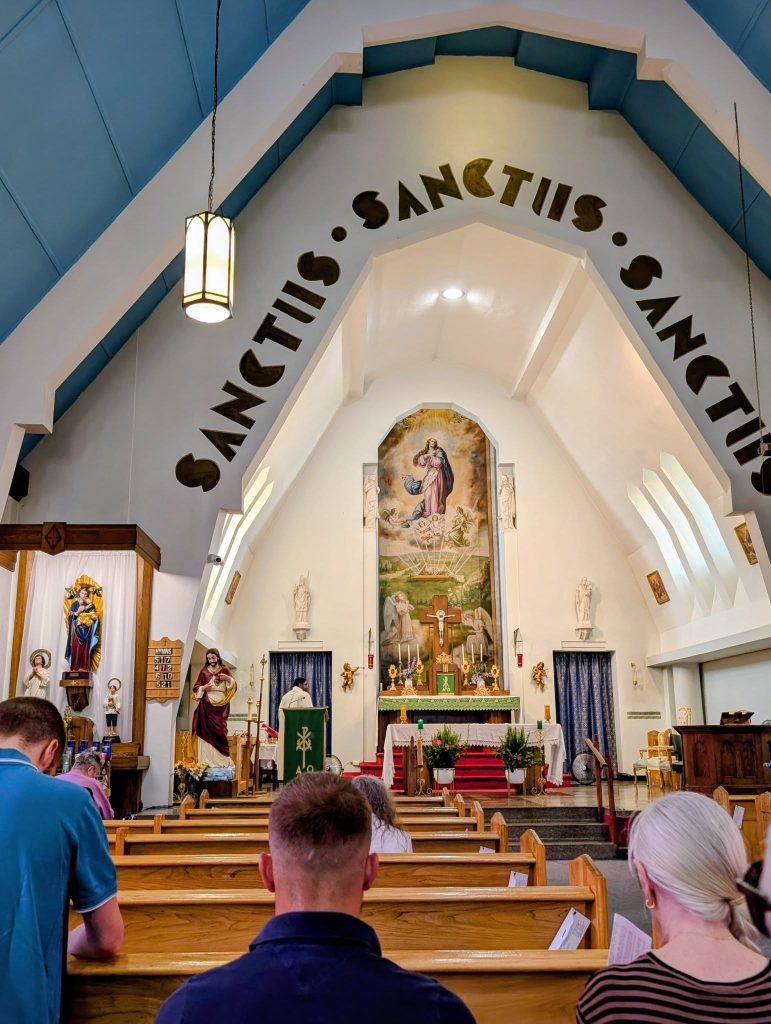
“Just as the field in the parable was corrupted by weeds sown by the enemy, our soul is tainted by sin when we allow it to take root in our lives,” Fr. Victor said. The most important thing is for us to choose to lead a life that is of God. “We are not perfect creatures, but we are not alone in this struggle of ours. God gives us the gift of the Holy Spirit. God made us to be intelligent creature. God created us naturally good and we must be aware of that,” he said.
While his homily touched on heavy topics, Fr. Victor was decidedly conversational in tone and infused his preaching with humour and personal anecdotes — not least of which was the perpetual temptation that Coca Cola poses to him.
The music at the 9:30 AM liturgy was provided by five choristers, a pianist and a conductor. They sang from the transept and the hymns were mostly from the Catholic Book of Worship. These included songs well-known to most English-speaking Catholics, such as “Taste and See,” “Lord Jesus We Must Know You,” “Oh Holy Spirit by Whose Breath,” and “Now Let Us From This Table Rise.”
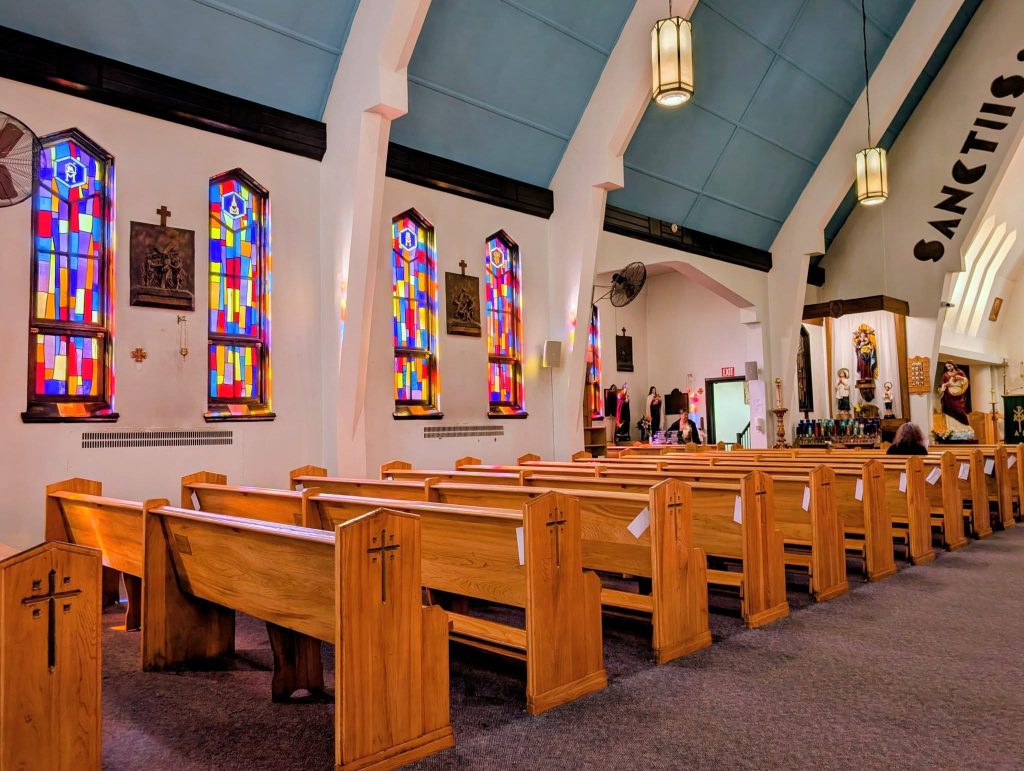
Today, the Assumption of the Blessed Virgin Mary Parish is an example of the diversity that characterizes Roman Catholicism in major Canadian cities. The parish serves as a hub for the Filipino community, with Mass in Tagalog celebrated each Sunday at 12:00 PM. The community also runs a youth ministry, which meets on the first Saturday of every month, for a special Mass followed by a gathering for the Parish’s young adults.
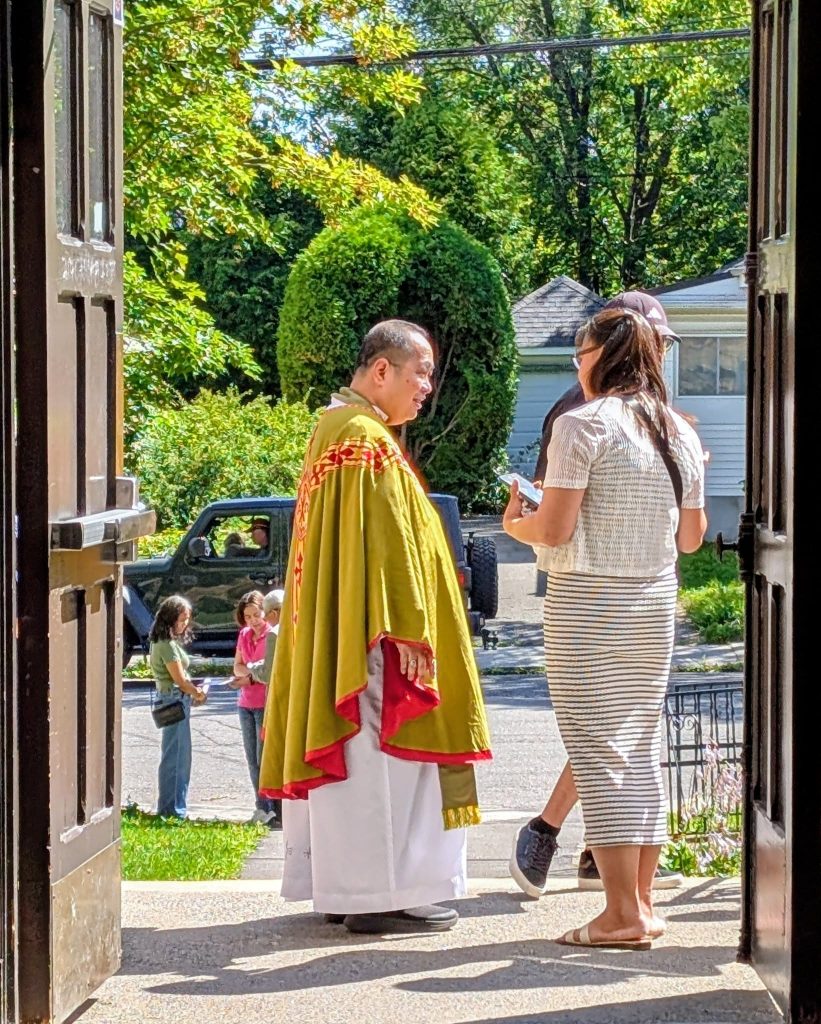
As Sunday Mass ended, Fr. Victor took the time to greet and chat with parishioners in the church entrance on what was undoubtedly a picture-perfect mild and bright summer day.
Christopher Adam
Born in Montreal, Christopher Adam has called Ottawa home for the past twenty years. He received his MA from Carleton University, with a thesis focusing on twentieth century European church history, and a PhD in History from the University of Ottawa. Over the years, he has published widely and works in the faith-based charitable sector in Ottawa.
A pleasant surprise! Our sincere thanks to Christopher Adam for this write-up that highlights our parish Church’s history, heritage, and Scripture reflection at Assumption Parish.
Thank you for sharing this beautiful article, Christopher Adam. I truly enjoyed reading about the rich history of Assumption of the Blessed Virgin Mary Church. I also loved how you described Father Francis’ homily—full of God’s message and gentle humor. Your writing was inspiring and a pleasure to read.
That was a kind and thoughtful observation of your visit to our church of Assumption of the Blessed Virgin Mary. Sharing that short history of the church must have brought back wonderful memories to our older parishioners especially Mary Stanton whose uncle was Fr. Austin Stanton that you mentioned in your article. Thank you Christopher Adam . We , the present parishioners are deeply grateful for your kind words .
Thank you Christopher Adam for your wonderful reflection of your visit to Assumption of the Blessed Virgin Mary Parish in Vanier. I am also a parishioner and I have been a parishioner all me life in fact I am as old as the church as the priest asked my mother to wait for my baptism and have it done at the first mass which was Christmas Eve but she insisted that I be baptised immediately and so it was at the church two blocks away that they used from August 1931 until the new church was built. The original church was too small to accomodate all the parishioners as when it open word got around that there was an English Catholic Church on 2nd Avenue in Eastview so people came from far away as it was the only English church in the area.