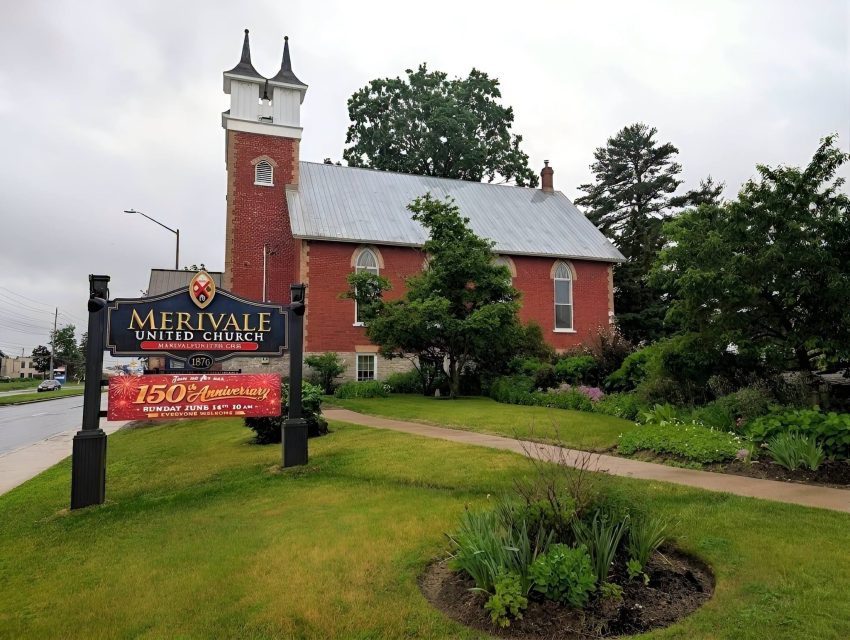
Were the nineteenth century founders of Merivale United Church to rise from their slumber in the adjacent cemetery, they wouldn’t recognize the sprawling suburbs that have swept away the farmlands, which once surrounded their redbrick church. Yet this small church, built in 1876, still stands at the aptly numbered 1876 Merivale Road address — a memento amidst the box stores and strip malls, and home to a living faith community. That community, however, stretches further into the past than the 150 year-old heritage structure that stands as a witness to its history. Already in 1842, Presbyterians and Anglicans shared a log meeting hall on this land, using it as a gathering and worship space. The original modest building stood here until 1875, when it was demolished to make room for the larger redbrick church that was about to be erected. On June 14, I joined Merivale United Church for their 150th anniversary celebration. The day included two religious services with wonderful music, an exhibit, a complimentary lunch and even a hired ice cream truck.
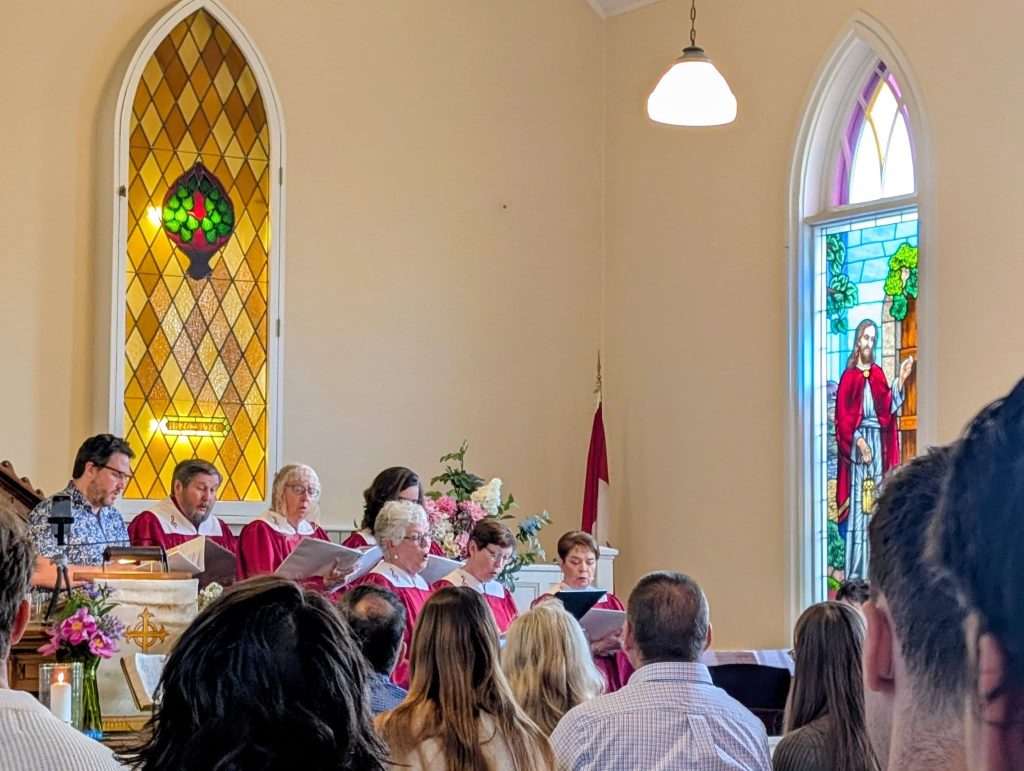
Over 75 people gathered in person to celebrate Merivale United’s past and present, as well as its life-giving partnership with Fallowfield United Church, as one pastoral charge in Ottawa’s west-end. The collaboration runs deep, with Fallowfield working with the Merivale faithful on important renovation projects and the overall preservation of this historic church. One might assume that this partnership stemmed from the decline that the United Church of Canada has been experiencing in recent decades, yet this is not the case. The pastoral charge was established in 1955, at the height of the United Church’s prominence as the country’s largest and most influential Protestant denomination — a thoroughly national church that played a significant role in Canadian nation-building.
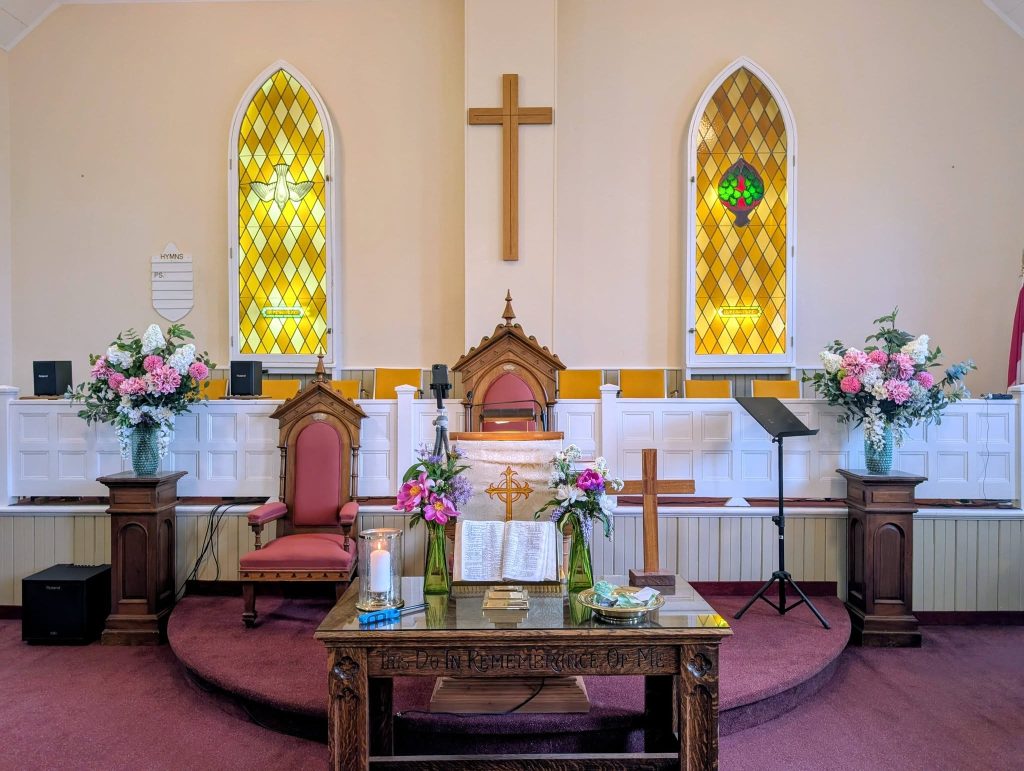
The community began its life as Merivale Presbyterian Church, while the other half of the pastoral charge was once Fallowfield Methodist. With the establishment of the United Church of Canada in 1925, Merivale United was born. In 1932, a tower was added to the church and the interior underwent extensive renovations. In 1967, a Christian Education Hall was built on the property. At the time, upwards of 100 children attended Sunday School here. It’s connected to the church via a tunnel and in between the two buildings one will find a beautifully-maintained garden.
On June 14, Reverend Matt Gallinger led the two religious services. The first, at 10:00 AM, was a Sunday liturgy and the second the Merivale Cemetery Dedication Ceremony. The latter was moved indoors due to the near torrential rains that lashed the city. Maureen Hutchinson serves as the congregation’s organist and choir director. Her choristers elevated the worship with a wide selection of beautifully sung hymns, mostly from Voices United and More Voices. Among these were “For the Beauty of the Earth,” “Called By Earth and Sky,” “This is the Day,” and “I am the Light of the World.” The Offertory Hymn’s words were particularly fitting for both the anniversary and the liturgy:
We do not worship as we ought, but only as we’re able. The vines were planted, seeds were sown. They grew in your good pleasure. What once was common, daily food, becomes a holy treasure. Our hopes and dreams, our tools and cares we lift in prayer before you. Lord, by your grace, now come to us, as humbly we adore you.
Reverend Gallinger’s reflection took stock of both the past and present, and was mostly temporally-oriented towards what following Christ can look like in our world and in everyday life. He also spoke about something that makes the United Church of Canada unique: it was formed by the coming together of different churches, while most Christian denominations are established through schism. Reverend Gallinger, who is relatively new to the congregation, spoke about the deep roots of many families who have lived in this area and worshiped in this church for generations, at a time when the church was surrounded by farm country. “What we carry on here is a long living tradition of people and families who have lived and worshiped side-by-side for 150 and more years. There are still families present today who have been here that long,” he shared, noting especially one of the original families, the Nesbitts, whose descendants were present for the service.
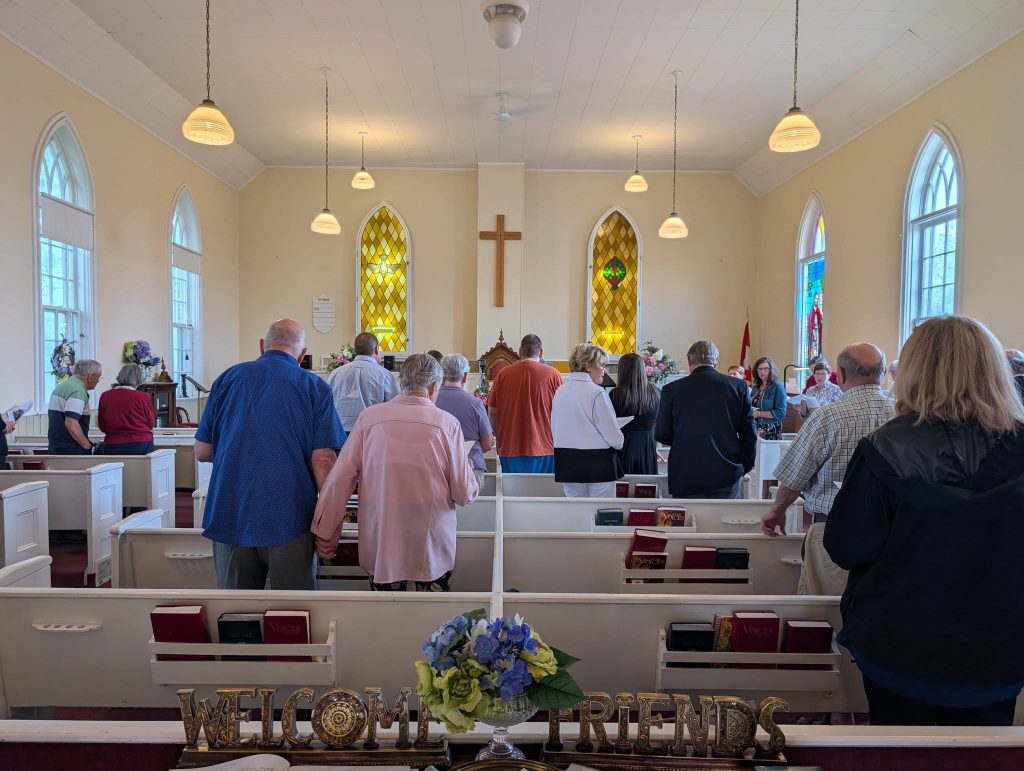
What does it mean for a church to be visible in the broader community? This is one of the questions Reverend Gallinger posed. Despite the complete transformation of the surrounding area, the building has stayed and it has remained visible. Reverend Gallinger shared:
Our most important job is to be visible in the way that we do it here in the United Church. We are a visible sign of love and of acceptance. We are a voice for justice. We were the Church that supported the legalization of divorce. We were the Church that supported the widening of marriage, beyond the traditional boundaries. We were the first Church to apologize for our role in residential schools. We were the first and loudest church to call for universal basic income. We were the church that pushed on environmental issues back in the days when acid rain was the thing we talked about. A lot of you here are too young to even know what acid rain was. We come from a long line of passionate, visible people who have dared to say: ‘we can make this world a better place.’
Following the two morning services, the congregation hosted a lunch catered by Chef Ric. Members and friends of the community were served a variety of sandwiches, salads, fruit platters, desserts and ice cream. Both floors of the church’s hall filled with the faithful, their extended families and visitors, and with the sense that this community has the vibrancy to continue as a Christian gathering place for years to come.
Christopher Adam
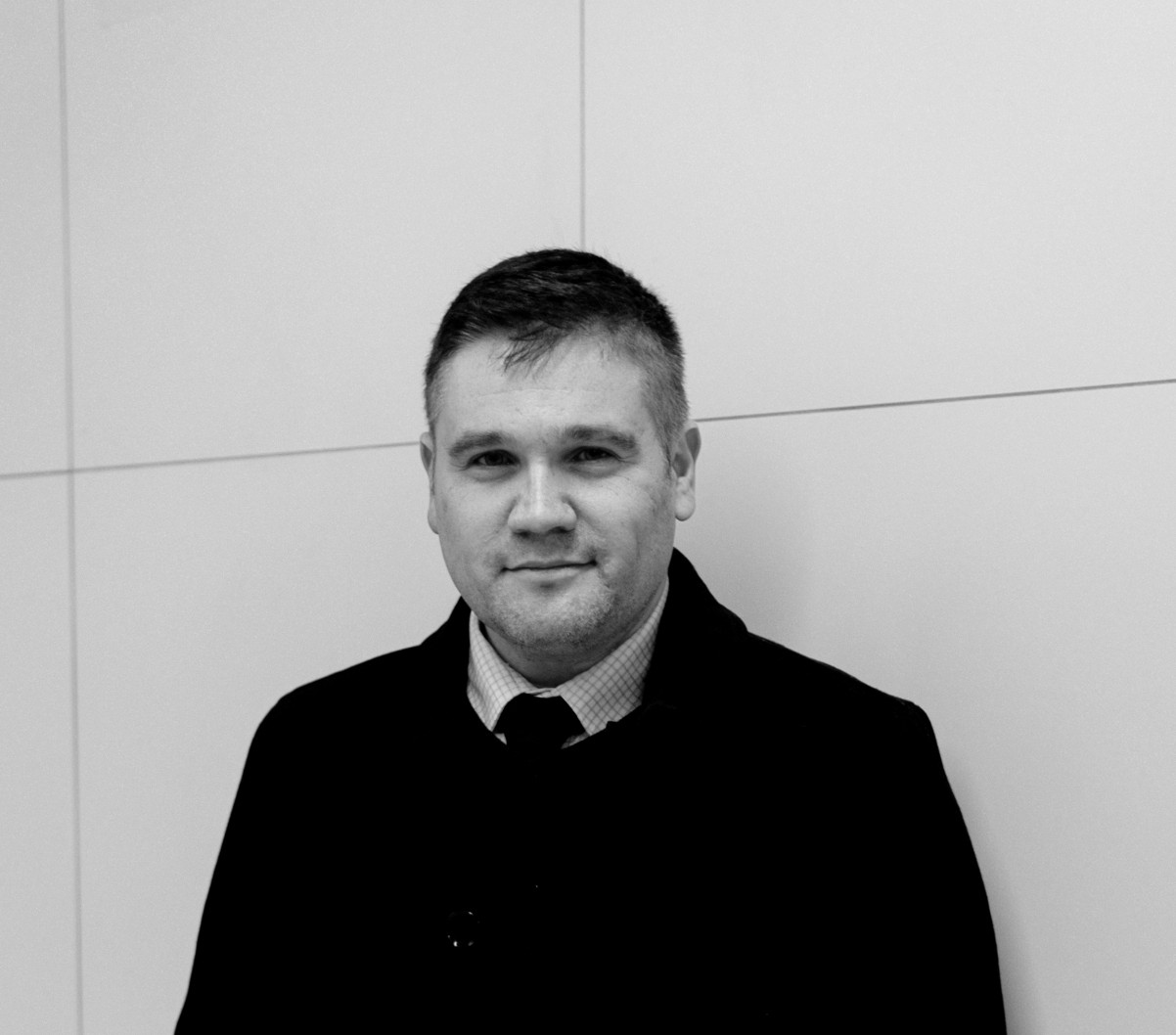
Born in Montreal, Christopher Adam has called Ottawa home for the past twenty years. He received his MA from Carleton University, with a thesis focusing on twentieth century European church history, and a PhD in History from the University of Ottawa. Over the years, he has published widely and works in the faith-based charitable sector in Ottawa.
My maternal grandparents Andrew and Margaret Davidson are buried there as are my paternal grandparents William and Mary McNab also my parents Andrew and Ella McNab. As well aunt and uncle Mabel and George Nesbit and Alice Melinda and John Nesbit.
Remembering my father, Reverend Frederick Hewitt, who served as minister for a few years at the Merivale – Fallowfield Pastoral Charge. Both he and his wife, my mother, Mrs. Gertrude Hewitt, loved these two congregations as they ministered there. They are both buried in the Merivale United Church cemetery. I do wish i had known of these services. I and my family members would have been delighted to be with the church families to mark this anniversary.