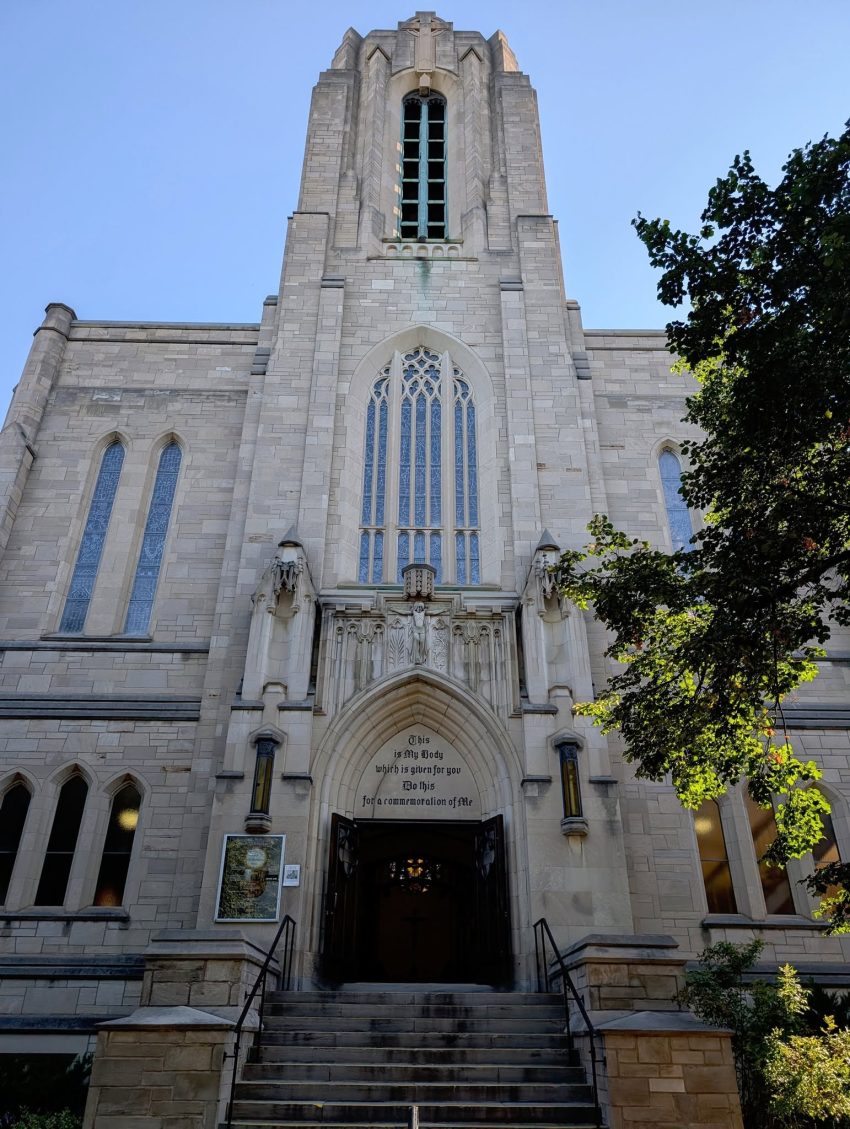
Blessed Sacrament Parish, towering over a residential street in the Glebe, is one of the best examples of early twentieth century Gothic Revival and Collegiate Gothic architecture in the nation’s capital. On September 6, I joined over 100 parishioners for 10:00 AM Mass. I found a community that is serious about quality music and liturgy. Located at 194 Fourth Avenue, the landmark church’s imposing and austere architecture conveys a seriousness of purpose, too. The words of the Mass, based on the Douay-Rheims translation of Luke 22:19, are inscribed above the main doors of the church: “This is my body which is given up for you. Do this for a commemoration of Me.” The inscription permanently binds the building to its primary purpose.
Blessed Sacrament came into being as a territorial parish in 1913, with the first Masses celebrated at the Precious Blood Monastery on April 13 of that year. The monastery at 774 Echo Drive closed its doors in 1991 and the building is now the home of the Royal College of Physicians and Surgeons of Canada. In October 1913, a small, temporary church was erected on Fourth Avenue to serve the Parish. Less than a year later, World War I broke out and the community’s parish priest, Fr. John O’Gorman, gave an impassioned address to parishioners. The Ottawa Citizen shared his rousing words nearly two decades later, in a feature piece on the Parish’s history appearing on May 7, 1932:
Canada’s position is endangered. The British Empire, of which it is a free and important part, is fighting for its life. Canada must do her duty, and fight with the Empire. This is our patriotic duty as Canadians, no matter whether we are of English, Irish, French, German or Ruthenian extraction. It is also, as our bishops remind us, our religious duty.
The present terrible war which has pitted brother against brother in Europe should have been averted, and would have been averted had the nations of Europe obeyed the commandments. Britain, at any rate, did not desire the war, and entered it only when it was absolutely necessary for her to do so. Not merely has she shown that her participation in the war had a just cause, but she has pledged herself to conduct it in an honourable manner, and what is most important of all, to see that it has a just termination. Chiefly upon Britain will rest the responsibility of seeing that the terrible scourge of war be turned eventually into a blessing.
Fr. O’Gorman served as a military chaplain in the Great War, spending time with soldiers in Britain, France and Belgium. When he preached about the battlefield, he spoke from the vantage point of personal experience. In 1916, he was wounded in the Battle of the Somme. A total of 117 parishioners of Blessed Sacrament Parish enlisted in overseas service during the Great War. Seven were killed on the battlefields of Europe.
By the time the new church was completed in 1932, Blessed Sacrament Parish counted 500 families. On May 7, 1932, the inaugural Mass was celebrated in the new church in the presence of Archbishop J.G. Forbes. Some 45 children received their First Communion at a second Mass celebrated that same morning, while a third Mass on that Sunday saw the Bishop of Alexandria, Msgr. Felix Couturiere, serve as the presider, with several military chaplains assisting.
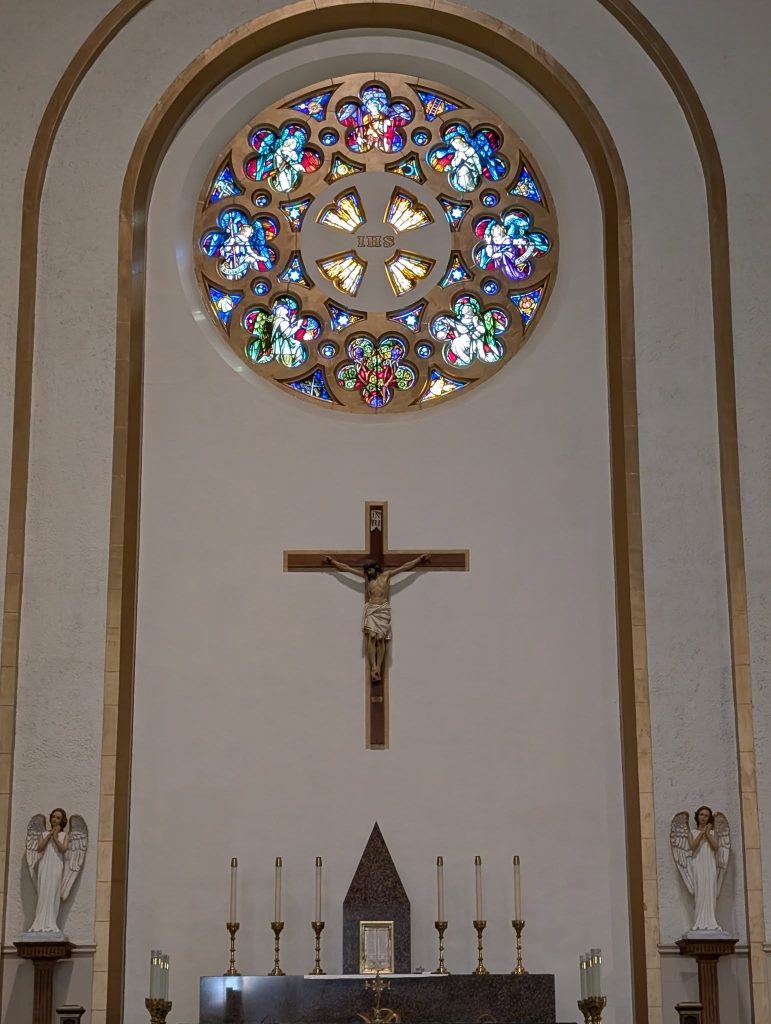
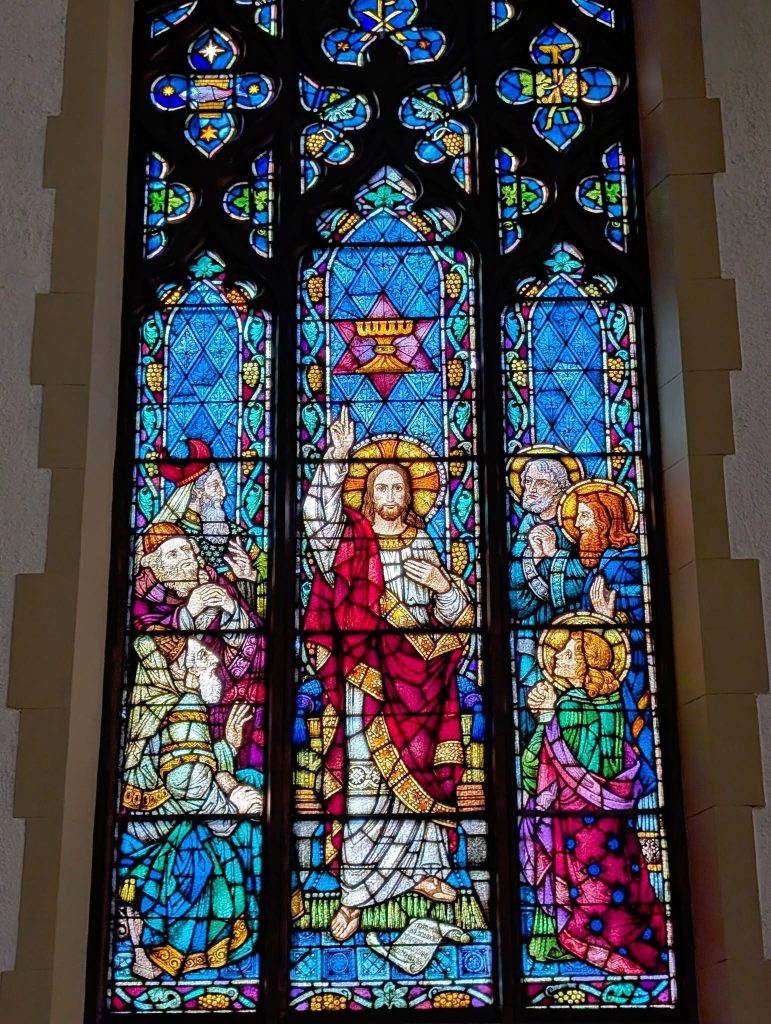
The Ottawa Citizen referred to Blessed Sacrament Church as a “splendid new Glebe edifice,” and one that is “a worthy addition to the city’s beautiful sacred edifices.” The Citizen described the church’s imposing granite altar as being “the severest possible type.” The stained glass rose window in the sanctuary was installed at the time of the church’s opening, while the stained glass in the nave was added later. The Citizen noted that the rose window was “a sample of the best type of Canadian-made stained glass.”
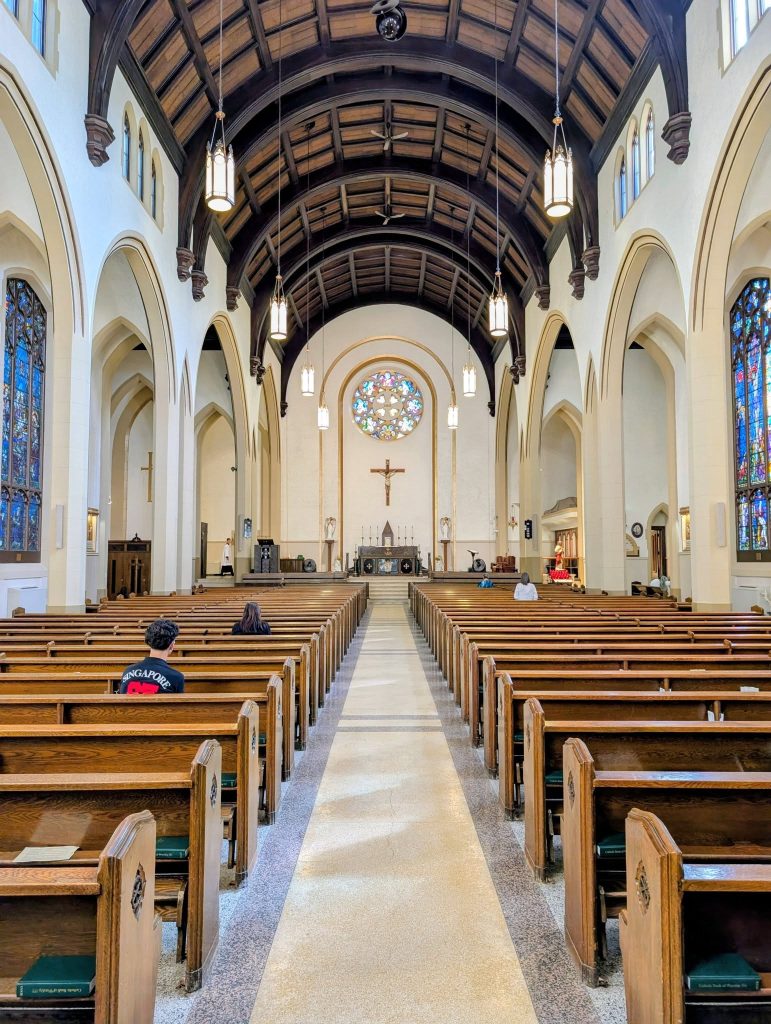
In many ways, Blessed Sacrament Church was considered strikingly modern at the time of its opening. The building was designed to be as fireproof as possible, with a concrete floor covered in a layer of terrazzo, as well as a steel roof, finished with copper. The building’s HVAC system also incorporated modern ventilation mechanisms. The church’s sacred art was considered contemporary in style, with the Citizen noting that the bas-relief Stations of the Cross present “a simplicity and straightness of line that from one point of view is modernistic and from another point of view is so primitive as to be almost pre-medieval.” The paper added that the Stations of the Cross display “artistic reserve.”
When I entered Blessed Sacrament Church on September 6 ahead of the 10:00 Mass, a handful of parishioners gathered to pray the rosary together. As soon as Mass began, the importance placed on high-quality music and hymnody became evident. Talented choristers led the faithful in song, and were accompanied on the organ, piano and violin. At times, they chanted a cappella. The Parish has a robust music ministry. Among the hymns were “Christians Let Us Love One Another,” “Now in this Banquet” by Marty Haugen, and “O God Beyond All Praising.” The music ministry is coordinated by Richard Bethell.
Blessed Sacrament’s pastor is Fr. Tim Nelligan, a retired military chaplain. Fr. Tim has been featured and quoted in the press on several occasions, particularly for his principled stance against the new Canadian policy restricting military chaplains from invoking God at public gatherings, apparently in an effort to achieve the impossible: religious neutrality. On September 6, Fr. Tim presided at Mass, while Fr. Thomas Skaja, Fr. John Hayes, and Fr. Paul Mwalongo concelebrated.
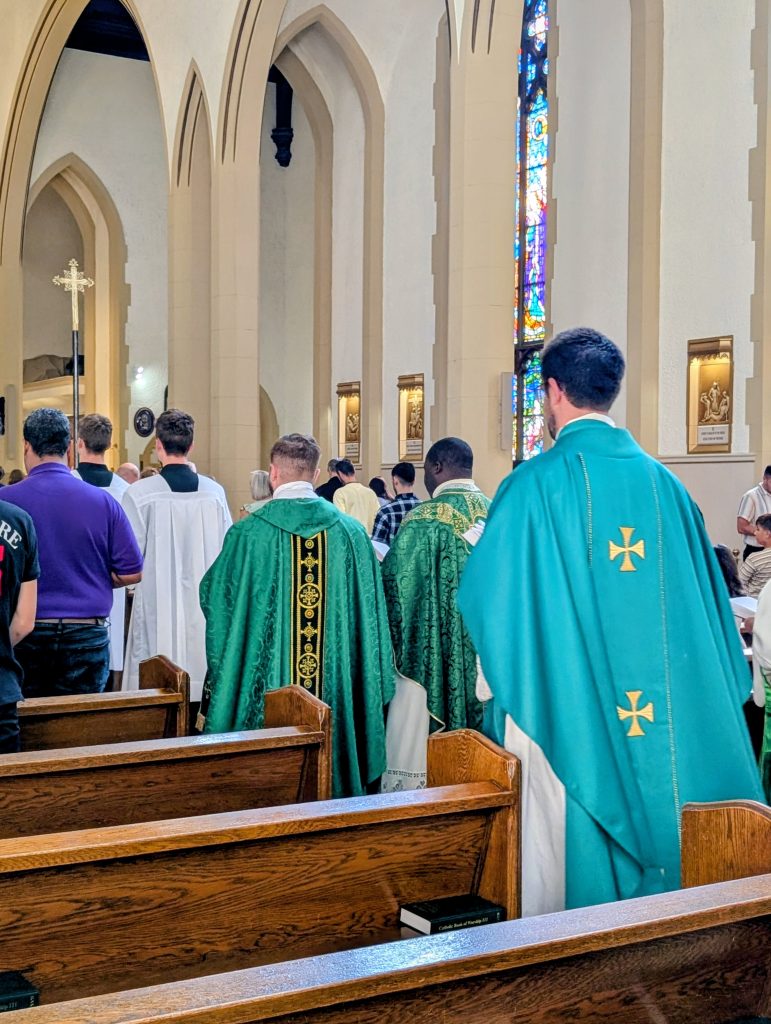
Fr. Tim explored the concept of charitably correcting people around us, and doing so out of love and concern, as expressed in Matthew 18. It’s much harder to offer fraternal correction than to remain indifferent, look the other way, and not trouble ourselves by getting involved. “For us as Christians, the activity of our conscience, the activity of our soul, is in defense of the honour of God… to defend the relationship of love that we’re called to have in the presence of God, and with one another, and in caring for one another. Fraternal correction is part of that. You don’t do it out of a position of superiority, and you don’t harm the person when you do it. We do it out of love and charity,” Fr. Tim shared.
Fr. Tim spoke about how many were silent and simply went about their business during the great tragedies of the twentieth century, mentioning both the Holocaust and the genocide in Bosnia specifically. Our faith does not call for neutrality when we witness sin and evil, nor when faced with the great moral issues of our day.
As Mass ended, the faithful were invited to the Parish Hall. Coffee and tea, as well as cheese, crackers and cookies awaited. And after a caffeine boost, I walked out into the radiant September sunshine.
Christopher Adam
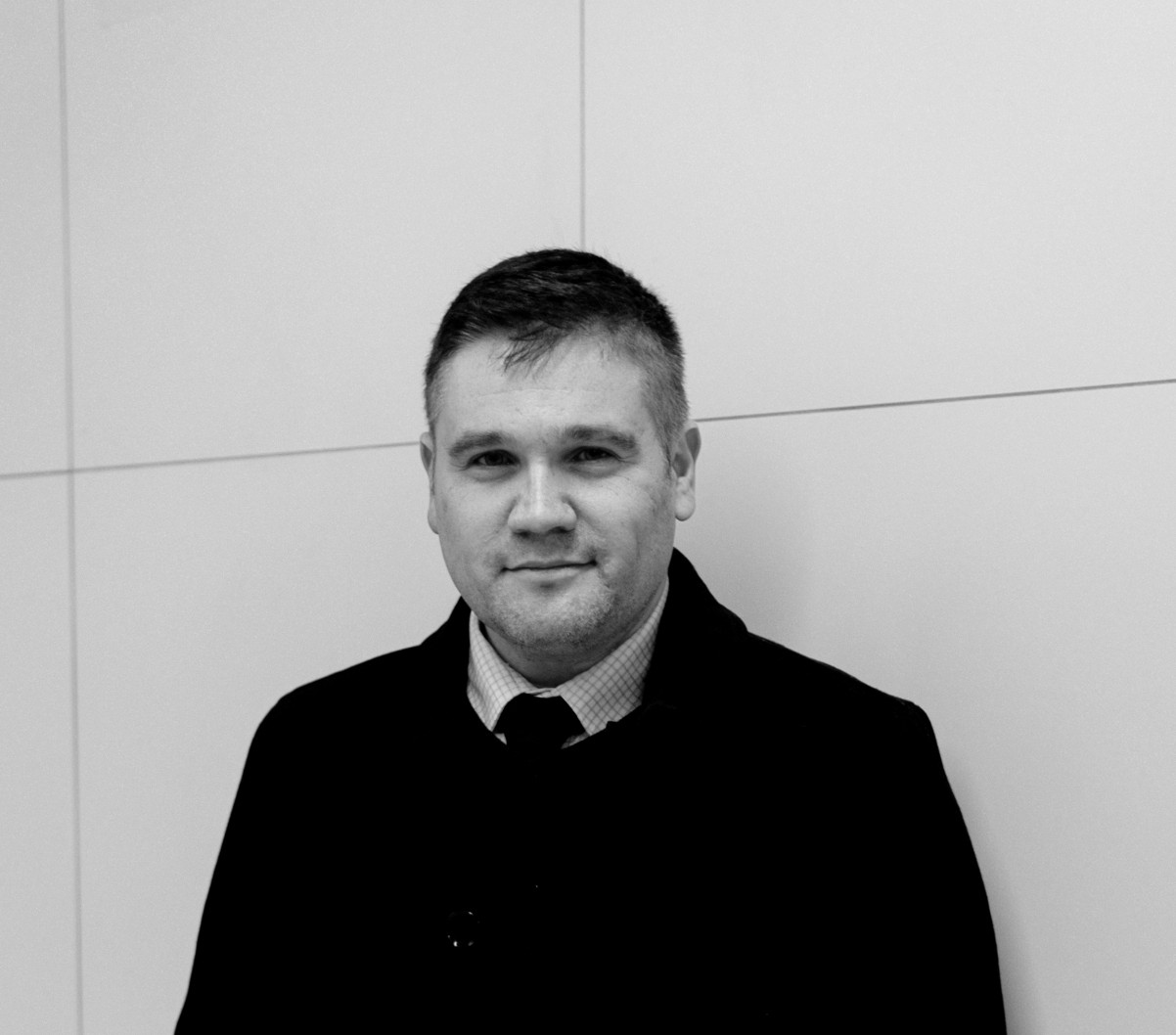
Born in Montreal, Christopher Adam has called Ottawa home for the past twenty years. He received his MA from Carleton University, with a thesis focusing on twentieth century European church history, and a PhD in History from the University of Ottawa. Over the years, he has published widely and works in the faith-based charitable sector in Ottawa.