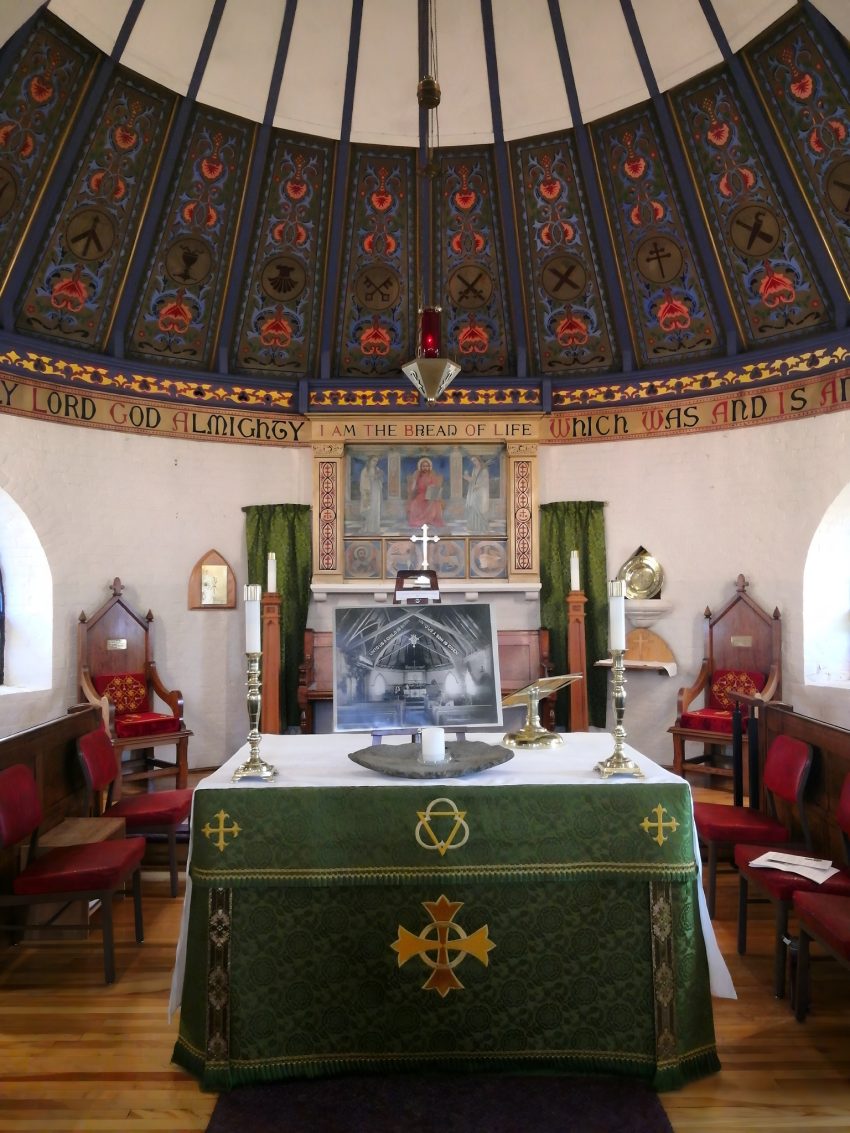
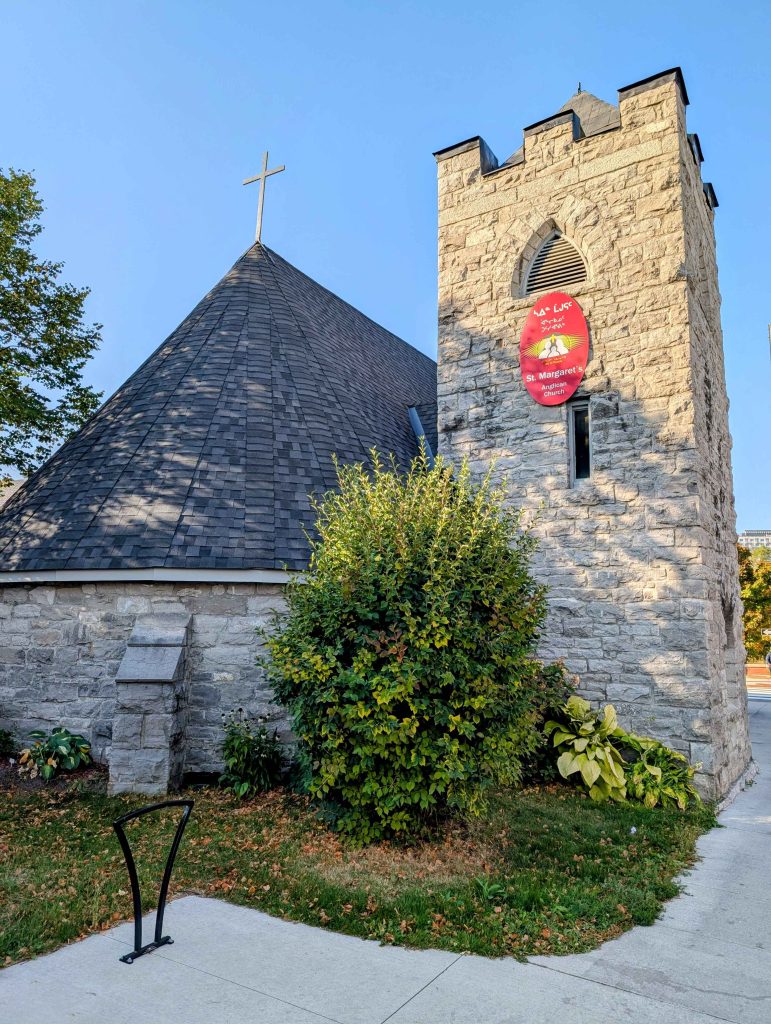
Built in 1887, St. Margaret’s Anglican Church was once a village chapel serving the rural community of Janesville. In its early years, it was a mission church of the much more affluent St. Bartholomew’s Church in nearby New Edinburgh. This “chapel of ease” located along the road that connected Ottawa to Montreal served poorer English immigrants. Today, it’s a stone’s throw from downtown Ottawa and a parish that is home to two worshiping communities on Sundays: English speakers who gather at 9:30 am and Inuit who celebrate in Inuktitut at 11:30 am. I attended the English celebration on Holy Cross Sunday. The 50 people in attendance all but filled the pews of this small, historic church.
St. Margaret’s incumbent priest is the Rev. Colin McFarland and while presiding at the Holy Eucharist, he was assisted by Rev. Canon Aigah Attagutsiak, who ministers to the Inuit congregation. Rev. McFarland is an adept homilist and his homily was rich in historical, philosophical, and theological context. There was a little slice of psychology to it as well, owing to the insightful understanding of the human mind that permeates Scripture, even while these were tines predating modern psychology. The homily began by exploring the first reading, Numbers 21: 4-9. We hear of the Israelites getting cantankerous from wandering in the wilderness — hungry and thirsty — and impatient with God and Moses, speaking ill of both. God punished the Israelites by sending them the poisonous, insidious fury of snakes. The Israelites begged Moses to intercede on their behalf with God and to pray for mercy. God answered the prayer by instructing Moses to create a bronze serpent and affix it atop a pole. Whenever the Israelites look at the bronze serpent, they would be cured from the venomous snake bites.
Rev. McFarland spoke of how the Israelites were forced to face the consequences of their sin by looking at that bronze serpent. Facing with honesty the negative impact of our actions is often seen as the first step in healing situations and relationships. He then delved into the Gospel reading, John 3: 13-17 , where Jesus connects what will become his fate on the Cross to the story of the serpent: “Just as Moses lifted up the snake in the wilderness, so the Son of Man must be lifted up, that everyone who believes may have eternal life in him.” Rev. McFarland spoke of the great paradoxes of Christianity. As with the bronze serpent, both a reminder of the suffering and pain for the Israelites and a symbol of healing, so Christians face the cross each Sunday in church — the worst instrument of cruelty devised by humans, a sign of grave injustice against Jesus, which nonetheless is the instrument of our salvation.
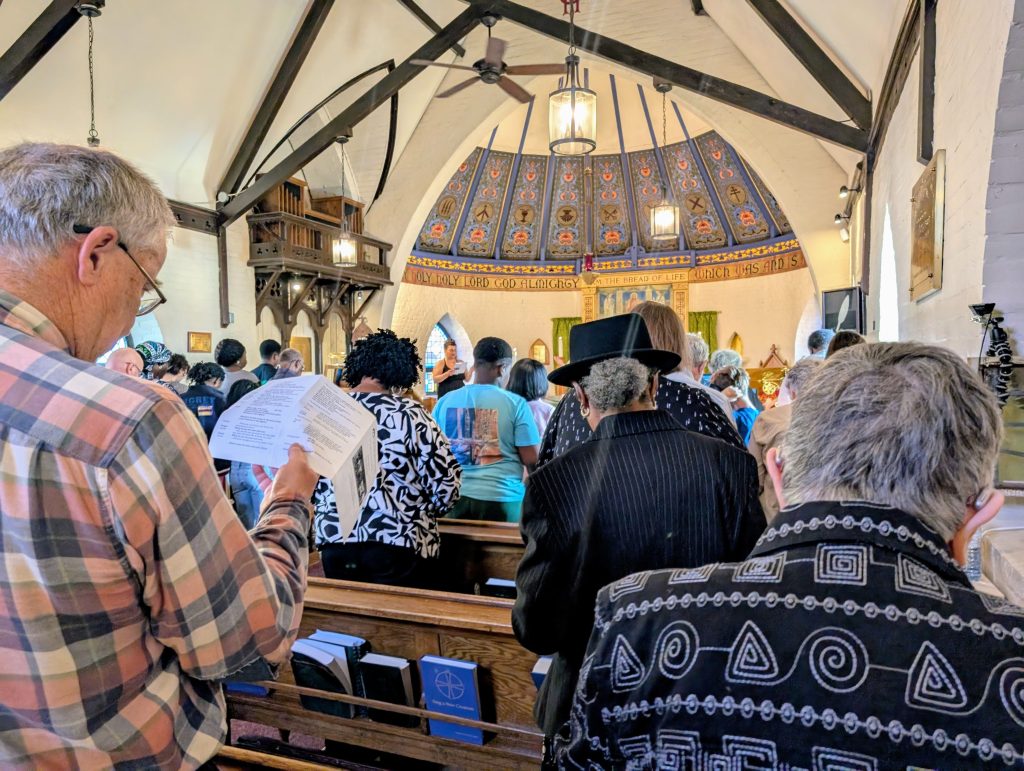
The hymns, led by Cantor Cat Keresztesi and accompanied by organist Francine Brisebois, reflected well the readings and the themes of Holy Cross Day, with “Lift High the Cross” and “Healer of Our Every Ill” standing out the most. And while the celebration took place in English, this church’s unique connection to the Inuit was also present, with bilingual (English and Inuktitut) responses. That’s where I learned that “Qujagivavut Guuti” is Inuktitut for “Thanks be to God” and “Niqtuqpattigit Ataniq Jesusi Christ-uusi” is “Glory to you, Lord Jesus Christ.”
As the English congregation filed out of the church, coffee, juice and a variety of refreshments awaited the faithful in the adjoining hall. That well-used space is also where the Inuit congregation shares a lunch after their own Sunday liturgy, with art displayed on the walls and community newspapers keeping alive their connection to the north.
Born in Montreal, Christopher Adam has called Ottawa home for the past twenty years. He received his MA from Carleton University, with a thesis focusing on twentieth century European church history, and a PhD in History from the University of Ottawa. Over the years, he has published widely and works in the faith-based charitable sector in Ottawa.