
On the First Sunday of Lent, February 22, I visited St. George’s Parish at 415 Piccadilly Avenue North, in Ottawa’s Westboro neighbourhood. I attended their 10:30 AM Sunday Mass, alongside around 100 parishioners. Opened in 1924, the church is a great example of Collegiate Gothic architecture. That’s the architectural style commonly associated with private schools and colleges in North America established in the early 20th century. The interior’s rich woodwork — especially the dark, timber trusses that run along the length of the ceiling — catches the eye. The exterior reminded me of Montreal’s Loyola Chapel, located on the campus of Concordia University, where I completed my undergraduate studies a lifetime ago. Fittingly, the Chesterton Academy of Ottawa, a private Catholic school with a classical curriculum, is located at St. George’s.
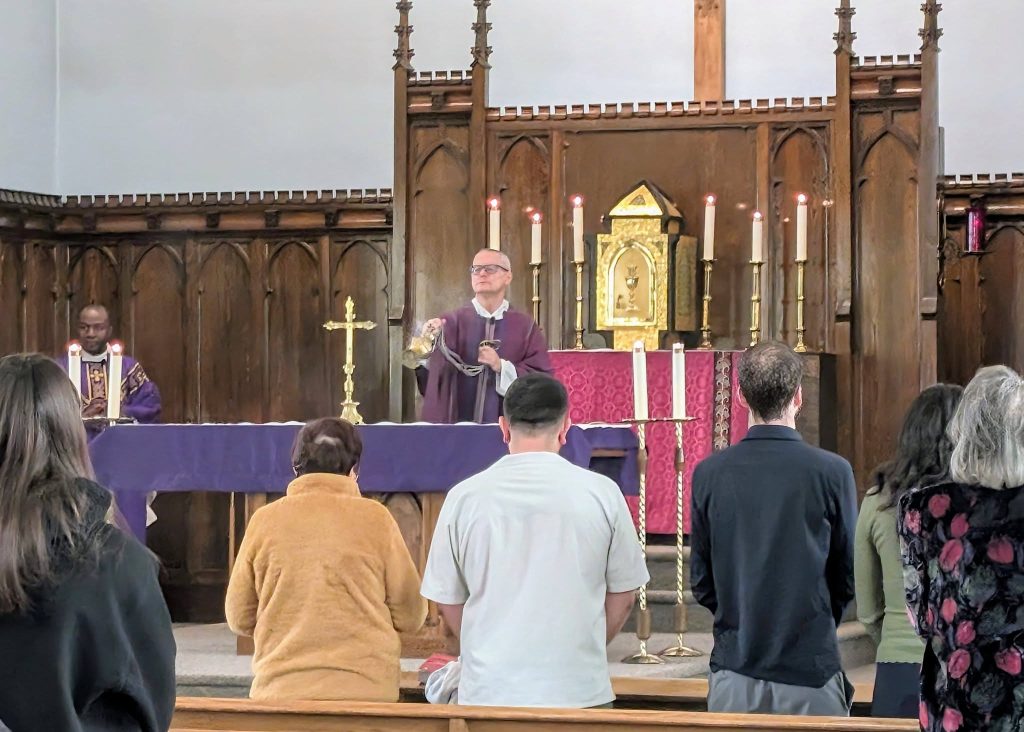
The September 22, 1924 issue of The Ottawa Citizen included a report on the opening of the new St. George’s Church, and referred to the inaugural liturgy as “deeply impressive.” It characterized St. George’s Church as “one of the most handsome and substantial sacred edifices” in Ottawa. Bishop Patrick Thomas Ryan of Pembroke presided at the inaugural Mass, and he was assisted by St. George’s first pastor, Fr. George Prudhomme. Built using buff brick, limestone and cement, the church was designed to include four classrooms in the basement, along with a vestry and a modest parish hall. The church bell weighed 500 pounds and was manufactured by a company in Troy, New York. During a blessing following the inaugural Mass, the bell was referred to as “the brass herald of Christ, its message one of hope and warning to the faithful, announcing the approach of the Great High Priest of the new and eternal covenant. It proclaims the means of life through the Sacraments and the sacrifice of Christ, and each one must be a church bell.”
When I arrived on February 22, the 9:00 AM Mass had just ended and parishioners from this earlier, chanted liturgy streamed out of the church. The 10:30 AM Mass, while incorporating a modest amount of chanting, mostly featured contemporary praise and worship music led by a cantor, who also served as the pianist. The music included the Hillsong piece “Desert Song,” with lyrics that seemed especially apt for Lent:
This is my prayer in the desert
When all that’s within me feels dry
This is my prayer in my hunger and need
My God is the God who provides.
Other music from the liturgy included “Praise God From Whom All Blessings Flow” and contemporary Christian songwriter Phil Wickham’s piece “Battle Belongs.”
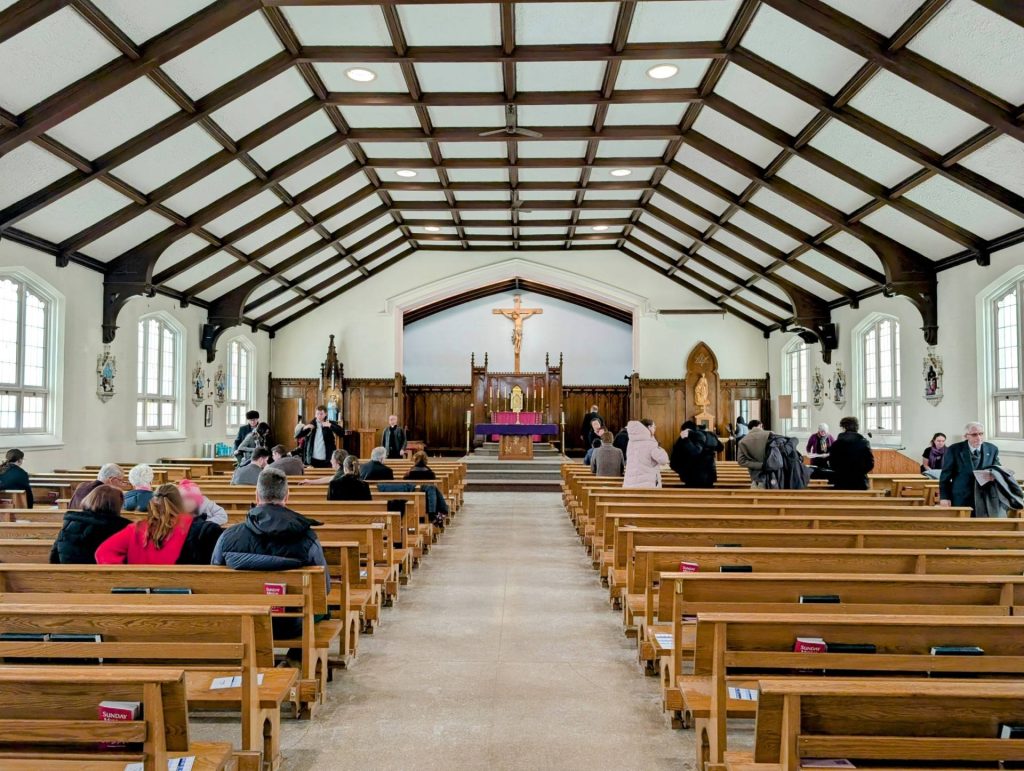
The Mass included several messages about stewardship — a theme that can be difficult, nonetheless important for any parish community seeking sustainability and growth to discuss. A younger parishioner was invited to share his testimony on how he and his family tithe. Following this, Monsignor Hans Feichtinger expanded on this theme in his homily. Msgr. Feichtinger, originally from Passau, Germany, is also an academic and an author. He has published numerous articles in the US-based Crisis Magazine, most recently on matters of liturgy. Msgr. Feichtinger’s style, in both his homilies and his writing, is spirited and assertive. Speaking to the faithful about the Church’s trajectory, he shared a perspective anchored in ambition:
“It’s a sign of spiritual sanity that in our parish we can talk even about money. In the spirit of this honesty and directness, I would also like to add a statement that I borrow from a political speech that was recently given in Germany, and rephrasing it: I have no interest in being a polite and orderly caretaker of the Church’s managed decline. These are borrowed words, but I really mean them. I really have no interest in spending any of my energy and time on managing decline. So, if you have time for that, there will be endless problems between me and you. I am interested in the opposite — growth, development, renewal, and — you could also call it — tradition. Traditions means that the fire of the Holy Spirit can be passed on to others. It’s making sure that the Gospel of Christ can be heard.”
Msgr. Feichtinger alluded to a speech given by US Secretary of State Marco Rubio at the Munich Security Conference on February 14, in which he had spoken about European and Western decline.
Following Mass, all were invited downstairs to the Parish Hall for coffee, cookies and fellowship. St. George’s Parish refers to this weekly Sunday tradition as “Coffee Talk,” which it sees as an important way to continually enhance the sense of community. Msgr. Feichtinger, an important and lively part of that community, mingled and chatted with parishioners enthusiastically.
Christopher Adam

Born in Montreal, Christopher Adam has called Ottawa home for the past twenty years. He received his MA from Carleton University, with a thesis focusing on twentieth century European church history, and a PhD in History from the University of Ottawa. Over the years, he has published widely and works in the faith-based charitable sector in Ottawa.
St. George’s is a wonderful parish. I’ve been attending for about 4 years now and am very happy to call it my spiritual home — as are many others! Those looking for a welcoming and reverent community should certainly consider it.
This video was put together for the same “Stewardship Sunday” initiative that the testimony you referred to was part of, and paints a good picture of the kind of parish community we have: https://youtu.be/GULCZ41G3Ro