
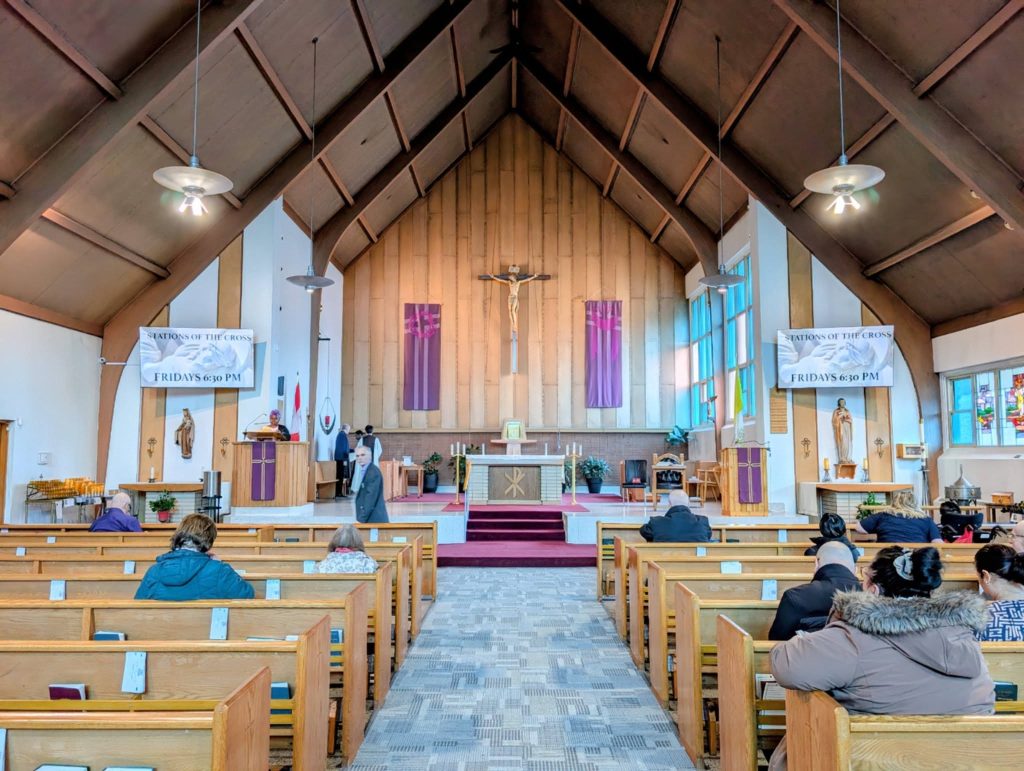
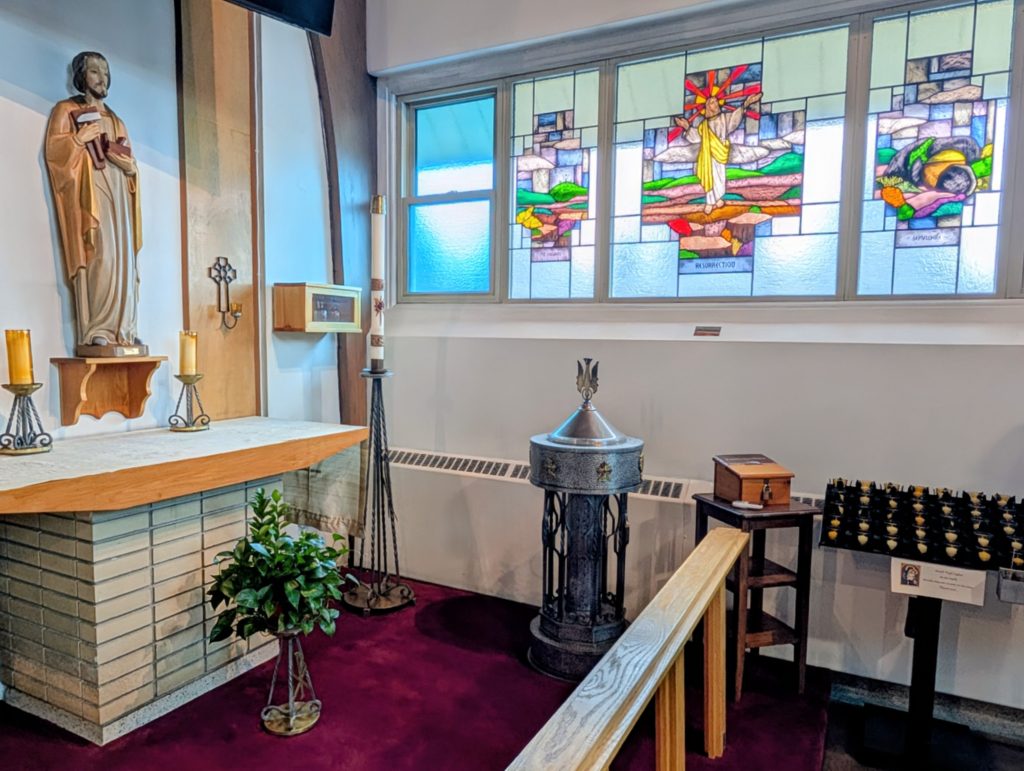
On the Third Sunday of Lent, March 8, I joined around 100 parishioners for 10:00 AM Mass at Our Lady of Mount Carmel Parish in Manor Park. The establishment of a new parish for English-speaking Catholics in 1953, and the completion of the Mid-century modern A-frame church at 400 St. Laurent Boulevard in 1957 was a sign of rapid post-war growth in Ottawa. The most notable features of the church, incorporating the functionalist aesthetics of the mid-20th century, are the blue-tinged stained-glass windowpanes above the main entrance and the campanile (a bell tower), which includes sacred art integrated into the rectangular concrete.
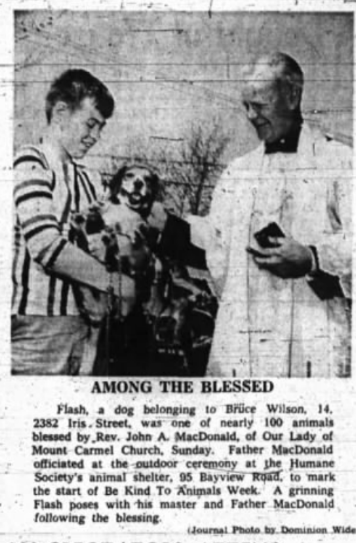
In the early days, Our Lady of Mount Carmel’s prolific first pastor, Monsignor John A. MacDonald, was featured a number of times in the local press, including by The Ottawa Journal in 1960. The paper reported on the 25th anniversary of his ordination — a milestone celebrated at Our Lady of Mount Carmel with his brother, also a priest, presiding at the Mass. Msgr. MacDonald served in diocesan leadership as a vicar, and eventually as Pastor of St. George’s Parish. When in 1964 he joined the Humane Society in blessing house pets, some 200 people and 100 pets attended the outdoor ceremony — one that The Ottawa Journal covered.
The January 4, 1964 issue of The Ottawa Journal also reported on an annual initiative spearheaded by Msgr. MacDonald among the children in his parish. He had learned of a similar initiative in Montreal and thought of importing it to Ottawa. The Journal wrote of how the boys and girls were taught about the importance of self-sacrifice, and about helping the more vulnerable youth of the city. On the Feast of the Epiphany they were invited to donate a Christmas gift they had received for the benefit of a child who Santa may have “overlooked.” The Journal wrote of the tradition as “a knightly custom” that has gone “unheralded and unsung, as the young of the parish exhibit their earnest approval of brotherly love.” Msgr. MacDonald would tell the children that their gifts are indeed “special offerings to the infant Jesus.”
Msgr. MacDonald died in 1986, but the Parish he was instrumental in founding continues strong today. It’s a multi-generational and multicultural community. Today, its Pastor is Fr. Sean Wenger — an agile priest known for his interest in evangelization, parish renewal, and for his substantive, confident homilies. His preaching places an emphasis on the experiential. Fr. Sean’s homily on the Third Sunday of Lent engaged with the story of the Samaritan Woman at the Well from the Gospel of John, and with the Lenten self-reflection to which we are all called: do we live each day and each moment as sons and daughters of God? In light of the spiraling regional war in the Middle East and the on-going war in Ukraine, Fr. Sean began by noting the importance of praying for world leaders, including Pope Leo — that they find the way to bring about a more just and lasting peace in the world.
Referring to the readings, Fr. Sean posed a question to the congregation: do you see God? He then continued: “You might say that God is invisible. And while that’s true in some ways, it’s not entirely true. Remember the Sermon on the Mount? Jesus told us that blessed are the pure of heart, for they will see God. Seeing God is not a matter of whether He can be seen, but rather it has to do with the condition of my heart.” It’s a question of seeing God, hearing His voice and experiencing His love, Fr. Sean added. He quoted Romans 5:5 on how God’s love for us has been poured into our hearts through the Holy Spirit. We have the capacity in our very being to see, hear and feel God’s presence.
Fr. Sean noted that the story of the Samaritan woman at the well is an account of how one person came to truly see God. He remarked that the reason the woman was drawing water in the middle of the day, an unusual time to do so, was because she wanted to avoid being seen by other women in the city. As we learn in the story, the Samaritan woman has had five husbands and she was presently living with her sixth man, to whom she was not married. Yet she’s not alone at the well; Jesus is there waiting for her. “What does she see? She sees a Jewish man who asks her for a drink, even though the Gospel tells us that the Jews didn’t share any vessels with Samaritans. And, in Jesus’ time a man wouldn’t talk to a woman alone, unless they were married,” Fr. Sean shared. When Jesus reveals to the Samaritan woman her whole life, she begins to see him differently, notably as a prophet. As her faith grows, she starts to see him as the Messiah. “Faith is seeing, while not having faith is blindness,” Fr. Sean said. “God can reveal Himself to this woman, a Pagan who is with her sixth man. And He can reveal Himself to us today,” he added.
During the liturgy, choristers sang from the choir loft and were accompanied by a pianist. The hymns included “Come Thou Font of Every Blessing,” as well as the praise and worship pieces “All Who Are Thirsty” and “Remembrance,” and a recessional that followed in the genre of Christian worship music.
The Parish hosts a Coffee Sunday gathering every second Sunday in the Parish Hall. On March 8, parishioners contributed a generous spread composed of pies, tarts, cookies, fresh fruit, and cheese to accompany that which is most indispensable of all: the coffee and tea.
Christopher Adam

Born in Montreal, Christopher Adam has called Ottawa home for the past twenty years. He received his MA from Carleton University, with a thesis focusing on twentieth century European church history, and a PhD in History from the University of Ottawa. Over the years, he has published widely and works in the faith-based charitable sector in Ottawa.