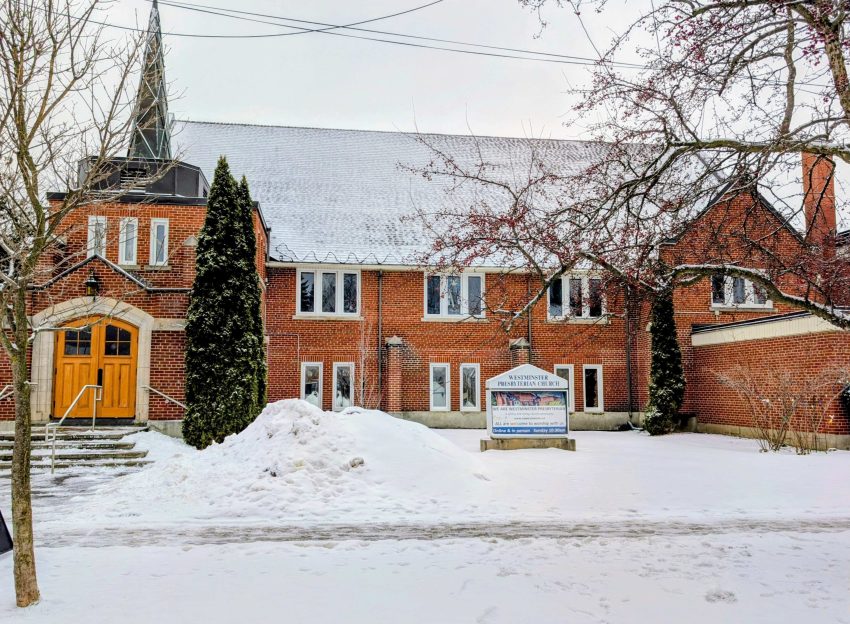
At the height of the Cold War, on March 2, 1954 — standing before 500 people gathered at the newly dedicated Westminster Presbyterian Church — Progressive Conservative MP and soon-to-be Prime Minister John Diefenbaker declared that Christianity was “freedom’s finest fruit” and called upon “this wonderful church [to be] the embodiment of freedom.” I visited Westminster Presbyterian Church on March 22, joining 60 members of the congregation for the 10:30 AM service. Located at 470 Roosevelt Avenue, Westminster Presbyterian Church’s roots go back to 1928 and to the laying of the current church’s cornerstone in 1931. At first meeting in private homes and the Westboro Masonic Hall, the congregation later gathered in what is today the church’s basement hall. Due to the impact of the Great Depression and then World War II, it was more than two decades later, on February 28, 1954, that the current sanctuary was finally completed — at a cost of $60,000.
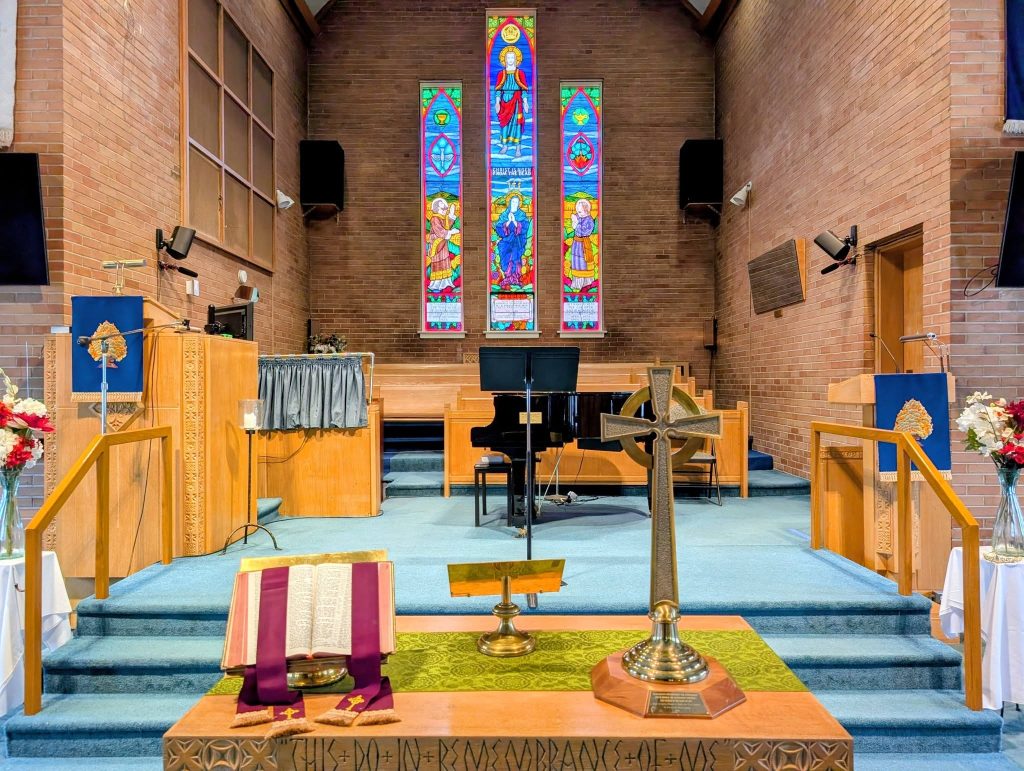
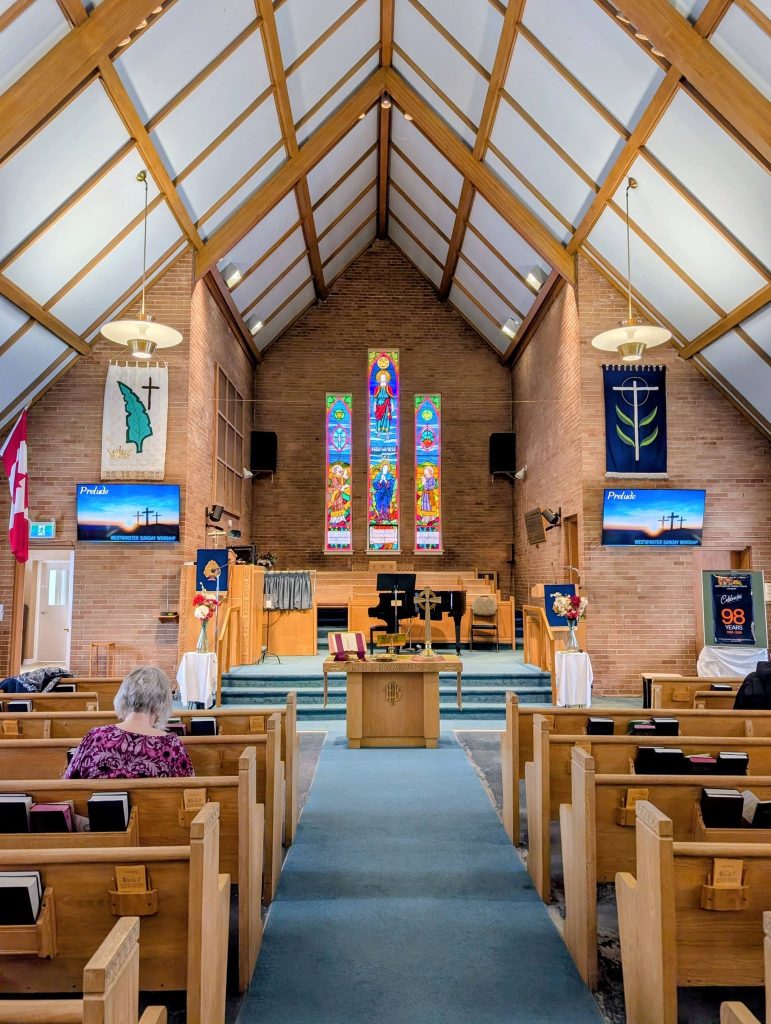
On the occasion of the new red-brick church’s dedication, The Ottawa Citizen referred to the ceremony as a “picturesque ritual” and noted that the opening of a new west-end church was a “dream come true” for local Presbyterians and for their clergyman, Reverend Donald S. Campbell, who had served as a Navy chaplain during World War II. The church on Roosevelt Avenue was built to accommodate up to 330 people in the nave and chancel. The March 1, 1954 issue of The Ottawa Citizen captured the words shared by the Moderator of the Presbyterian Church’s General Assembly, Reverend W.A. Cameron. He prayed that the church would be “forever set apart from all profane and common use, and consecrated in the worship and service of Almighty God.” In his sermon, he added: “The service of dedication will not make this a house of God. It will only be one if He is always welcome here and if those things have a place here that are most pleasing to Him.”
When I visited on March 22, the service began with words of welcome from Sue Matthews, who served as Guest Preacher that Sunday. The congregation’s minister, Reverend Chris Clarke, was away. We learned that Ms. Matthews, a lay preacher, is also a school librarian by profession and grew up in the Salvation Army. The Scripture reading was 1 Corinthians 12:12-31, where we read: “Just as a body, though one, has many parts, but all its many parts form one body, so it is with Christ. For we were all baptized by one Spirit so as to form one body—whether Jews or Gentiles, slave or free—and we were all given the one Spirit to drink. Even so the body is not made up of one part but of many.”
In her sermon, Ms. Matthews shared her love of music and her experience playing in several bands. She observed that being part of a band or any musical ensemble teach you about faith and living in community with others. “I’m not a soloist, but I’m good in the background — playing my part,” she said. Music was always an important element of Ms. Matthews’ life. Growing up in the Salvation Army, a brass band played every Sunday morning. She adeptly drew a parallel between the many parts of a band coming together to produce something beautiful with the message from 1 Corinthians about how the body of Christ is made up of many parts. She shared:
“There are many areas of life, including in the church, where we need to be part of a team and contribute to make things run smoothly. All of the roles in a church need to be filled and all of them are important. The question is: where do you belong? When the roles aren’t filled, we feel that something is missing. God has a design and a plan for each of us, including for ministry. Maybe you feel like nobody would notice if you didn’t do your part. But we would notice. Your role might seem small, but it’s important: from cleaning the floors to preparing coffee, from making sure the words are projected onto the screen, to checking in on someone in their time of need.”
Ms. Matthews shared that her mother always worked behind the scenes, in quiet ways. When the power went out in the home of someone in her community. she sent her husband and daughter over to their place with hot soup and with some coffee in a thermos, to make sure they stayed warm. The service of those working in the background is no less important.
The congregation’s music ministry included 10 choristers, accompanied by Music Director Mi-Kyong Lee, who served as both organist and pianist. The music included traditional hymns, such as “In the Cross of Christ I Glory” and “We are One in the Spirit,” as well as the early twentieth century African-American gospel song “This Train is Bound for Glory.” Near the end of the service, we sang the Doxology, before the liturgy was wrapped up with a benediction and a postlude.
Following the service, all present were invited to the church hall located below the sanctuary. A wide range of refreshments — including cheese, crackers, cookies, fresh fruit, along with coffee and tea — awaited the faithful. Several members of the congregation introduced themselves to me and shared from the history of their community, which is now in its 98th year.
Christopher Adam
Born in Montreal, Christopher Adam has called Ottawa home for the past twenty years. He received his MA from Carleton University, with a thesis focusing on twentieth century European church history, and a PhD in History from the University of Ottawa. Over the years, he has published widely and works in the faith-based charitable sector in Ottawa.
Wonderful article and thanks for writing this. Sue & I go to the same church together and she is as wonderful a person as she is a lay preacher. Her love for God shines through everything she does and am very blessed to have her as a dear friend of mine.
The service overall was also great from the singing to the refreshments downstairs . It was my first time going there and is located only 100 metres from a neighbouring church where I was married nearly 20 years ago.
Thanks again for the wonderful write up