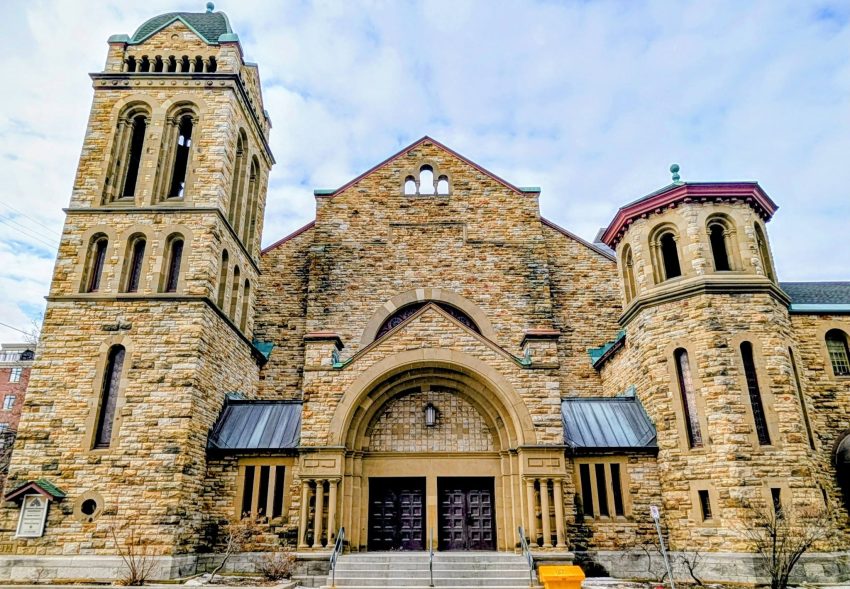
Built in 1912, with a Neo-Byzantine sanctuary that can accommodate over 800 faithful in pews and an imposing Romanesque Revival exterior, Dominion-Chalmers United Church at 355 Cooper Street is among Ottawa’s early twentieth-century architectural gems. On Palm Sunday, I joined 40 members of this small, but engaged congregation for their 10:30 AM Sunday service. While the church community sold the heritage building to Carleton University in 2018, thus freeing itself of the considerable upkeep expenses, the faithful lease back the sanctuary and other spaces. The sheer grandeur of that sanctuary is striking. The cupola above, the meticulously painted columns, the rounded archways and the light streaming in through the yellow stained glass are together reason enough to arrive early to the service and take in the architecture. The congregation’s continued presence keeps alive the Christian faith in this landmark building — one that now serves as an arts and performance venue.
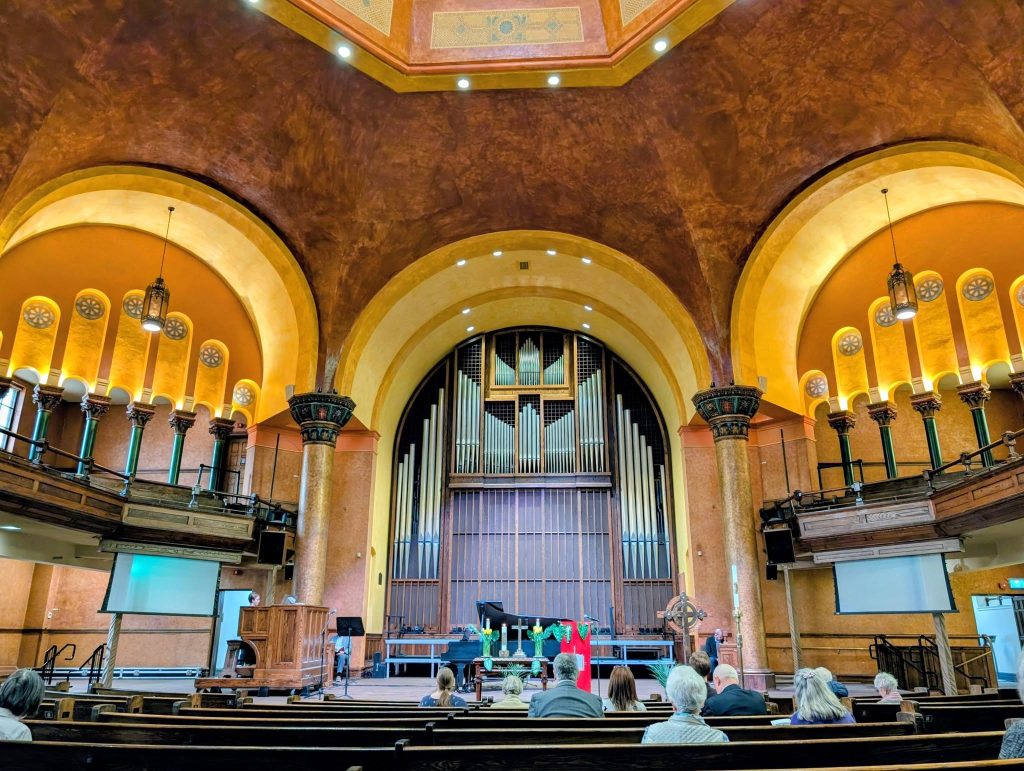
The welcome, shared by Reverend Andrew Love, encapsulated the message of Palm Sunday, when Jesus rode into Jerusalem on a donkey:
Palm Sunday crowds welcomed Jesus by waving branches. The crowds shouted with praise, laying their cloaks before Him, yet Jesus wept for the city, seeing what others could not. Today, we come with our own hopes and burdens, ready to welcome the One who brings peace — not as the world gives, but as only He can. Let us open our hearts as we journey with Him this Holy Week toward the cross and beyond.
In his ministry, Rev. Love fosters a strong connection to the Jewish people and to Israel. He spoke about how members of his congregation had joined Temple Israel Synagogue for a Shabbat service on the Saturday before Palm Sunday, reaffirming the bond between Christians and Jews. In his Substack blog Theologic, he has spoken out against antisemitism and has been critical of the United Church of Canada’s stance on Zionism and on the Israeli-Palestinian conflict. He recently addressed an open letter to the United Church’s General Council. In it, he called on his denomination to “reclaim the sacred ground of honest, respectful engagement with the Jewish community in Canada, even as we voice deep humanitarian concern for Palestinians in Gaza and the West Bank.”
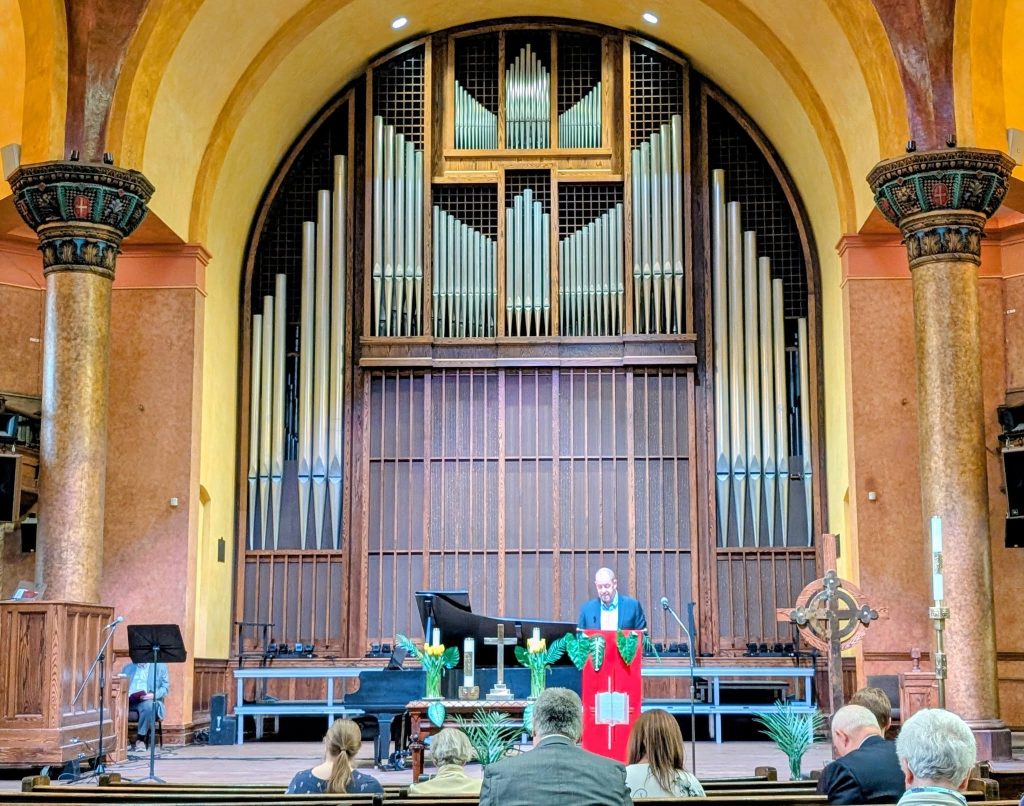
Rev. Love’s sermon on Palm Sunday reflected his connection to Israel. He spoke in detail about the geography of the Jerusalem area and the experience of driving from Tel Aviv’s Ben-Gurion Airport to Jerusalem. One drives up a considerable hill on the way to Jerusalem, with the city being around 750 metres above sea level. “Running a marathon in Jerusalem would be quite difficult, because it’s pretty hilly and it’s a lot of up and down,” Rev. Love observed. Scriptural references to Jerusalem always speak about going up to the city and building holy sanctuaries on high ground. The Old City itself is almost surrounded by other hills, including the Mount of Olives. That hill would have been a good place for the Romans to get a complete view of the city. The people in positions of authority, and indeed just about everyone else, would have seen the crowds that gathered to greet Jesus as he rode into Jerusalem. “Those in positions of authority would not have liked what they had seen,” Rev. Love said.
First century Palestine had lots of prophets claiming to be the Messiah. “In many ways, Jesus was another messianic prophet,” Rev. Love noted. “And the Judeans were a rebellious people. They had constant wars with Rome. They were a thorn in the side to the empire. There was a lot of tension in the air at this moment in time. And along comes this guy, riding on a donkey, making really audacious statements,” Rev. Love said. He then proposed a somewhat different interpretation of Palm Sunday than what one might more commonly hear from ministers. Usually, Jesus is portrayed as entering Jerusalem not as a conquering ruler, but as a promised prince of peace. While Jesus’ ministry was about humility and peace, he also took a political stance. “Let’s not be under any illusion here, folks. Jesus was making a political statement when he entered Jerusalem, and it was a very forceful political statement. He wasn’t preaching a message of violent confrontation, he was doing the opposite,” Rev. Love said.
When Jesus entered Jerusalem, we know from Matthew’s account that the whole city was in turmoil. The crowd is somewhat confused as to who Jesus really is, with some seeing him as a prophet — one of many in those days. Yet according to the Gospel accounts, the crowds shout Hosanna — which means “come save us now.” It’s in this confusion that Jesus is making a bold proclamation, by arriving the way he did, knowing that all the religious and political authorities would see what was happening.
“Out of this turmoil, we start to see the foundations of Good Friday. In fact, Good Friday takes on more meaning if we understand the context. Jesus goes into the Temple and cleanses it. This is not a party. Too often in the Christian world, Palm Sunday is seen as a party. I look at it as something much more provocative. It’s a political procession and Jesus is putting a stake in the ground about what he fundamentally is about. He is here to upset all of the social orders. This is a revolution in the making. The proclamation of the coming of the Kingdom is so much more than just another prophet,” Rev. Love shared.
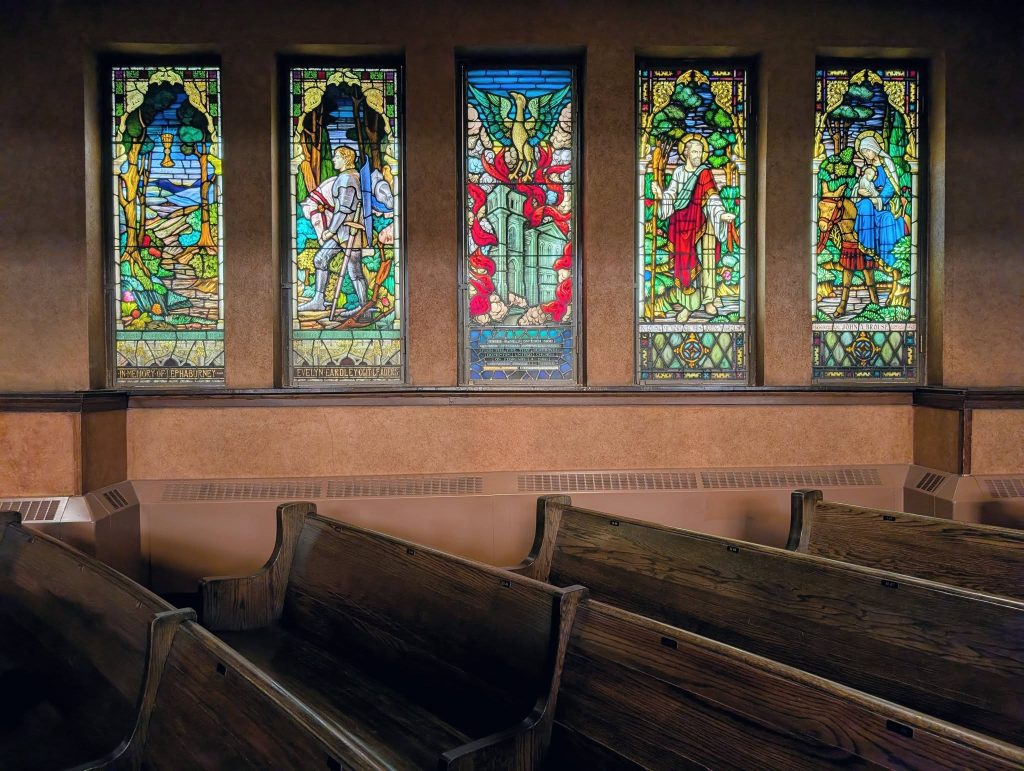
Organist Francis Armour played the Casavant organ during the service; he accompanied a cantor who led the congregation in song. The organ includes an innovative and mobile console on wheels — a convenient and recent upgrade for this multipurpose sanctuary. The congregation ensures that ahead of each service, a large Celtic cross, which once adorned the organ, is placed in the sanctuary, along with the Christ candle and the appropriate liturgical colours. These are then removed and stored in another space on-site, ready for use the following weekend.
The liturgy included a selection of hymns, mostly from Voices United, such “All Glory, Laud and Honour,” “Ride On, Ride On in Majesty!” and “My Song is Love Unknown.”
After the service, all present were invited to Woodside Hall — a bright and airy community space — for tea, coffee, cookies and other refreshments. The hall looks on to Churchill Gardens, named in honour of a family in the congregation. In addition to offering a time of fellowship after Sunday service, Dominion-Chalmers United Church also hosts a weekly complimentary dinner, a prayer service and a faith-based discussion series every Thursday evening beginning at 6:00 PM called “Time Out With God.” Based on the warm welcome I received from several members of the congregation in Woodside Hall, it’s clear to me that this weekday evening programming is open to all.
Christopher Adam
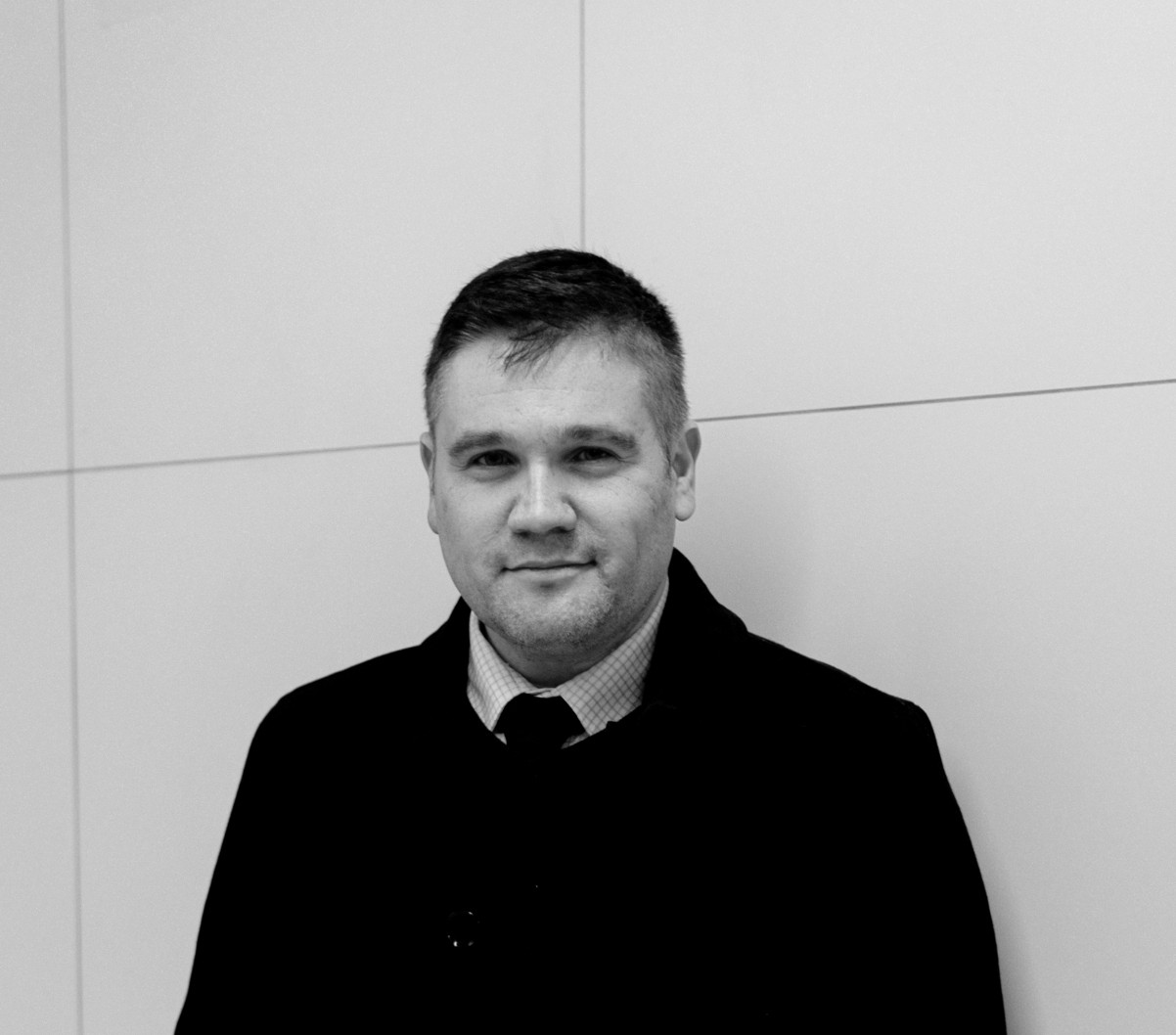
Born in Montreal, Christopher Adam has called Ottawa home for the past twenty years. He received his MA from Carleton University, with a thesis focusing on twentieth century European church history, and a PhD in History from the University of Ottawa. Over the years, he has published widely and works in the faith-based charitable sector in Ottawa.