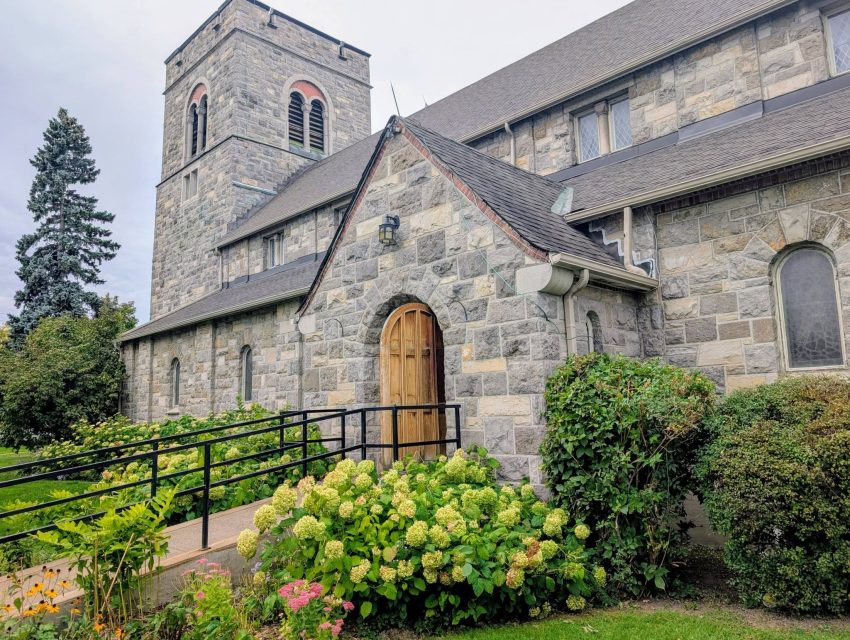
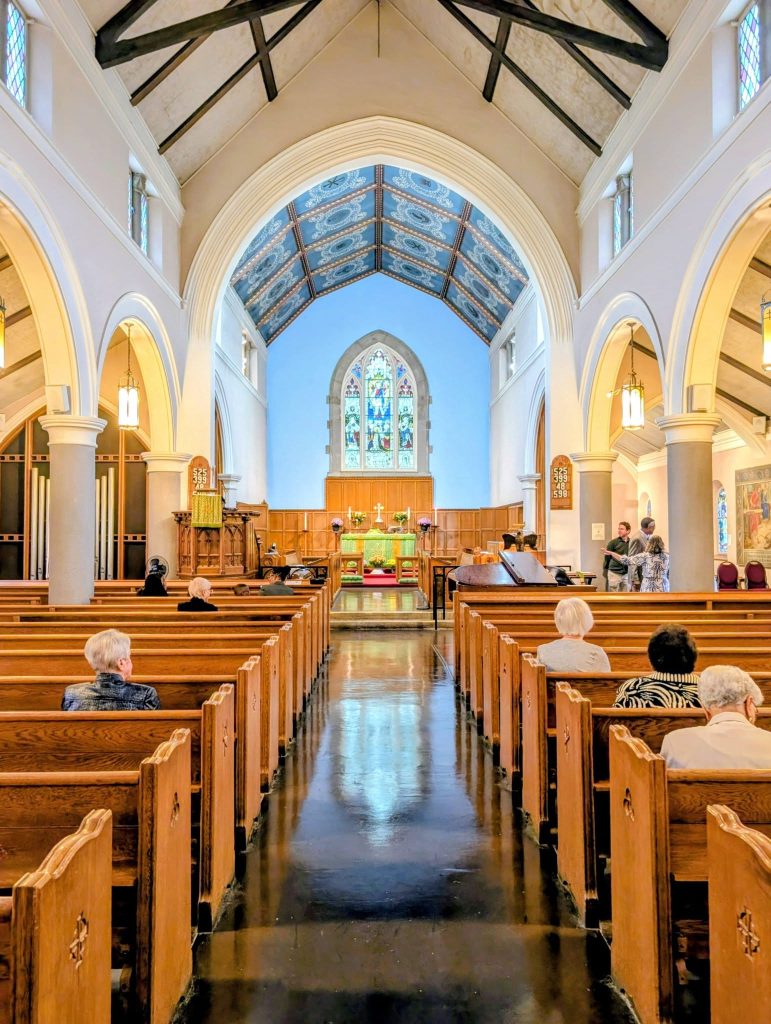
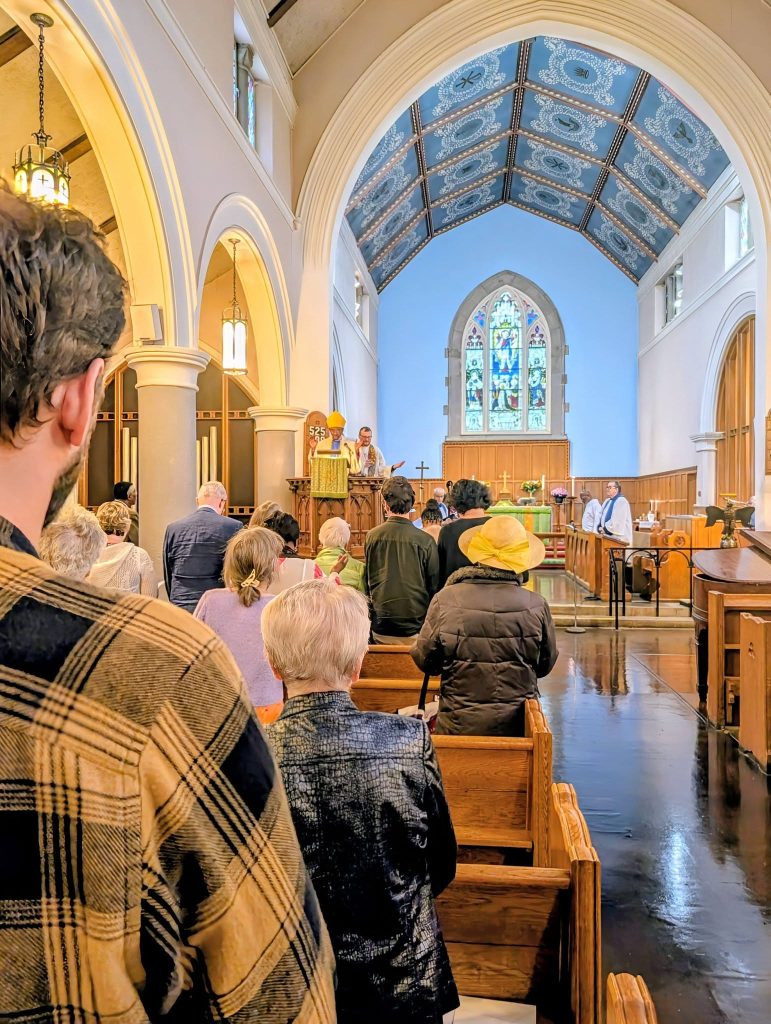
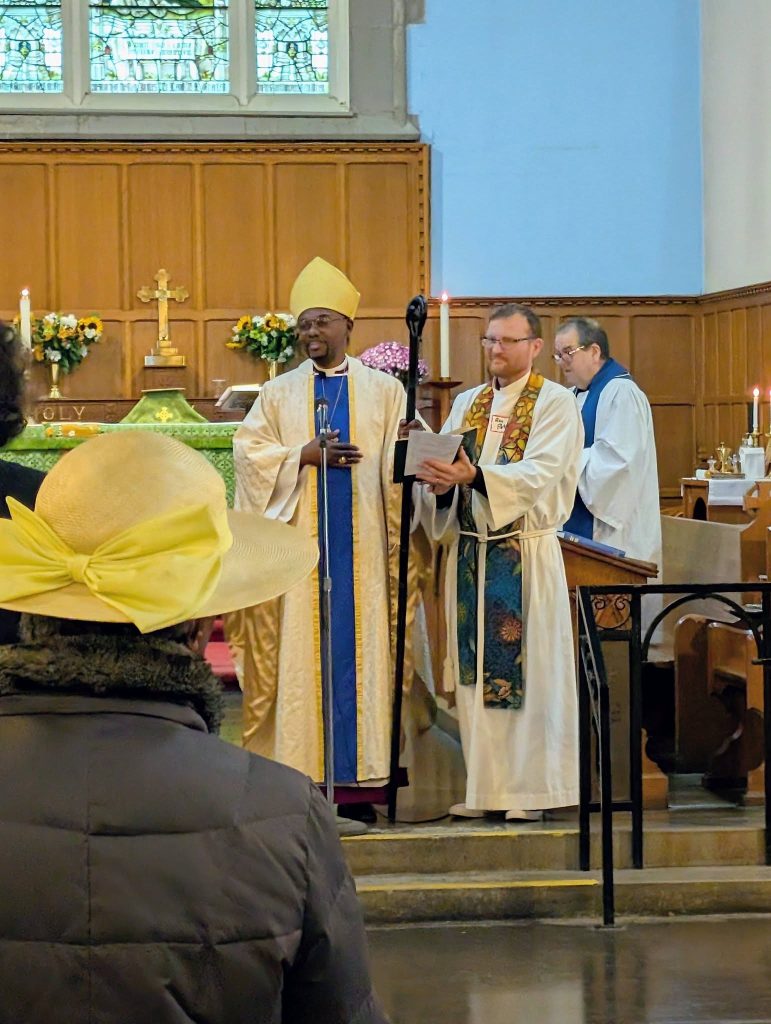
Farther afield, on Sunday, September 20 at 10:00 AM, I joined 100 parishioners of St. Thomas’ Anglican Church in Montreal for the 185th anniversary of this English-language faith community and to celebrate 75 years since the construction of their current church at 6897 Somerled Avenue. Located in NDG — a historic and predominantly Anglophone neighbourhood — St. Thomas boasts a colourful history and remains a vibrant, multi-generational community with an active children’s ministry serving the church’s young families. Many of those youngest parishioners enhanced the anniversary celebration by singing worship songs. The Anglican Bishop of Montreal, Victor-David Mbuyi Bipungu, presided with the parish’s Incumbent, Reverend Peter Lekx, at this upbeat celebration.
St. Thomas was not always located in NDG, the western half of Montreal’s most populous borough, Côte-des-Neiges–Notre-Dame-de-Grâce. The first St. Thomas’s Church was built in 1841, thanks to the initiative of philanthropist, merchant and brewer Thomas Molson, in what is today the Ville-Marie Borough, southeast of downtown Montreal. In some ways, Molson saw the church, located near his brewery, as his personal project and responsibility. He financed its construction and even paid the clergy stipend for some 15 years. The church building, however, had a very short lifespan. In 1852, a major fire that destroyed the Molson brewery and distillery also gutted the new church. In conflict with Bishop Francis Fulford, and in opposition to his demand that the community fully come under Church of England jurisdiction, Molson began rebuilding the church in the same location and kept it independent of the CofE until his death in 1863. Three years later, St. Thomas finally came under Synodal jurisdiction.
As industrialization in this part of Montreal took root, the location no longer served the needs of St. Thomas’ parishioners. A third church was erected at the corner of Sherbrooke Street East and Delormier Avenue, near what is today Plateau Mont-Royal and La Fontaine Park. The facade and bell tower of the 1906 red brick church still stand at 2022 Sherbrooke Street East, but the building has been repurposed and heavily modified. It’s now dedicated to the performing arts and known as the Jean-Pierre-Perreault Building.
The end of World War II saw a significant rise in NDG’s housing supply. It became a neighbourhood increasingly popular among veterans and their families. As the east-end English population declined, the St. Thomas community moved once again and in 1951-52 erected the grey-stone church that now stands at the corner of Somerled and Rosedale. Connecting the new church to its long history, the new building’s cornerstone was laid by John Henry Molson, the son of Thomas Molson, in September 1951.
In its June 30, 1951 issue, The Montreal Gazette described plans for the new church in what it referred to as the “Rosedale District” as “typically Anglican” and built in the Norman style. It was designed by the architect P. Roy Wilson and built by the firm Walter Hyde & Co. Ltd. The Reverend F.J. Sinnamon, who served as an overseas military chaplain during the War, was the first clergyman to minister at the new NDG location.
Writing in an anniversary pamphlet distributed after the liturgy, Rev. Lekx shared: “For 185 years, our calling at St. Thomas’ has not ultimately been about preserving an institution, but about loving God and sharing that love with the people around us. We worship because God is worthy of our love; we serve because our neighbours are worthy of our love; and we gather as a community so that we may grow more deeply into each of these callings together.”
Bishop Victor-David offered an animated homily. With enthusiasm, he asked the congregation to repeat after him on several occasions the words “Surely the Lord is in this place!” Jacob had uttered those words, recorded in Genesis 28:10-17, and they served as the first reading of the day. In that passage, we read: “Jacob woke from his sleep and said, “Surely the Lord is in this place—and I did not know it!” And he was afraid and said, “How awesome is this place! This is none other than the house of God, and this is the gate of heaven.”
Reflecting on the anniversary and the generations that have come before, Bishop Victor-David shared: “Each generation has been a living stone in the continuing work of God in this place. Some of those stones have been prominent and visible: the clergy, wardens, musicians, ministry leaders. And others have served quietly, often without recognition: those who prepared food, visited the sick, welcomed strangers, prayed faithfully, gave generously, and encouraged others.”
The St. Thomas choir included 7 choristers, a pianist and an organist. While the children sang some spirited praise and worship music, including the song “Waymaker,” most of the repertoire was built on traditional hymnody. Among these were “The Church’s One Foundation,” “Let All Mortal Flesh,” and “Go to the World.” The hymns were drawn from the Book of Alternative Services and the Book of Common Prayer. In particular, “The Church’s One Foundation” seemed apt given the celebration of this faith community’s establishment 185 years ago. St. Thomas had been erected on sufficiently sturdy foundations to withstand the demographic decline of the Anglophone community, the gradual secularization of the past decades, and Québec’s laicité zealotry. Despite the headwinds — and as provincial governments come and crash — the church stands.
Hal Hopson’s “Come Let Us Go to the House of the Lord” served as the anthem and Denis Bédard’s “Te Deum” as the organ postlude.
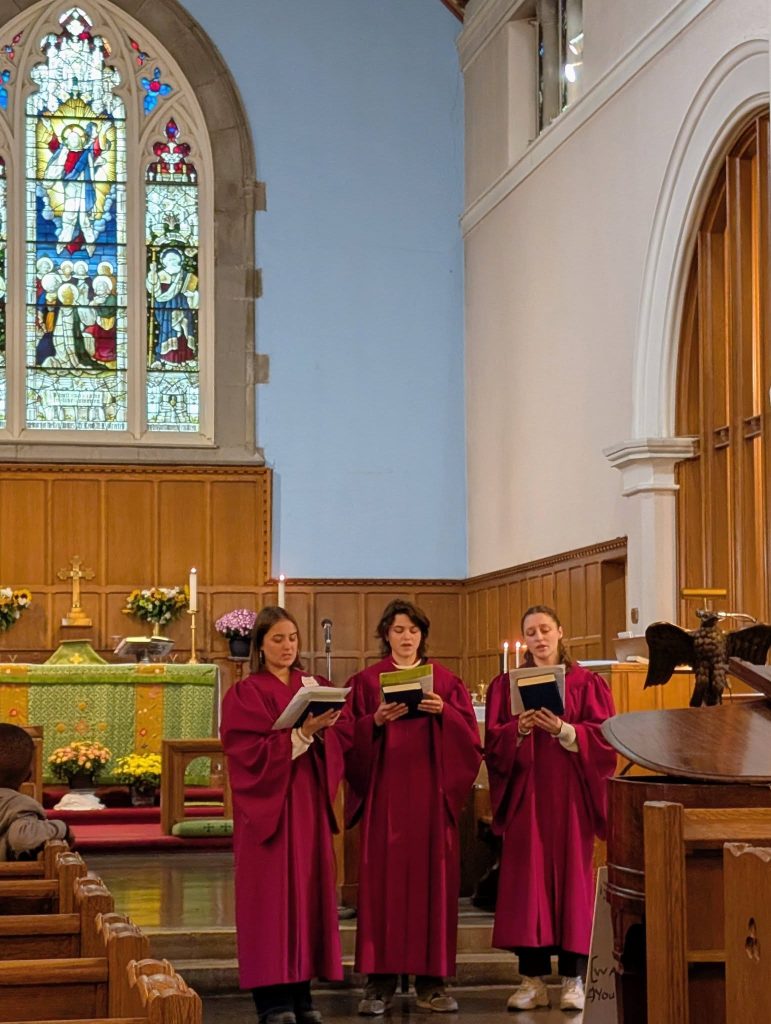
Following the liturgy, St. Thomas hosted a festive reception in the Parish Hall. The congregation was invited to enjoy a wide array of sandwiches, hors-d’œuvres, cheese, crudites, baked goods, and an anniversary cake, as well as fruit punch, coffee and tea. It was a hearty and varied Sunday lunch! While another Christian faith community celebrated their Sunday service upstairs in the church, the parishioners of St. Thomas’ took the time to visit with each other and gather as a parish family.
Christopher Adam
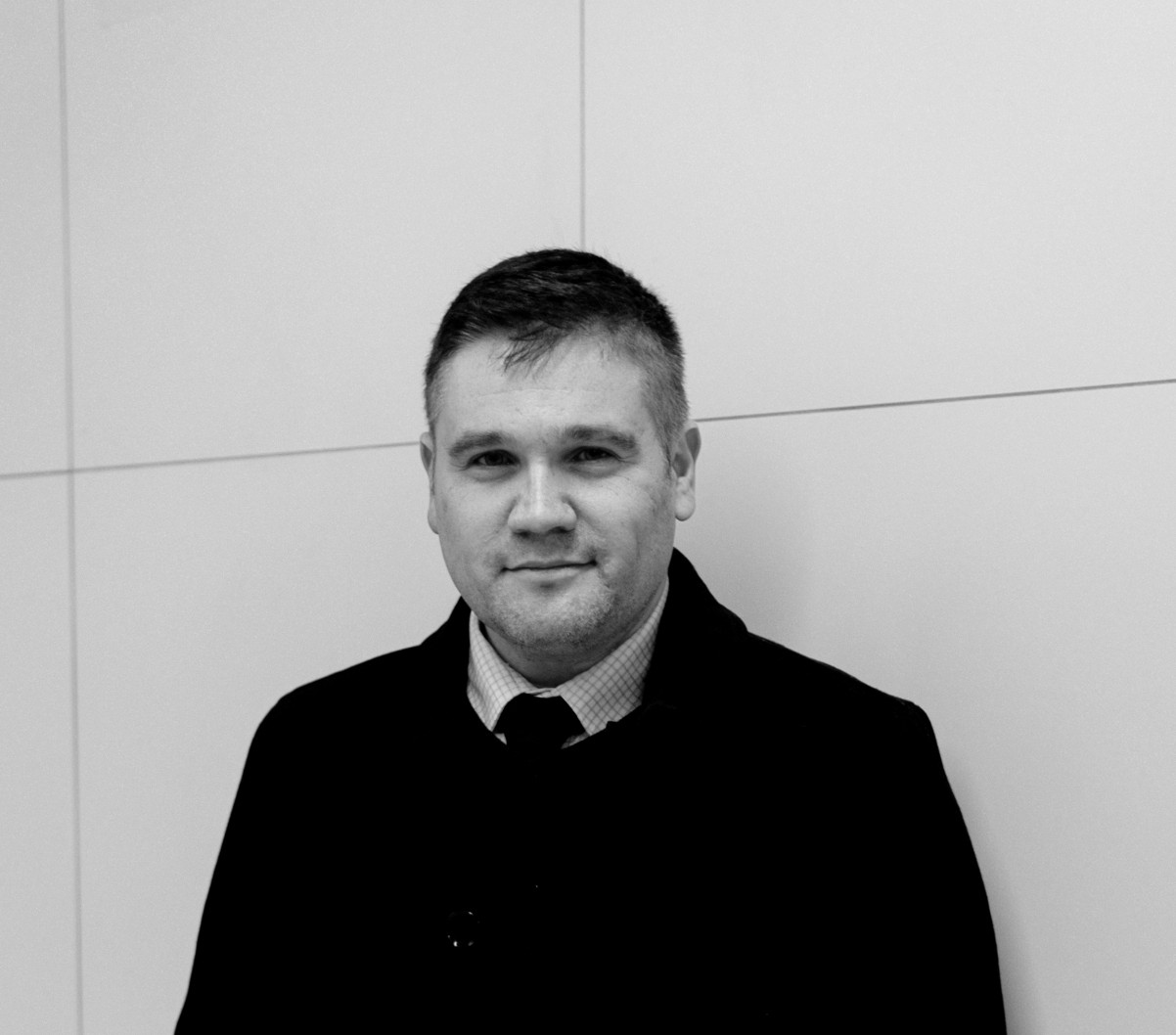
Born in Montreal, Christopher Adam has called Ottawa home for the past twenty years. He received his MA from Carleton University, with a thesis focusing on twentieth century European church history, and a PhD in History from the University of Ottawa. Over the years, he has published widely and works in the faith-based charitable sector in Ottawa.