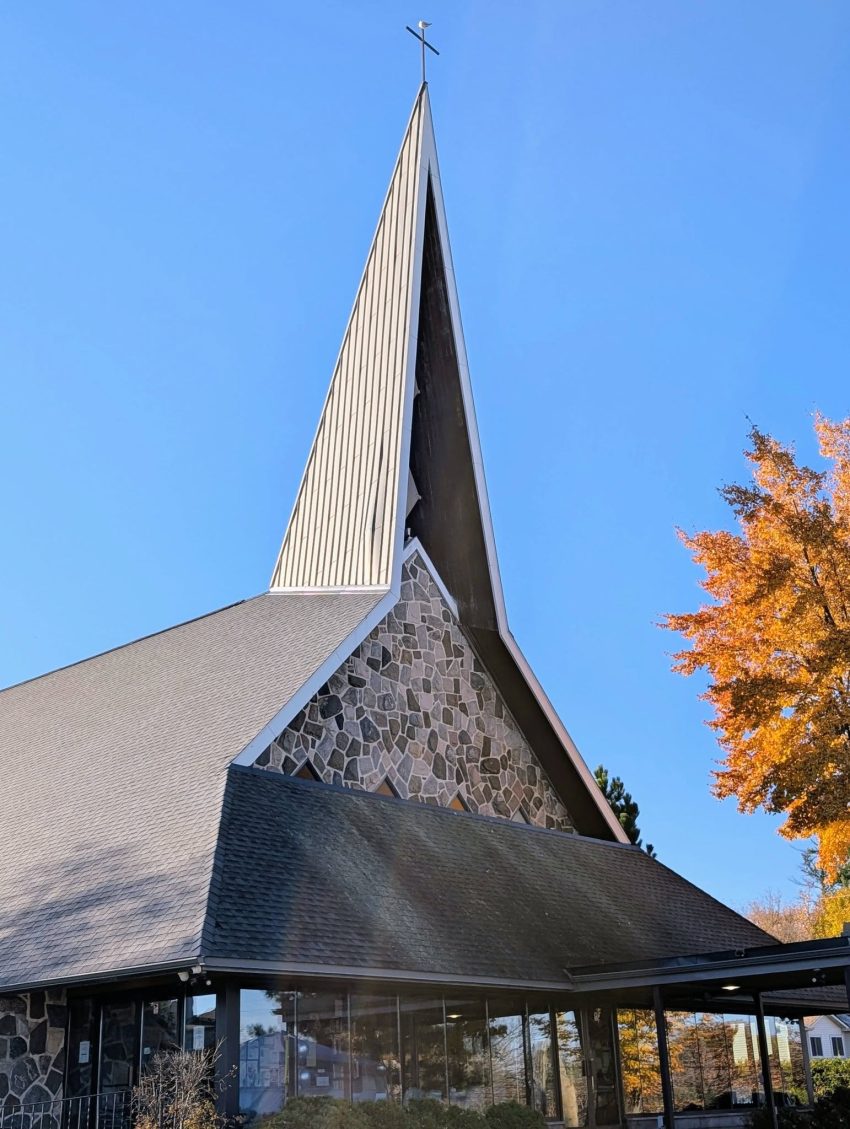
The story of St. John the Apostle Parish at 2340 Baseline Road is intertwined with the rapid twentieth century expansion of Nepean, then an independent municipality. On October 25, I joined more than 150 parishioners to celebrate the church’s 60th anniversary at 10:30 AM Mass. I found a vibrant and diverse community. While the 10:30 AM Mass has the largest attendance, an early morning liturgy is also celebrated at 8:00 AM, as well as an anticipated Mass on Saturdays at 5:00 PM. On arriving a few minutes before the start of Mass, I was warmly welcomed by a greeter standing in the narthex, known in the church as the Glass House. It’s named for its floor-to-ceiling windows.
St. John the Apostle Parish was established on October 8, 1966, when Archbishop Marie-Joseph Lemieux of Ottawa decided that it was time to redefine parish boundaries in the capital’s booming western suburb. Census data shows that Nepean’s population grew by more than 120% in the years between 1960 and 1966. In the area near the intersection of Baseline and Greenbank, the home of the new St. John the Apostle Church, farmlands were giving way to suburban development. What is now 2340 Baseline Road once belonged to the National Capital Commission.
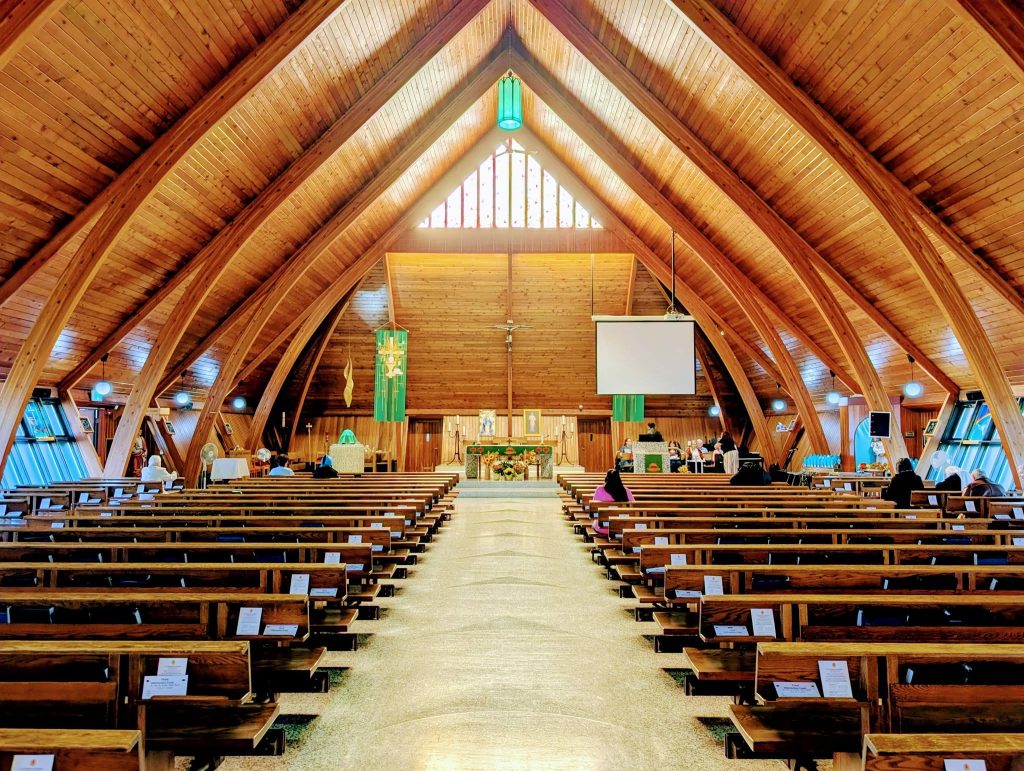
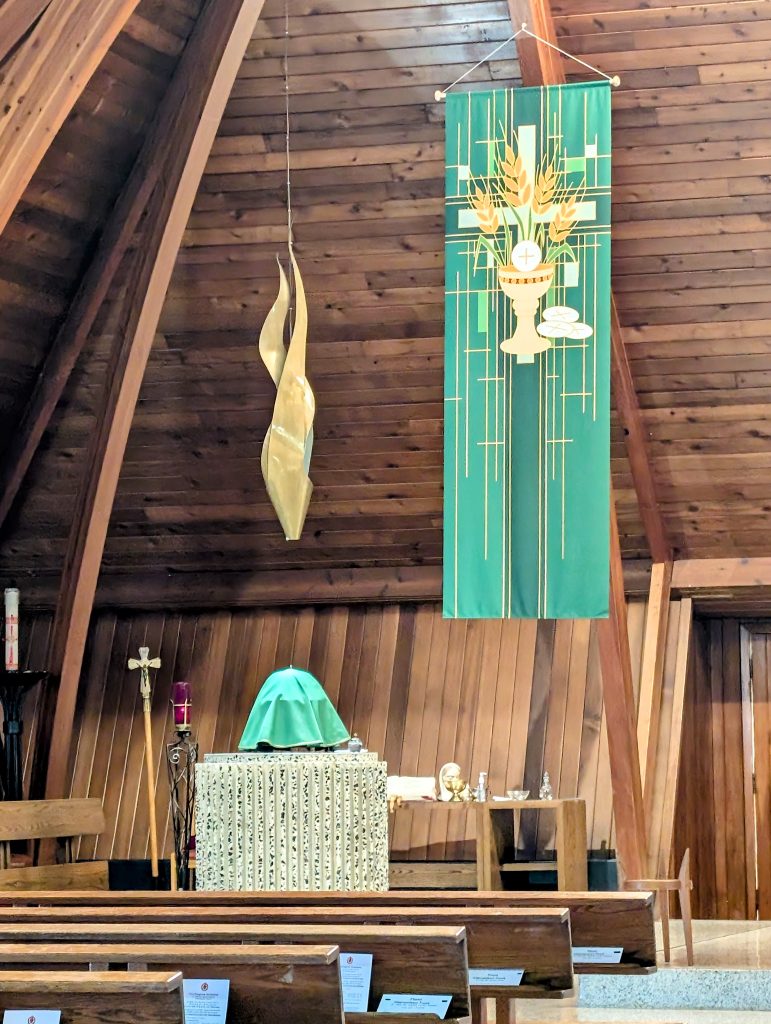
The new parish’s first Masses were celebrated at St. Raymond’s School, with the first such liturgy held on October 16, 1966. These were the days of so-called “gymnasium Masses” in a booming suburb with a growing Catholic population. Fr. John Whelan served as the community’s first pastor. The modern, A-frame church was completed in 1969. Among the signature architectural features of this church is the dramatic, sloping roof, as well as the interior wood finish. The building was designed by the prominent architect Roger D’Astous of Montreal. It cost some $295,000 to complete. With the exception of the Glass House extension, St. John the Apostle Church is almost identical to Église de l’Enfant-Jésus, located in Tracy, Quebec and also designed by D’Astous. The Parish website displays photographs from the time of construction. They show a church with a monumental roof frame constructed from timber and glulam beams, and a vaulted ceiling. In its August 23, 1969 issue, the Ottawa Citizen called St. John the Apostle “one of Ottawa’s most impressive Roman Catholic churches.”
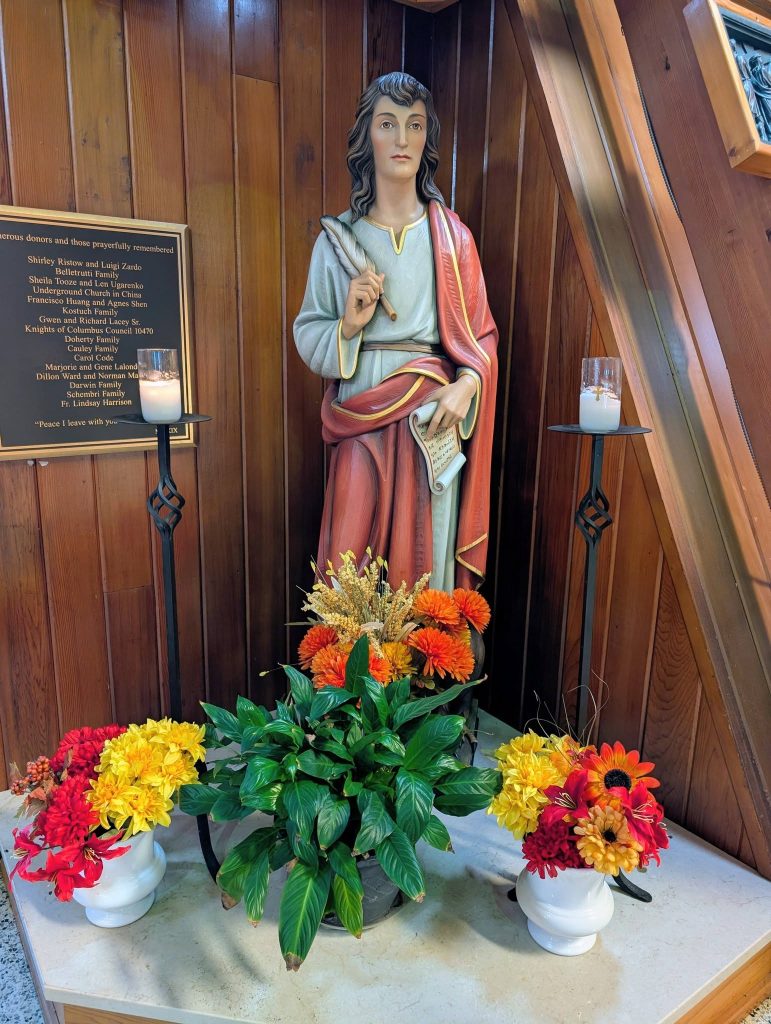
The exposed timber and the curved wooden beams are the defining features of the church’s Mid-century Modern interior. As there are no columns or divisions, the church feels wide and airy. A triangular clerestory window directly above the sanctuary lets natural light stream in. The window is yellow stained glass with red highlights sprinkled throughout. When the space is illuminated by daylight, the church takes on a golden, honey-coloured hue. With the exception of some modern memorial stained glass installed in the nave, and a statue of St. John the Apostle, the church is minimalist in terms of its ornamentation.
The St. John the Apostle choir included 11 choristers, accompanied on the piano. “Ode to Joy” served as the Processional Hymn. During the Offertory, the choir also led the congregation in singing a hymn that was new to me, with the lyrics: “Whatever is weak, may you strengthen, Whatever is broke may you restore, Whatever is lost may you find it…Whoever is hungry may we feed, Lord teach us to serve as you have served.” For the Communion hymn, the choir sang “In Christ Alone (My Hope is Found)” and “O Sacrament, Most Holy.” The song “How Can I Keep from Singing” served as the recessional hymn.
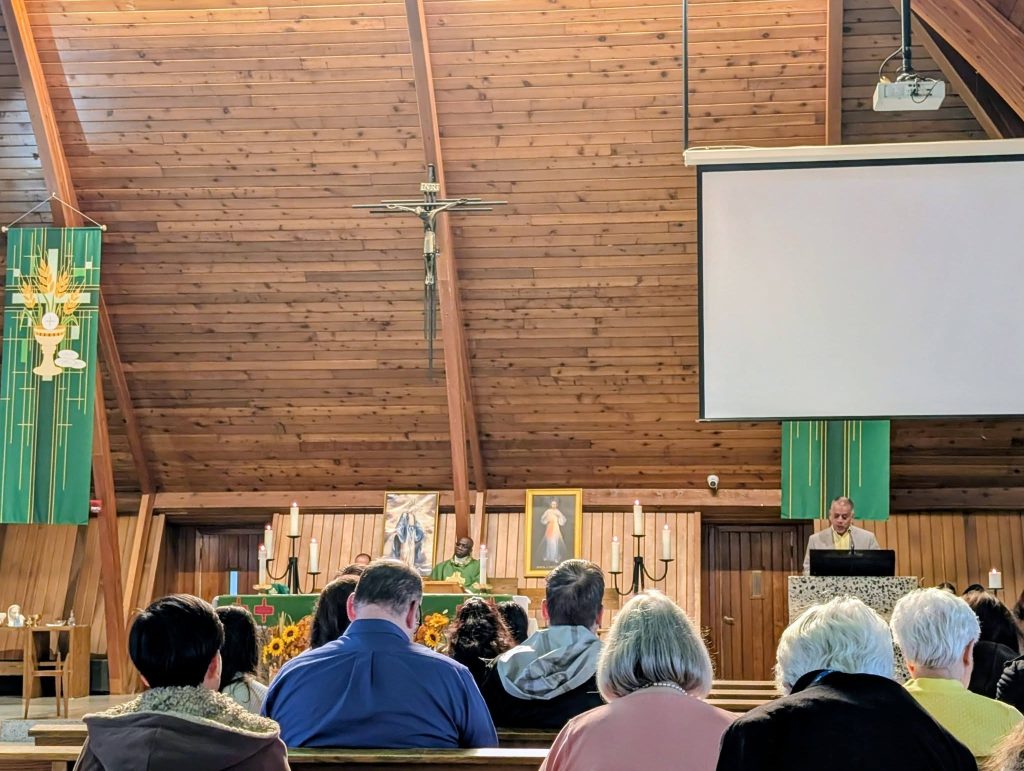
Fr. Emeka Onyeogubalu, the Pastor, gave the homily. He thanked God for both the people and the building that together form the foundations of the Parish community that celebrates six decades. An anniversary is a time to thank God for the many blessings and for the many saints who have passed through the doors of St. John the Apostle Church — including those who are still around and those who came before. Fr. Emeka recalled the pastors, including the late Fr. Whelan, and the lay volunteers. “We remember all the heroes and heroines who contributed their time, talent, energy, their money — everything they had — to sustain this Parish and to keep it alive for the mission of Christ, which still continues today,” he said.
Fr. Emeka recalled by name some of the parishioners still present today, who were among the founders of this Nepean church in the 1960s. He reminded the faithful of Jesus’ response to the question: which is the greatest commandment? Jesus answered that the greatest is love. We come to church to share in God’s love, Fr. Emeka said. He invited everyone to see the person sitting close to them in pews not just as fellow parishioners or perhaps as strangers, but rather as a sister and as a brother who we ought to know and love. He called on the congregation to reach out in love as well to the seniors and the shut-ins who can no longer attend Mass in person.
“At our baptism, we are brought in here and received by the entire community. And then at our death, our remains are brought in. This unites us and it’s what makes us a family,” Fr. Emeka said. He shared how he met a Vietnamese man once in the confessional who spoke very little English. Fr. Emeka doesn’t speak Vietnamese. They didn’t have a shared language and it was hard to make out everything he was saying. “But he wasn’t confessing to me,” Fr. Emeka exclaimed. “He was confessing to Our Lord Jesus Christ. That is the beauty of the Church.”
The Parish celebrated its 60th anniversary with a reception after Mass. The faithful enjoyed a wide array of baked goods, as well as refreshments in the Glass House. Originally, the organizers of the anniversary celebration had envisaged a larger gathering in the church hall. Damage from the Canada Day flooding washed away those plans. The community, however, hopes to host its anniversary dinner in April 2027.
Christopher Adam
Born in Montreal, Christopher Adam has called Ottawa home for the past twenty years. He received his MA from Carleton University, with a thesis focusing on twentieth century European church history, and a PhD in History from the University of Ottawa. Over the years, he has published widely and works in the faith-based charitable sector in Ottawa.