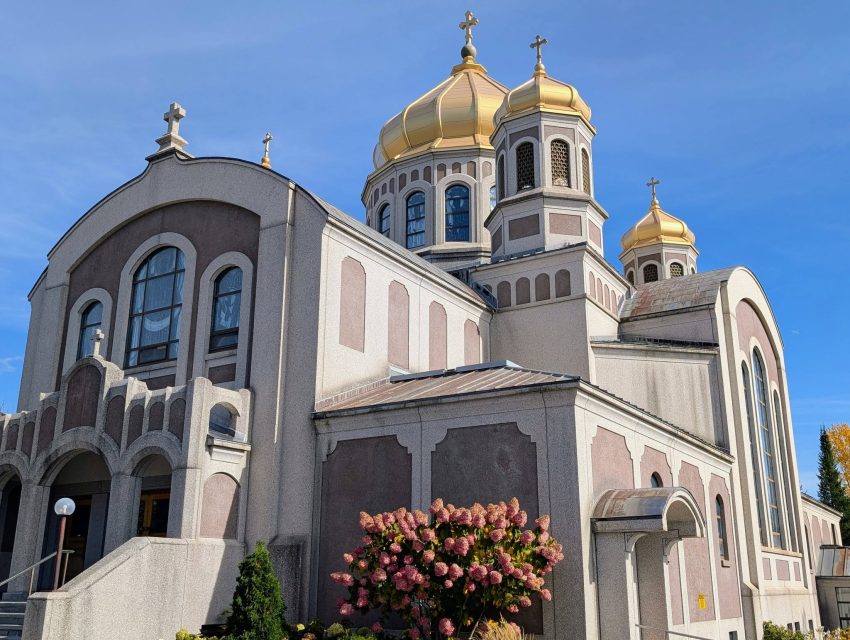
A lifetime ago, when I was a student in Eastern European studies at Carleton University, the golden domes of St. John the Baptist Ukrainian Catholic Shrine, just beyond the windows of Dunton Tower, served as an apt backdrop to our classes. On October 18, I joined over 100 parishioners for 11:30 AM Divine Liturgy at this extraordinary Neo-Byzantine church. Located at 952 Green Valley Crescent, the Shrine celebrates two liturgies every Sunday, including one in the Ukrainian language at 9:30 AM and a second liturgy almost entirely in English at 11:30 AM. While the Byzantine Rite is quite different from the Roman Rite, particularly from the Novus Ordo Mass, Ukrainian Catholics are in full communion with Rome. As such, Roman Catholics are welcome to receive communion at the Shrine.
Construction on the $4 million Shrine began in 1984, when representatives of the Ukrainian community attended the Papal Mass at LeBreton Flats during the visit of Pope John Paul II, and asked the Pontiff to bless the cornerstone. The Ottawa Citizen published photographs of the construction on several occasions, including in its September 15, 1986 issue, showing crane owner Maurice Dulepka accompanying Fr. Vladimir Shewchuk up to the top of the cupola, as the priest prepared to bless the new cross that adorned it. In its May 16, 1987 issue, the Citizen’s church news correspondent, Reverend R.G. MacNeil, reported on the Shrine’s opening. The article explained that a thousand years had passed since the adoption of Christianity in Ukraine, or Kievan Rus’ as it was then called, by Volodymyr the Great in 988 AD. The anniversary was a source of celebration and commemoration for Ukrainian Canadians. The Shrine opened a year earlier and, as Reverend MacNeil wrote, it “proclaims to all who visit that the Christianity planted in the fertile soil of Ukraine 1,000 years ago continues to flourish in Canada, one of the new homelands of the Ukrainian people.” The Shrine has the honorary title of “Sobor,” which sets it apart as a church of major significance for Ukrainian Catholics.
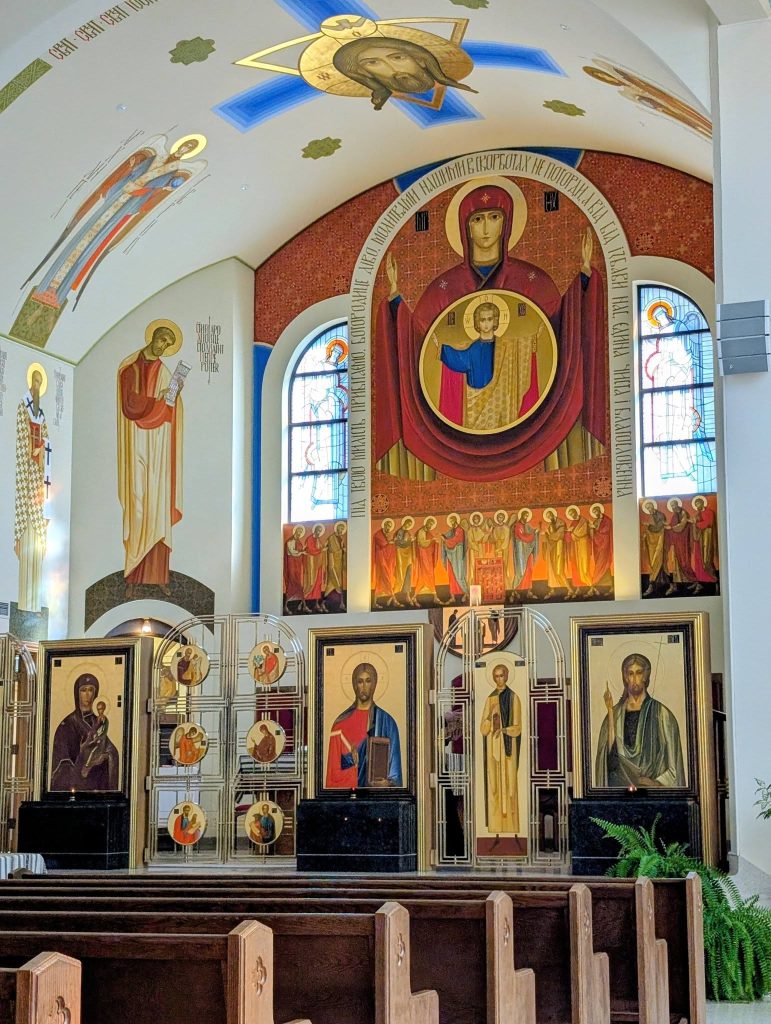
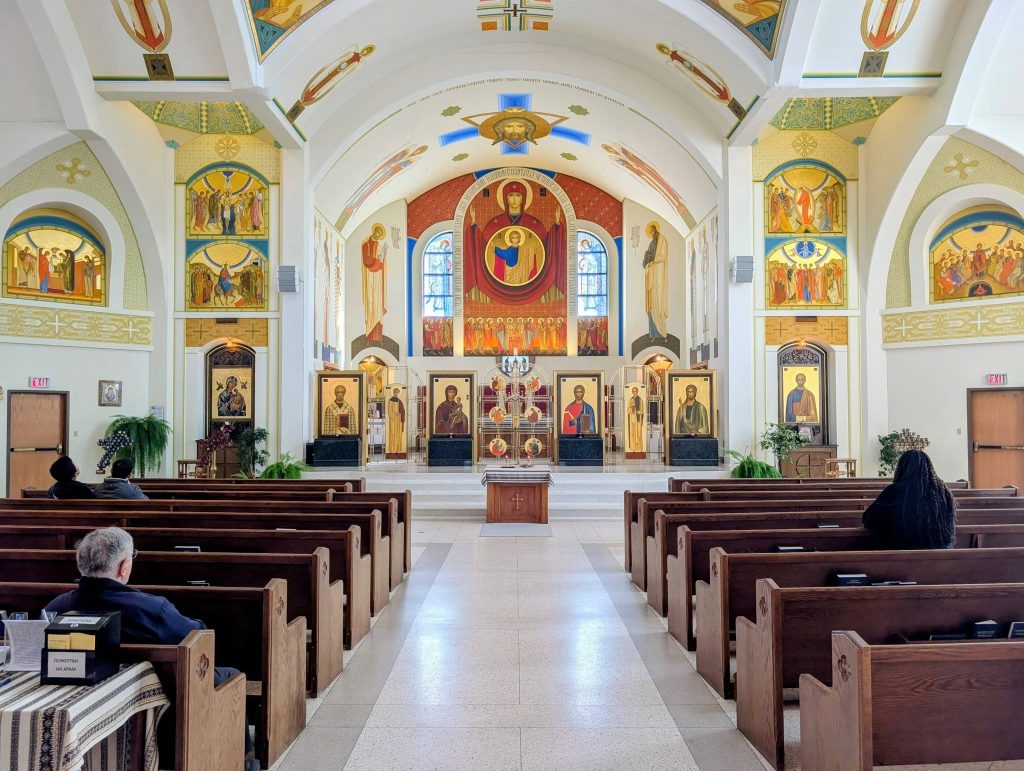
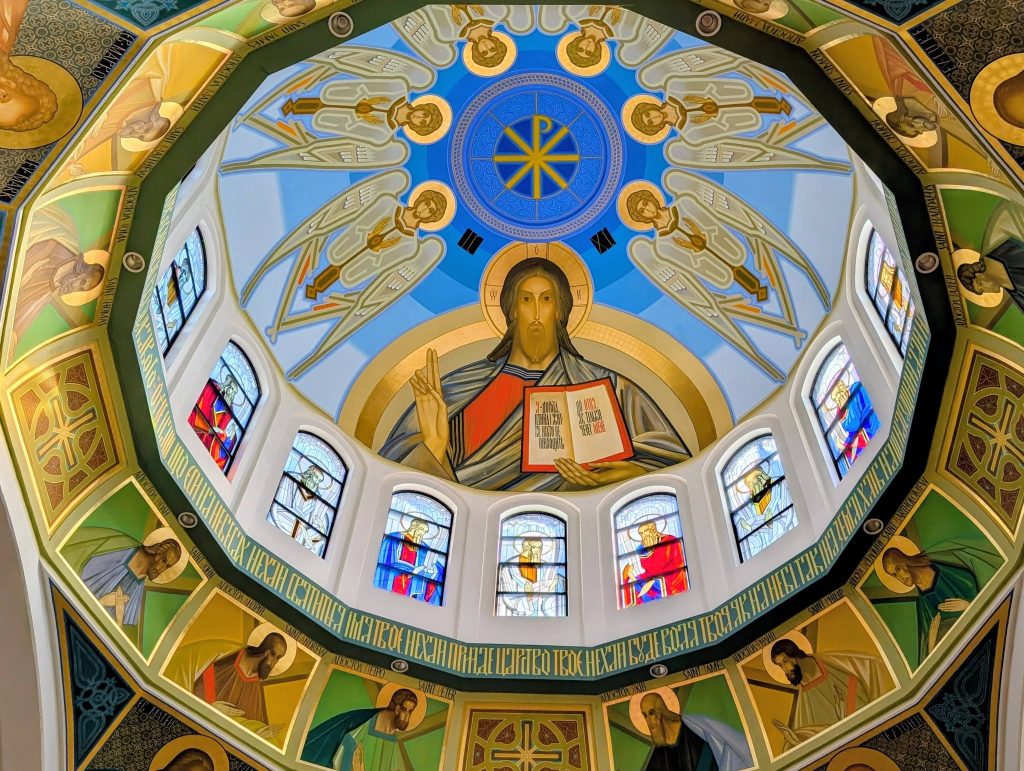
The Shrine was designed by the architect Julian K. Jastremsky, whose name is attached to a number of prominent Ukrainian churches in both Canada and the United States. When it first opened, the church did not yet have the beautiful iconography and sacred art that is a hallmark of the space today. Most of the art was added in 1999, under the direction of Professor Lubomyr Medvid, of the Lviv Academy of Fine Arts, in western Ukraine. The art and the stained glass windows represent the work of five artists from Ukraine. The Shrine is rich in ornate frescoes and icons, as well as stained glass. And as any faith community is about both the building and the people, it’s worth noting that the congregation is multi-generational, with a large number of young families present, as well as young adults.
The choir, which chanted and sang a cappella throughout the 90-minute liturgy, was exceptional too. While Ukrainian Catholics are in communion with Rome, the liturgy itself is quite different from a Roman Catholic Novus Ordo Mass. Most of the Divine Liturgy is chanted and there are no instruments — other than the human voice. Instead of kneeling, the faithful — for the most part — bow. The liturgy does feel more free-flowing and perhaps a little less traditionally linear and unified than a Novus Ordo Mass. And some of the liturgical movements during the Eucharist occurred away from the congregation, behind the iconostasis.
I appreciated hearing several hymns for the first time, including “How Glorious is our God in Sion” and the Thanksgiving Hymn, which is a Galician chant with roots in the seventh century. And before the liturgy, it was a welcome surprise to hear the choir sing from the loft the contemporary song “The Goodness of God.” Listening to that sung a cappella in this ornate Ukrainian Catholic church was both memorable and beautiful. The singing from above and the painted cupola overhead engaged both the ears and eyes.
Among the hymns, “How Glorious is Our God in Sion” struck me for its ornamental language: “Within our hearts we raise an altar unto the God our ancestors knew; And may our praises upward rising, be ever fresh as morning dew. Our hearts proclaim in joyful ovation, ‘the Lord is glorious in His creation.'”
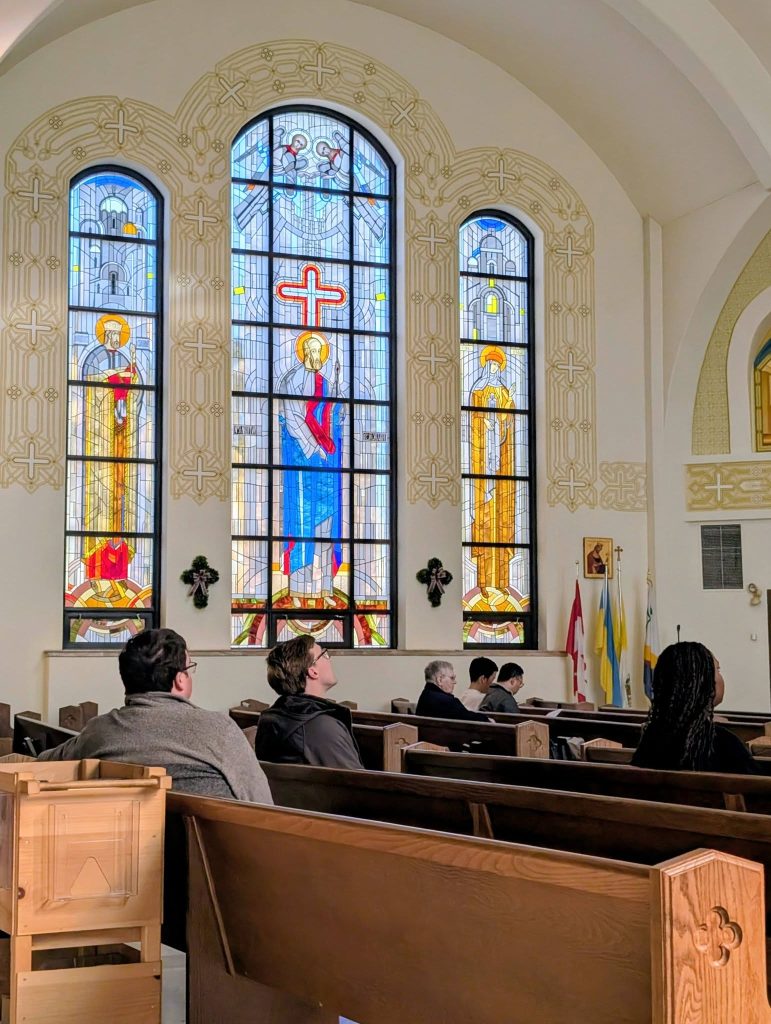
In his homily, Fr. Mykolai Kozelkivskyy, OSBM reflected on the Parable of the Sower and the Seed, as found in Luke 8. He spoke about how God is generous, and He plants His seeds everywhere, even in places where the outcome may be uncertain. We don’t have to be paragons of virtue or theological geniuses for God to plant seeds in our lives and in our souls. In fact, that seed may even grow amidst rocks or by well-worn paths.
In some cases, our faith and life may appear, on the surface, to be fertile ground for that seed to grow, and yet deep down the roots can’t take hold. “We might have degrees in theology. We might know a lot about the history of the Church, tradition, development, but to know God is not the same. Because to know God comes from deep down, it needs to have roots,” Fr. Mykolai shared. “Instead of asking why do other people fail to live the gospel, we can ask, “Where is the Word struggling to take root in me,” he added. The homily had a distinctly conversational tone.
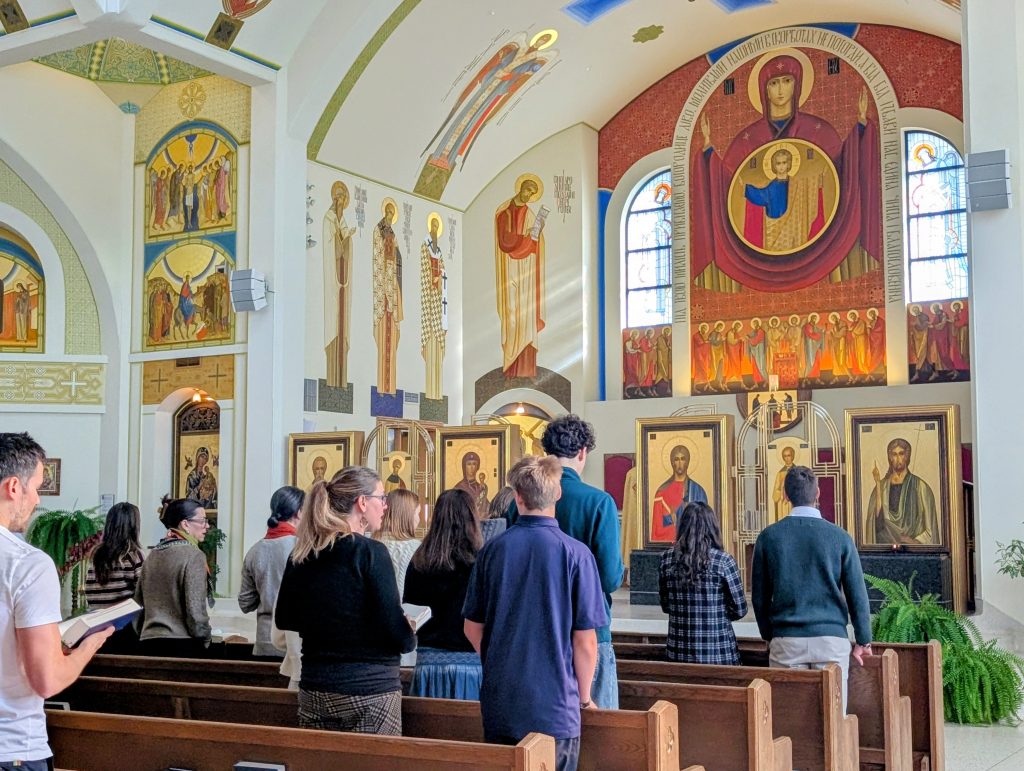
While in the Roman Rite, the faithful receive the consecrated Host either in their hands or directly on their tongue — and depending on the Mass one can also choose to partake of both species separately — in the Ukrainian Catholic tradition both bread and wine are combined in a small, golden spoon. The leavened bread is soaked in the wine. This is then placed directly into the communicant’s mouth. The communicant remains standing. Kneeling is not a common posture in the Ukrainian Catholic liturgical tradition.
The prayers of the people included Ukraine, as the country experiences severe testing during the on-going Russian assault. Incense, bells, and chanting added dimension to a liturgy that is meant to engage so many of our senses. As the service came to a close, the faithful departed in near silence, with only whispered, friendly conversations audible from the entrance.
Christopher Adam
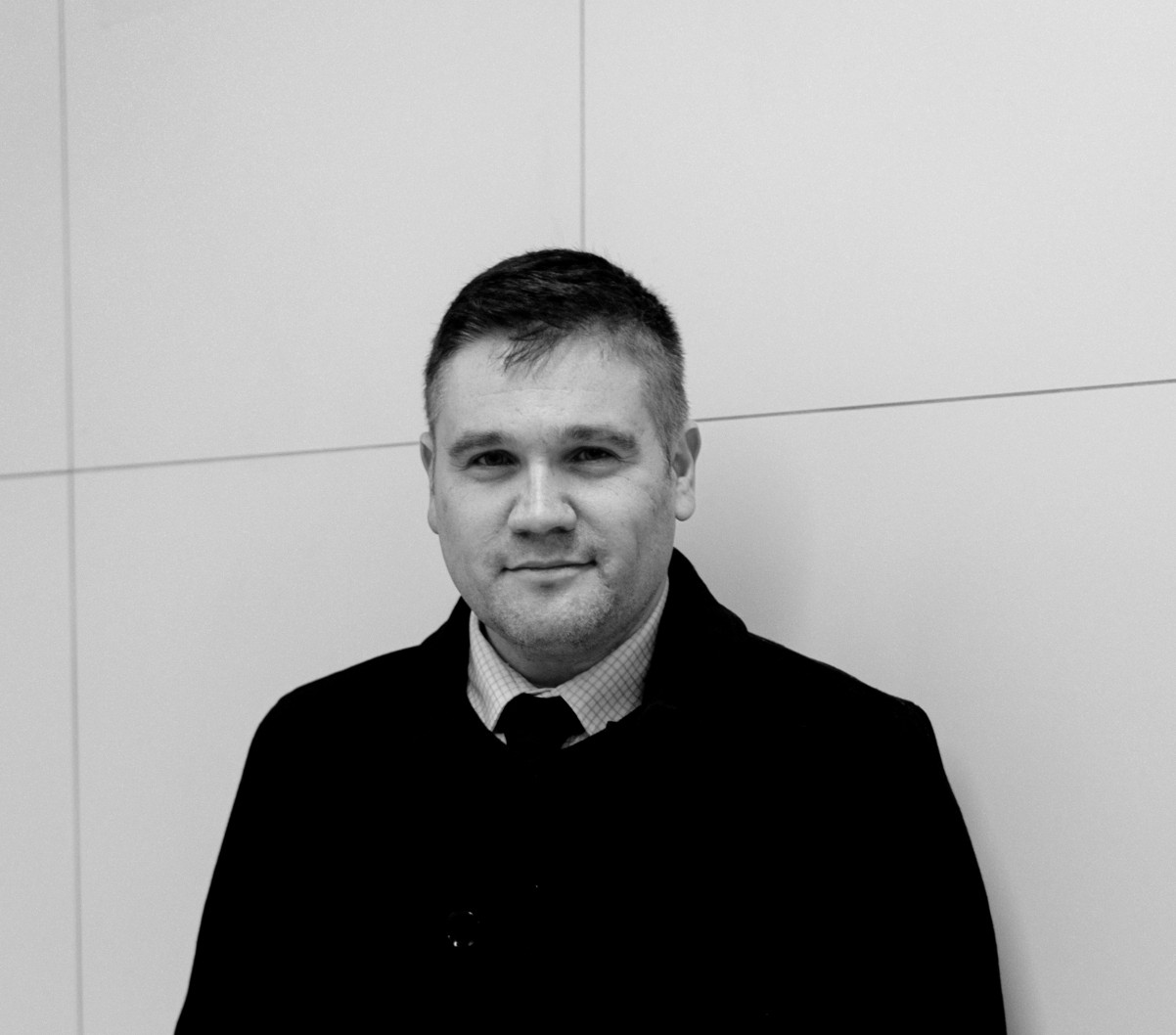
Born in Montreal, Christopher Adam has called Ottawa home for the past twenty years. He received his MA from Carleton University, with a thesis focusing on twentieth century European church history, and a PhD in History from the University of Ottawa. Over the years, he has published widely and works in the faith-based charitable sector in Ottawa.