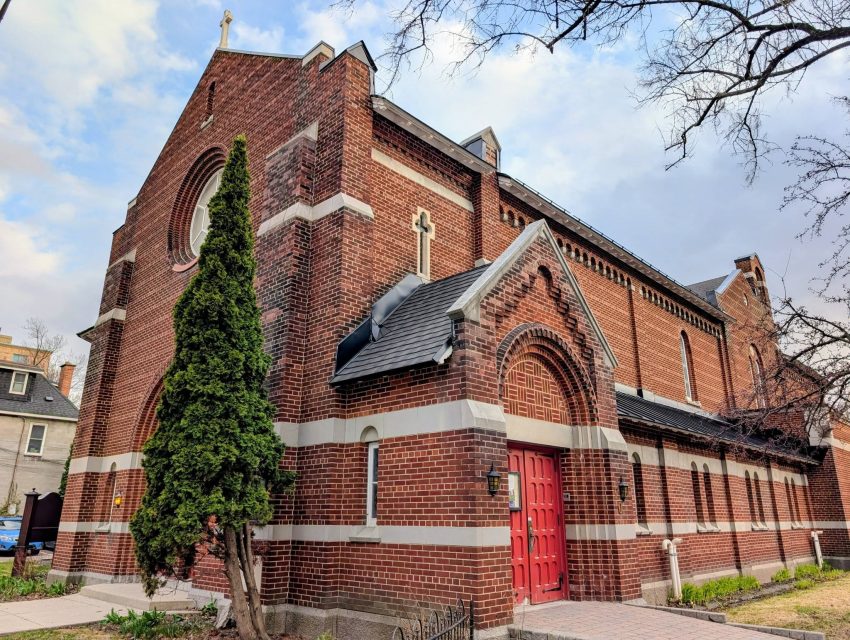
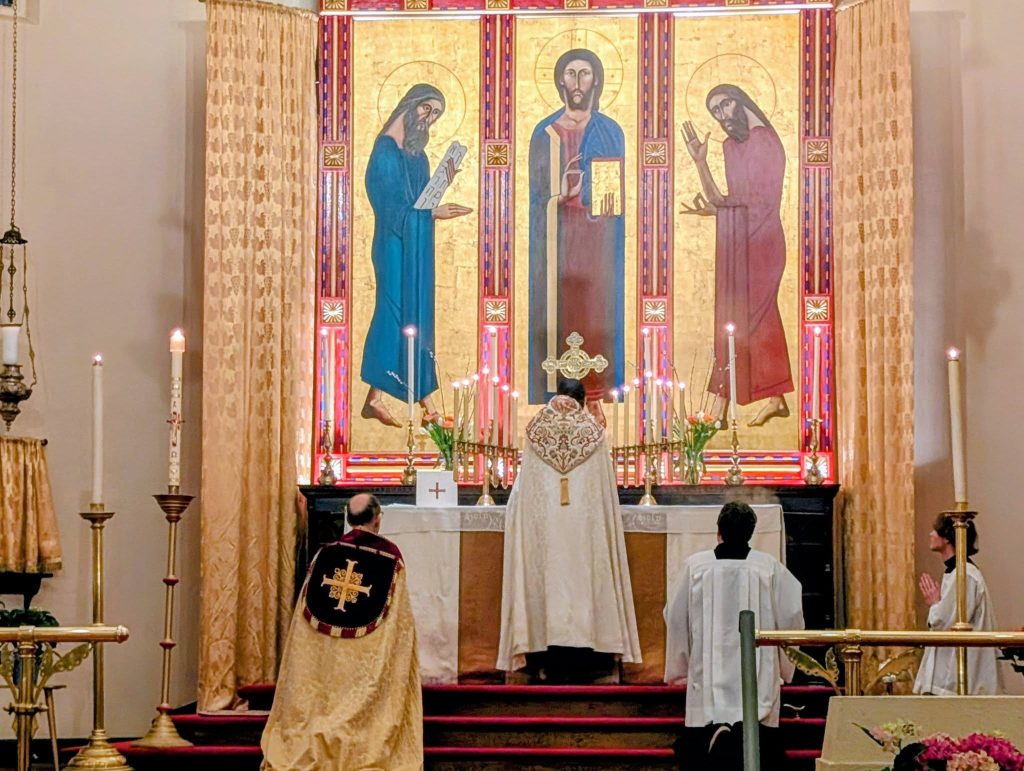
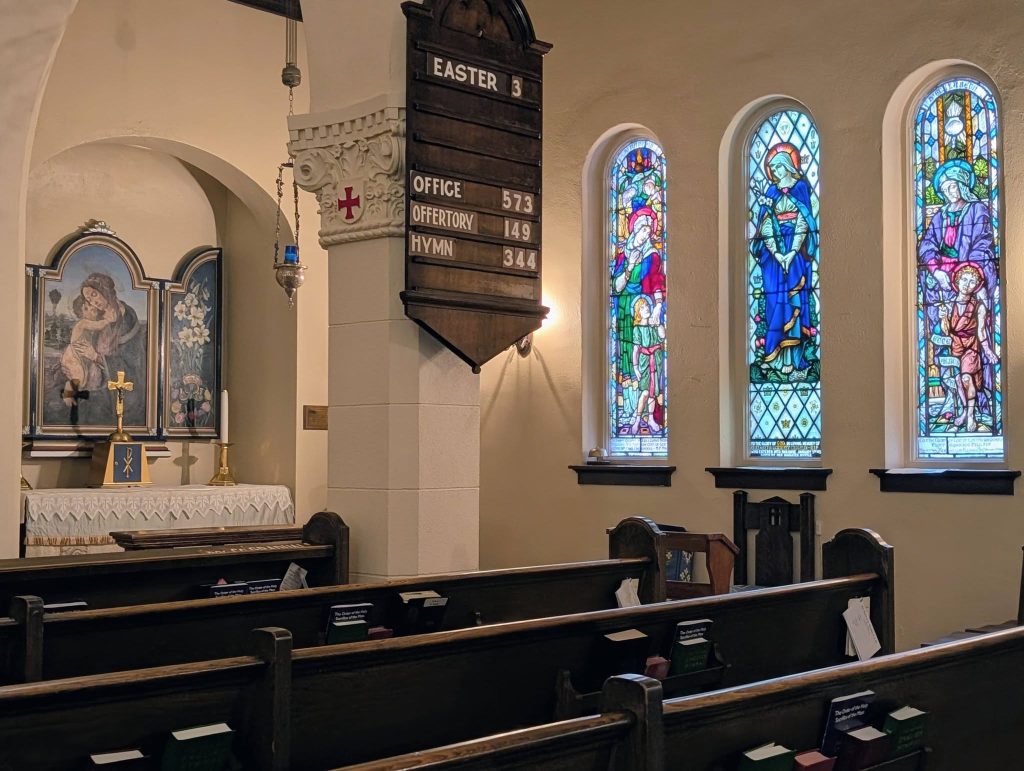
I arrived at the Anglo-Catholic Church of St. Barnabas, Apostle and Martyr on the cusp of dusk. The sounds of the robust parish choir rehearsing from the organ loft filled the church, while the herbal scent of incense from the morning liturgies lingered in the nave. And on April 19, the evening sun lingered too. It illuminated the church’s stained glass in a way that I didn’t experience when I last attended Evensong here — then in fall’s expanding darkness. I entered the historic Romanesque Revival church at 70 James Street, built in 1931, ten minutes before the start of the 7:15 PM Solemn Evensong. The wood panel sacred art above the altar, or the triptych, lends the space a Byzantine grandeur. By the start of Evensong, around 50 people had gathered at this downtown church.
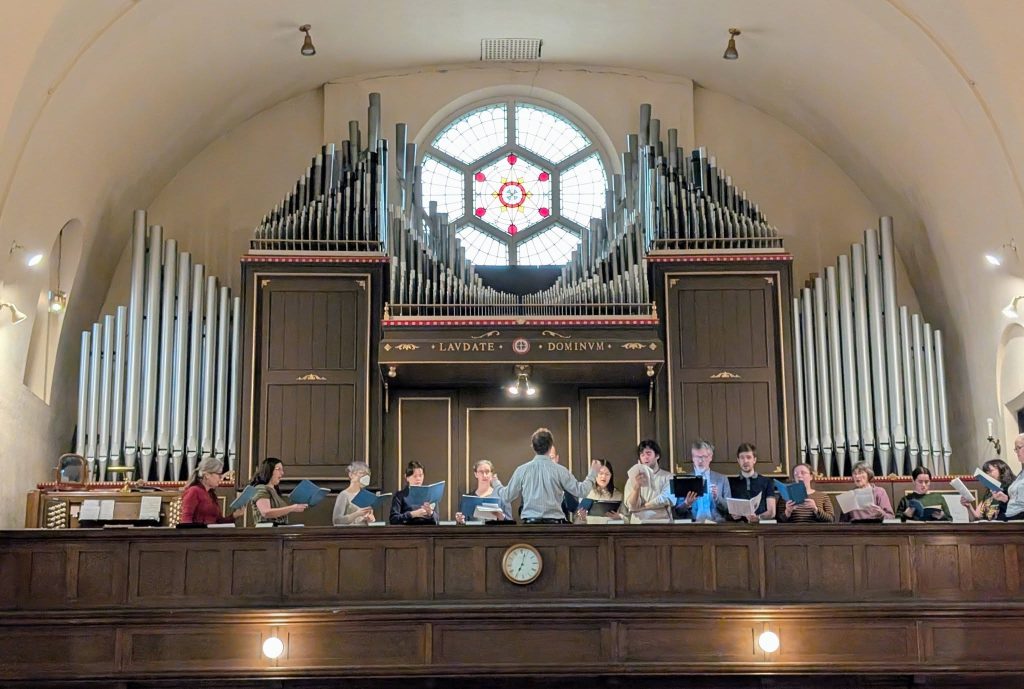
Shawn Potter serves as St. Barnabas’ choirmaster and organist. He led the choristers, singing from the organ loft, in a range of hymns, responses, an anthem, and in a Motet during the Benediction. “Jesus Lives! They Terror Now” served as the Offertory Hymn, with vivid lyrics that are hard to forget. They remind us of the hope of Easter:
Jesus lives! thy terrors now
Can, O Death, no more appall us;
Jesus lives! by this we know
Thou, O Grave, canst not enthrall us.
Alleluia!Jesus lives! henceforth is death
But the gate of Life immortal;
This shall calm our trembling breath,
When we pass its gloomy portal.
Alleluia!
“The King of Love My Shepherd Is” served as the Office Hymn, while “The Day Is Done But Love Unfailing” was the Closing Hymn. Its lyrics filled the church as darkness descended around us, pierced only by the candles and candelabras in the sanctuary:
Day is done, but love unfailing
Dwells ever here;
Shadows fall, but hope prevailing,
Calms ev’ry fear.
Loving Father, none forsaking,
Take our hearts, of love’s own making,
Watch our sleeping, guard our waking,
Be always near.Dark descends, but light unending
Shines through our night;
You are with us, ever lending
New strength to sight:
One in love, your truth confessing,
One in hope of heaven’s blessing,
May we see, in love’s possessing,
Love’s endless light!
St. Barnabas has an exceptional music ministry. It’s bolstered by the St. Barnabas Music Fund, which supports choral scholarships for young singers and musicians. By investing in young talent, this parish community markedly elevates the worship experience. It seems like a natural fit to do so, given the care that the Anglo-Catholic tradition demonstrates when it comes to offering good liturgy.
The Incumbent — the Reverend Canon George Kwari — presided, and the Venerable Paul Blunt offered the sermon at this Evensong service. Speaking from the pulpit, he broke open the reading, taken from the ever-elusive and mysterious Book of Revelation — in this case Chapter 20. This is where we read of an angel come down from heaven, who appears with the key of the bottomless pit: “He laid hold on the dragon, that old serpent, which is the Devil, and Satan, and bound him a thousand years, and cast him into the bottomless pit, and shut him up, and set a seal upon him, that he should deceive the nations no more.”
The Ven. Blunt, an archdeacon and retired priest in the Anglican Diocese of Ottawa, shared that as a young man, at the college he attended, he was always captivated by a set of large murals in the chapel. They depicted dramatic, apocalyptic scenes from the Book of Revelation. Providing the historical context in which Revelation was written, notably the horrific persecution of the early Church at the hands of the Romans, the Ven. Blunt shared that Revelation challenges us with its rich symbolism and it also challenges us in our tendency to want to hang on to the status quo. “God’s Kingdom challenges our assumptions that when things go wrong, we can fix things by physically enforcing the right way — the idea that might makes it right. When proclaiming Jesus’ Kingdom of mercy and grace, as his followers experienced, there will be costs. Those who stand up to the powers and authorities take a beating. Those who advocate an alternative to the status quo can usually expect those who benefit from the status quo to come down on them,” the Ven. Blunt said.
The times had become decidedly apocalyptic in the era when the Book of Revelation was written. Christians had been burned at the stake, crucified and torn apart by wild animals in public spectacles. Professing one’s faith was dangerous. “Revelation used symbolic language because symbols were a kind of code. It was a way of telling the stories and giving hope to the Church in a manner that the persecutors of that Church could not understand,” the Ven. Blunt shared. “Revelation was the underground resistance literature of the first century,” he added.
After the liturgy, all were invited to a reception in the Parish Hall. Here, accompanying the fruit punch, was a table of sweets and the widest array of savoury hors d’oeuvres: from deviled eggs, cheese and prawn cocktail to pigs in blankets. Amidst the tasty treats, some of the youth from the choir commiserated about the differences, similarities and respective value of both the Anglo-Catholic and the Roman Catholic traditions. Certainly, one of the great contributions of this downtown congregation to the Anglican community and more broadly to all Christians is the seriousness with which they approach both sacred music and their liturgy. The celebrations and gatherings at St. Barnabas truly do engage all the senses.
Christopher Adam

Born in Montreal, Christopher Adam has called Ottawa home for the past twenty years. He received his MA from Carleton University, with a thesis focusing on twentieth century European church history, and a PhD in History from the University of Ottawa. Over the years, he has published widely and works in the faith-based charitable sector in Ottawa.