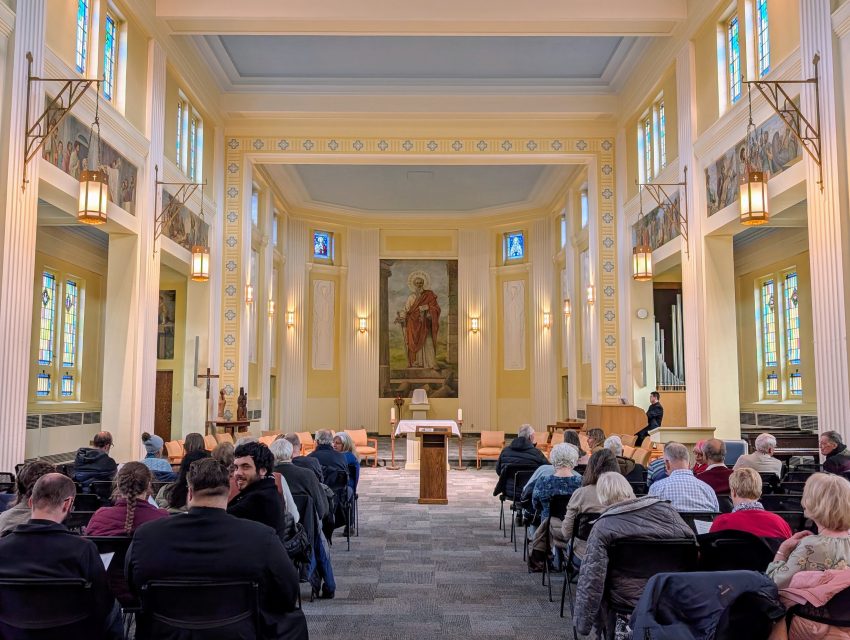
St. Cecilia, the patron saint of musicians, and the martyr’s feast day served as an opportunity for a choral Evensong featuring Matthew Larkin’s Caelis Academy Ensemble. The Evensong service on November 22 was also a coming together of Catholic and Anglican traditions. Fr. Doug Hayman, Rector of the Church of the Annunciation of the Blessed Virgin Mary, a parish that was received into the Catholic Church in 2012, officiated and gave the reflection. And Saint Paul University, which has a pontifical charter, is home to the De Mazenod Chapel, named after St. Eugène de Mazenod, the founder of the Missionary Oblates of Mary Immaculate. This is the religious congregation to which the university remains affiliated and entrusted.
The neoclassical chapel, which features a painting of St. Paul in its sanctuary, is housed in the former Oblate Seminary at 249 Main Street. It opened its doors in May 1937 and much of the building’s interior includes elements of Art Deco architecture. This is especially apparent in the lobby, stairwell and landing areas. A hint of Art Deco in the chapel is found in the light fixtures, but otherwise it’s a neoclassical space painted in shades of cream and blue, with exterior light streaming in through the yellow and blue windowpanes.
Organist and conductor Matthew Larkin directs the Caelis Academy Ensemble, a chamber-concert choir established in 2017. Sacred music is at the heart of the choir’s repertoire and its work now extends far beyond Ottawa. In August 2025, the Ensemble served as the visiting Choir-in-Residence at St. Paul’s Cathedral in London and in August 2027, they are preparing for concerts and liturgies in a number of continental European destinations, including St. Peter’s Basilica, in the Vatican.
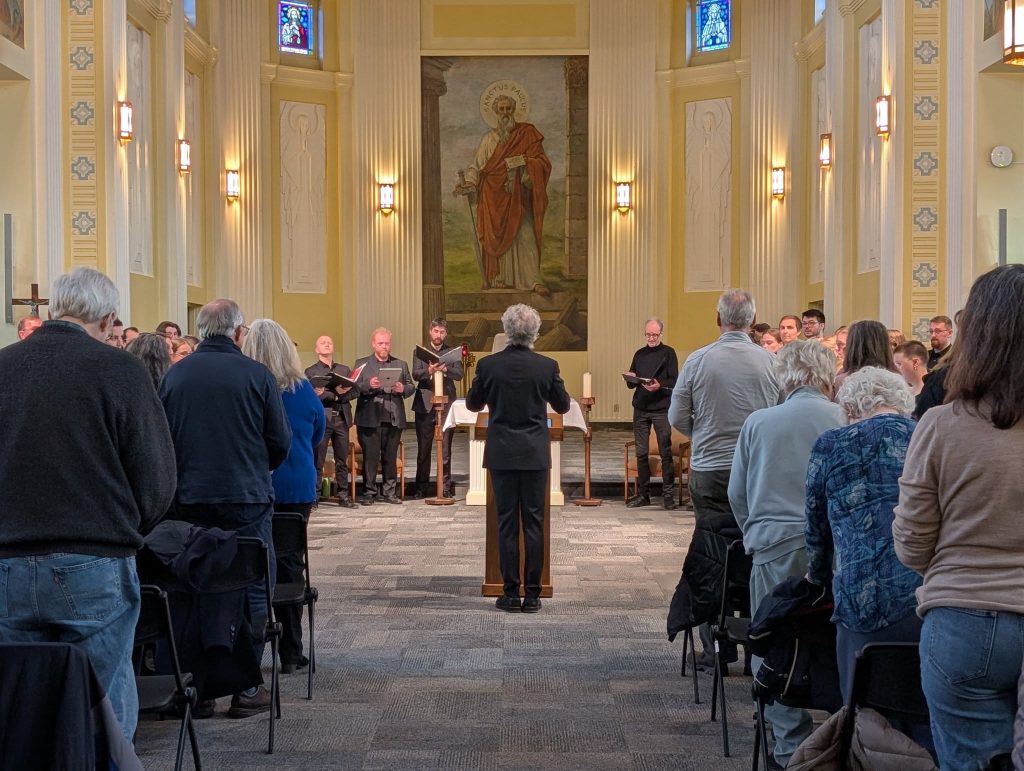
Mr. Larkin and his choir processed down the chapel’s main aisle, behind the cross-bearer. The service began with the Introit, “Let All Mortal Flesh Keep Silence,” as music and liturgy were bound into one sacred space with the words:
Let all mortal flesh keep silence and stand with fear and trembling and lift itself above all earthly thought. For the King of Kings and Lord of lords, Christ our God, cometh forth to be our oblation, and to be given for Food to the faithful. Before him come the choirs of angels with every principality and power; the Cherubim with many eyes, and winged Seraphim, who veil their faces as they shout exaltingly the hymn: Allelulia!
The words bore additional relevance, given that St. Cecilia’s Day was also the threshold of The Feast of Christ the King. In addition to Psalm 42 sung to a setting by Herbert Howells and Herbert Sumison’s Magnificat, the Hymn to St. Cecilia by Benjamin Britten, with poetry written by W.H. Auden in 1942, served as the choir’s anthem. Auden wrote this poem soon after his life took a religious turn and he returned to his Anglican roots in 1940. He was drawn to the concept of Agape love after what he described as a vision or perhaps a revelation he had as a 26 year old man in 1933, while relaxing with friends and colleagues on a summer night in Herefordshire, northwest of London. His poetry is sometimes ornamental, even flamboyant, and the Hymn to St. Cecilia is no different, as this excerpt demonstrates:
O dear white children casual as birds
Playing among the ruined languages,
So small beside their large confusing words,
So gay against the greater silences
Of dreadful things you did: O hang the head,
Impetuous child with the tremendous brain.
O weep, child, weep, O weep away the stain,
Lost innocence who wished your lover dead,
Weep for the lives your wishes never led.
…
Blessed Cecilia, appear in visions
To all musicians, appear and inspire:
Translated Daughter, come down and startle
Composing mortals with immortal fire.
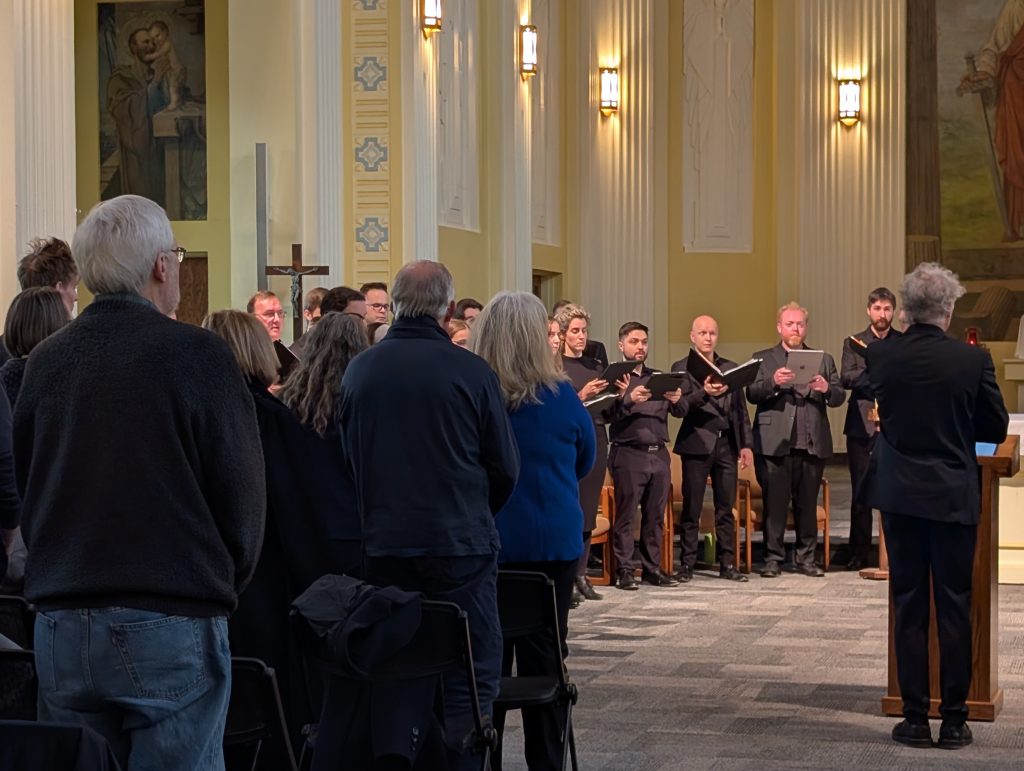
In his reflection, Fr. Hayman spoke of the virgin St. Cecilia’s life, the way she sang hymns in her soul, her persecution, martyrdom in the early days of Christianity, and of music as a medium for experiencing the Transcendent. In the early third century, Roman authorities gave her the option to renounce her faith and thus avoid execution. She refused and the authorities attempted to kill her through suffocation in a scorching hot Roman bath. When this method failed to kill her, they attempted a beheading, but legend has it that she survived several more days, despite her bleeding wounds. St. Cecilia was confident that all things on earth are held in the rhythm of Christ’s life, Fr. Hayman observed. “From as far back as we know, there have been musical societies that were formed under her patronage. There is something she glimpsed of the deeper mystery of the love of God — the rhythm, the harmony that is part of all Creation. We know that music is not just a set of words that are sung. There’s a depth to music that speaks to us personally and across the languages, cultures, races and creeds. Even if you don’t follow the lyrics going by, you’re still lifted up and moved by the music itself. When we sing ‘This is My Father’s World,’ we hear the line ‘All nature sings, and round me rings, the music of the spheres.’ Music moves all things,” Fr. Hayman reflected.
With Nathan Jeffery on the organ, the congregation was invited to join the choir in singing the concluding hymn “Angel-voices, ever singing.” The liturgical year approached its end with music, as we prepared to enter Advent with new songs.
Christopher Adam

Born in Montreal, Christopher Adam has called Ottawa home for the past twenty years. He received his MA from Carleton University, with a thesis focusing on twentieth century European church history, and a PhD in History from the University of Ottawa. Over the years, he has published widely and works in the faith-based charitable sector in Ottawa.