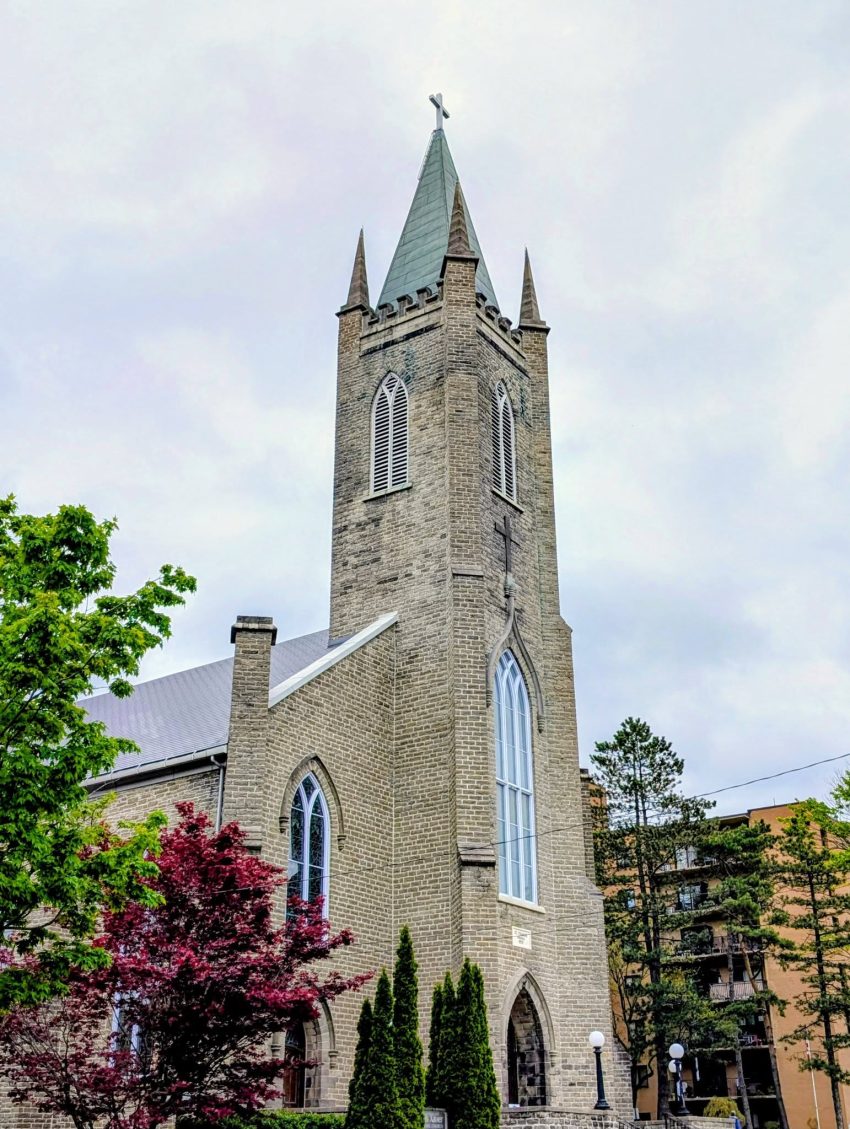
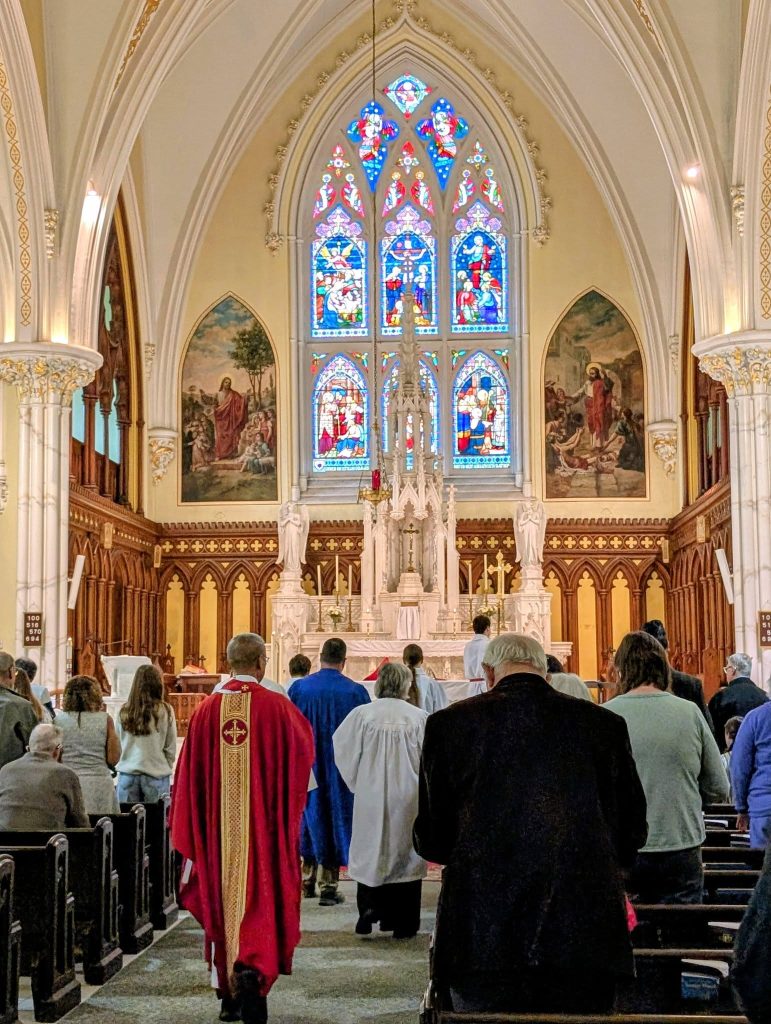
Downtown Brockville is known for its rich collection of historic churches. Among the most architecturally noteworthy is the High Gothic Revival St. Francis Xavier Church, completed in 1860 and located at 66 Church Street. On May 24, Pentecost Sunday, I joined over 120 parishioners at the 10:30 AM Mass. The Presider and Pastor, Fr. Andrew Shim, began the liturgy by inviting the faithful to greet each other in the pews, sharing their names with those seated nearest to them. The small gesture enhanced the sense of welcome and community. Later in the Mass, Fr. Andrew would invite parishioners to hold in prayer the name of the person they had just met in the pews.
The parish’s historian is its retired pastor, Fr. Brian Price, who has often presented on the church’s history, as well as given tours. He speaks with the mild Irish lilt that is sometimes present among Canadians of his generation in Eastern Ontario.
St. Francis Xavier is one of the best examples of High Gothic Revival architecture in the Archdiocese of Kingston. This is the second Catholic church to be built on this land — or, more accurately, immediately next door to where the original one stood. Where the current church stands was once the parish cemetery, which had to be moved beyond city limits, following a directive from Brockville’s municipal leaders in the nineteenth century. One lonely headstone from the former cemetery still exists behind the church. We can’t be certain if the remains of the deceased were ever moved from that plot.
The first church was a simple structure dating back to 1821, and there’s a quirky story associated with its inception. Four Roman Catholic women had married four Protestant men. They banded together to convince their respective husbands to provide $100 each to help build a very modest Catholic church in town, one which had a dirt floor and planks placed on tree trunks serving as makeshift pews. At first, the new Brockville church was a mission of the Catholic parish in nearby Prescott. It had been assumed that Prescott would grow into the more important town of the two. That changed when Brockville became the county seat, and home to the courthouse. St. Francis became a parish in its own right in 1830. Fr. Price estimates that in these early years, Brockville’s Catholic population numbered around 300 people. While the Catholic community was still modest in number, the old church — which accommodated less than 100 faithful — was soon no longer suitable. It would become a boys’ school, while liturgies were soon celebrated in the new, soaring church.
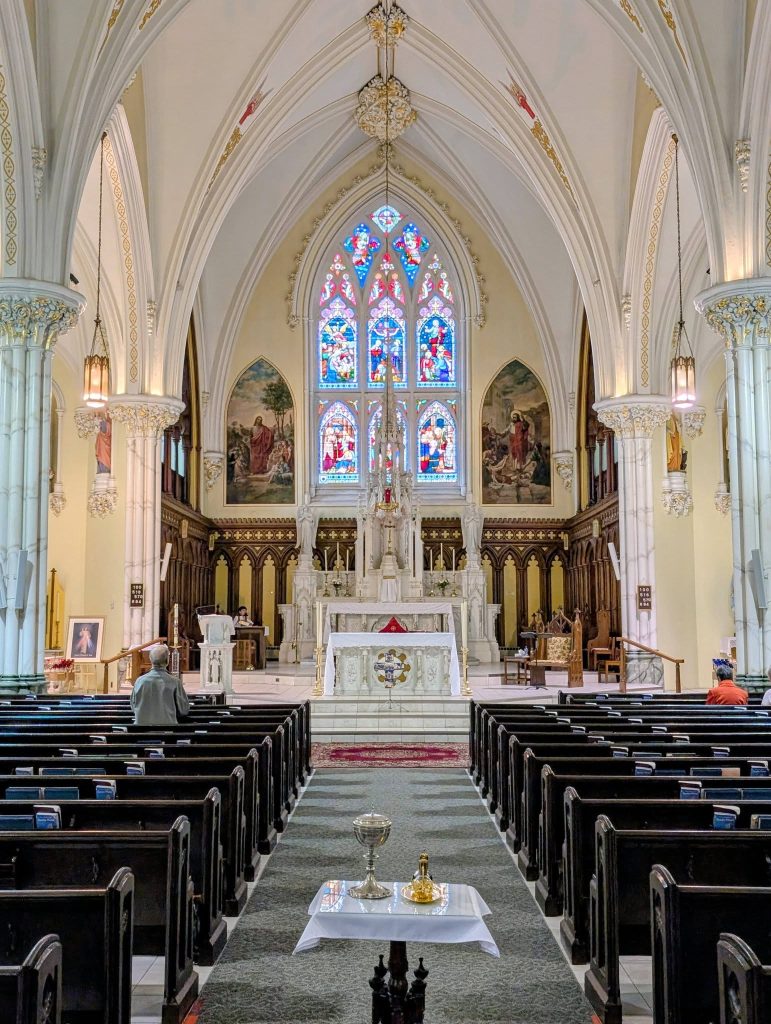
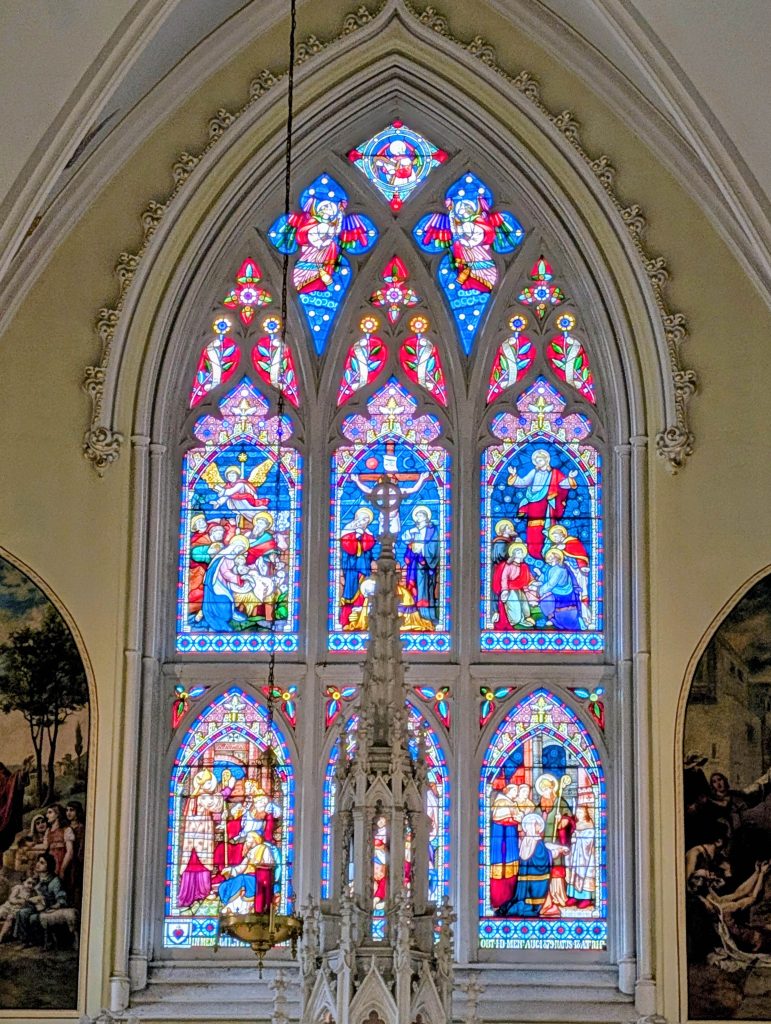
This grand structure, which took four years to construct between 1856 and 1860, is home to a vibrant faith community to this day. The stained glass windows, the first of which were installed in 1881, include rich colours and intricate imagery. The church’s soaring lines and pointed vaulting are hallmarks of Gothic architecture. The entire church was carefully repainted in the last two decades, while the windows were restored and the flooring replaced. In the late nineteenth century, St. Francis’ church bell was considered to be the “finest” in the Dominion of Canada. The organ was installed in 1876, built by Louis Mitchell of Quebec, one of Canada’s great organ builders.
For this Pentecost liturgy, two cantors — accompanied by a pianist — sang from near the east transept. At various times, they were joined by Fr. Andrew — he has a wonderful singing voice and sang parts of the liturgy. Much of the music came from the song book Holy is the Lord, published by Franciscan University Press. These included “Breathe on me Holy One — Draw Me to the Living Waters” by Jim Cowan, as well as “Holy Ground” and “Standing on Holy Ground.” Other hymns included “Come, Holy Ghost” and the “Gift of Finest Wheat” from the Catholic Book of Worship II.
In his homily, Fr. Andrew referenced the two-hundredth anniversary of the Archdiocese of Kingston. He noted that today, we’re standing on the shoulders of previous generations who sat in these exact pews and said ‘yes’ to God’s call. “The Holy Spirit is a single fire, but he gives a unique spark to every single person,” Fr. Andrew said, as he reflected on Pentecost and Paul’s words that there are a variety of gifts, but the same Spirit. “You’re not a carbon copy of the person sitting next to you. God does not make duplicates; He creates originals only. The Spirit has given you a specific personality, talents, experiences and passions. You have a unique mission and calling that nobody else can fulfill,” he shared.
Reflecting on the history of the lands that would become Canada, Fr. Andrew told the story of Canadian martyr Joseph Chiwatenhwa, a Wyandot who converted to Christianity after encountering Jesuits in 1636. He was baptized by Fr. Jean Brébeuf in 1637. His gifts and his unique mission lay in working with the Jesuits in the translation of hymns and prayers from French to the Wendat language. “He stepped into the waters of baptism as a proud Wyandot man and he brought his heritage with him. He walked shoulder to shoulder with the European missionaries,” Fr. Andrew noted.
Following Mass, parishioners were invited to mingle in the church’s entrance area over coffee, tea, homemade baked goods, cheese and crackers, and — perhaps everyone’s secret favourite — an assortment of Timbits. Fr. Andrew greeted me with a handshake. I commended him on his exceptional singing voice, which elevated Mass on this Pentecost. “Well,” he said,”we are all to make use of the gifts with which we are blessed.”
Christopher Adam
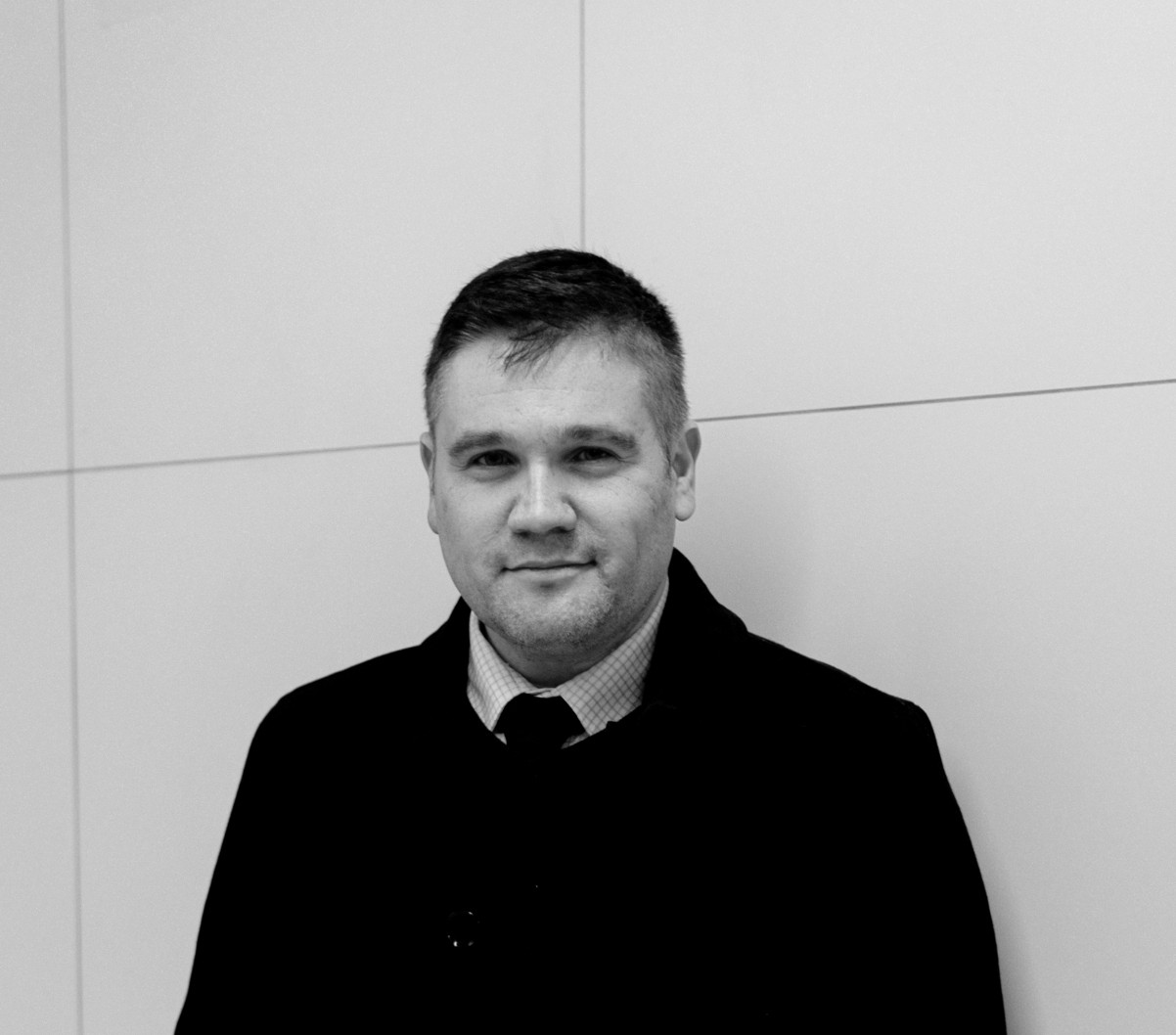
Born in Montreal, Christopher Adam has called Ottawa home for the past twenty years. He received his MA from Carleton University, with a thesis focusing on twentieth century European church history, and a PhD in History from the University of Ottawa. Over the years, he has published widely and works in the faith-based charitable sector in Ottawa.