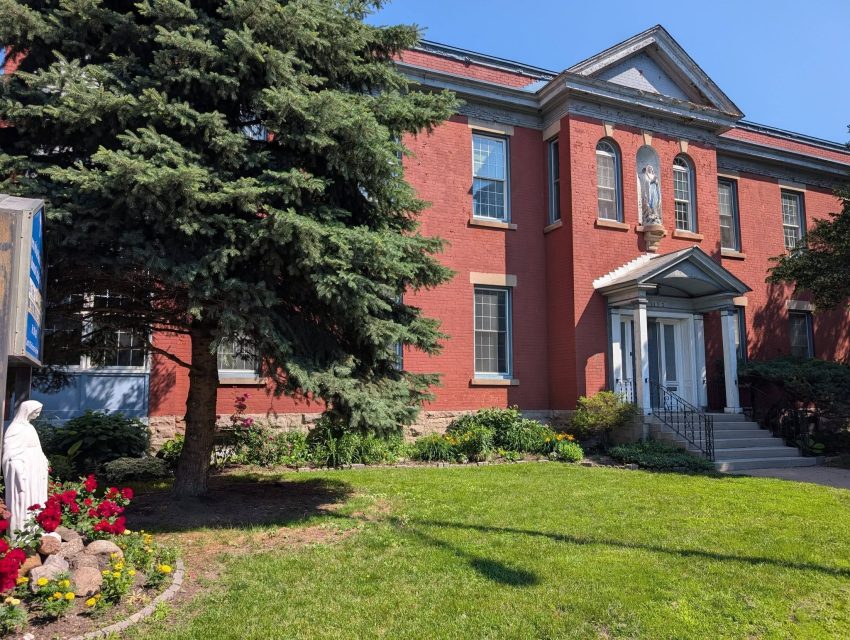
Every church’s architecture tells a story and it’s safe to say that the Queen of the Most Holy Rosary Parish has sufficient stories to fill a book. This isn’t a purpose-built church. The building at 1153 Wellington Street West had several lives — as a private residence called Fitzgibbon House dating back to the 1870s, later as a receiving house for thousands of disadvantaged British children, military barracks during World War II, and finally as a Roman Catholic parish in 1947. The liturgical space has the feel of a larger chapel. It’s a twentieth century wing added to the original building, with an entrance located at 20 Grant Street. On Sunday, June 28 I joined over 50 parishioners for 10:30 AM Mass. The Archbishop Emeritus of Kingston, the Most Reverend Brendan Michael O’Brien, presided.
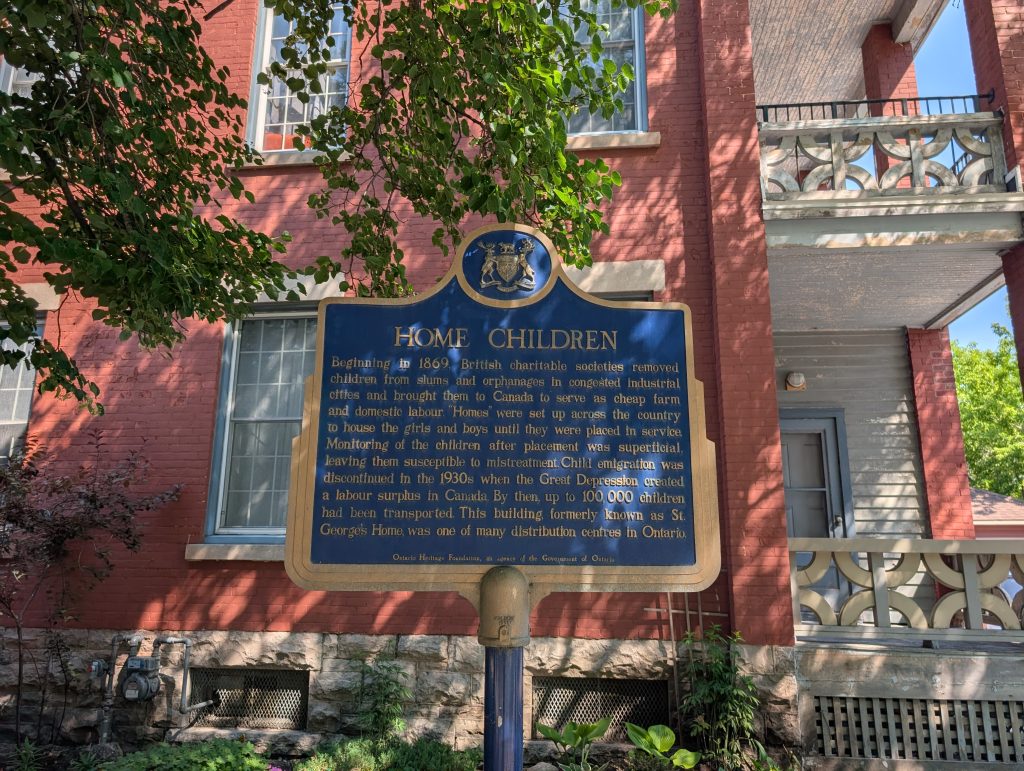
While the late nineteenth century building facing Wellington Street West began its life as a private residence, it would soon be owned by the Catholic Council of British Overseas Settlement. St. George’s Home, as the building became known, housed British Home Children. It served as a distribution point for around 8,000 of the 100,000 boys and girls who arrived in Canada from the United Kingdom. The program as a whole ran from 1869 to 1948 and it resettled both British orphans and other children from disadvantaged backgrounds, bringing them to Canada. The children would stay at places like St. George’s Home relatively briefly, before being relocated and employed in farm labour or domestic work. The home in Ottawa’s Hintonburg neighbourhood was run by the Sisters of Charity of St. Paul. After leaving these homes and being resettled on farms, many of the children faced abuse and a cold, unstable environment where they were moved around from family to family. A plaque erected on the parish’s property by the Ontario Heritage Foundation in 1998 reads:
Beginning in 1869, British charitable societies removed children from slums and orphanages in congested industrial cities and brought them to Canada to serve as cheap farm and domestic labour. ‘Homes’ were set up across the country to house the girls and boys until they were placed in service. Monitoring the children after placement was superficial, leaving them susceptible to mistreatment. Child emigration discontinued in the 1930s when the Great Depression created a labour surplus in Canada. By then, up to 100,000 children had been transported. This building formerly known as St. George’s Home was one of many distribution centres in Ontario.
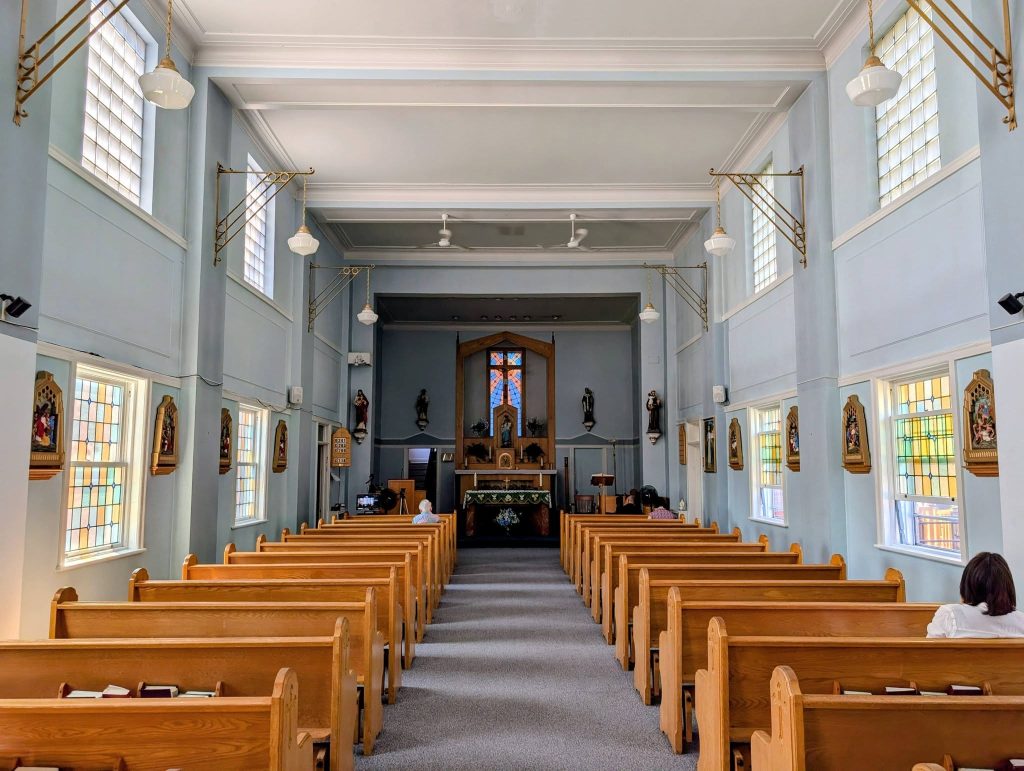
After the receiving home closed in 1935, the federal government leased the property and used it as military barracks in World War II. The Queen of the Most of Holy Rosary opened its doors as a Roman Catholic parish on May 25, 1947. The chapel was designed by the architects Martineau & Talbot of Montreal. The Archbishop of Ottawa, the Most Reverend Alexandre Vachon, presided at the blessing and dedication. An article from May 1947 published in the Ottawa Citizen observed that the chapel could accommodate up to 400 people. That occupancy level would likely prove to be a cozy format. It also described the chapel’s interior as Colonial-type architecture. To me, many features — such as the lighting fixtures, the windows and the clean lines — bear the hallmarks of Art Deco. Fr. Philip Cleveland Harris, the Parish’s first pastor, described the church as “both attractive and serviceable.”
On that first Sunday in 1947, the new Parish celebrated four liturgies in a single morning: a blessing and Low Mass at 7:30 AM, Children’s Mass at 9:00 AM, Low Mass at 10:00 AM and High Mass at 11:00 AM. The Missionary Oblates of Mary Immaculate provided the choral and organ music at the High Mass. Fr. Harris presided at that liturgy, assisted by clergy from St. Brigid’s and St. Margaret Mary in Ottawa, and from St. Peter Celestine in Pakenham.
Fr. Harris, ordained in 1915, was first appointed to serve in the fledgling parish in 1946, as the development of the new chapel got underway. Prior to that, he has served in Almonte, Mayo and Metcalfe, as well as at St. Isidore’s in South March, in what is today Kanata.
In addition to Saturday 5:00 PM and Sunday 10:30 AM Masses, as well as a Wednesday 12:15 PM Mass, the Parish is very involved in welcoming newcomers to Canada, as been for decades. In the 1970s, the Parish helped to settle Southeast Asian refugees. More recently a group called the Circle of Friends — formed in 2015 during the Syrian refugee crisis — has assisted newcomers to find housing and employment, and with everyday essentials like groceries and clothing. Even during my visit to the Parish, the air of welcome was evident.
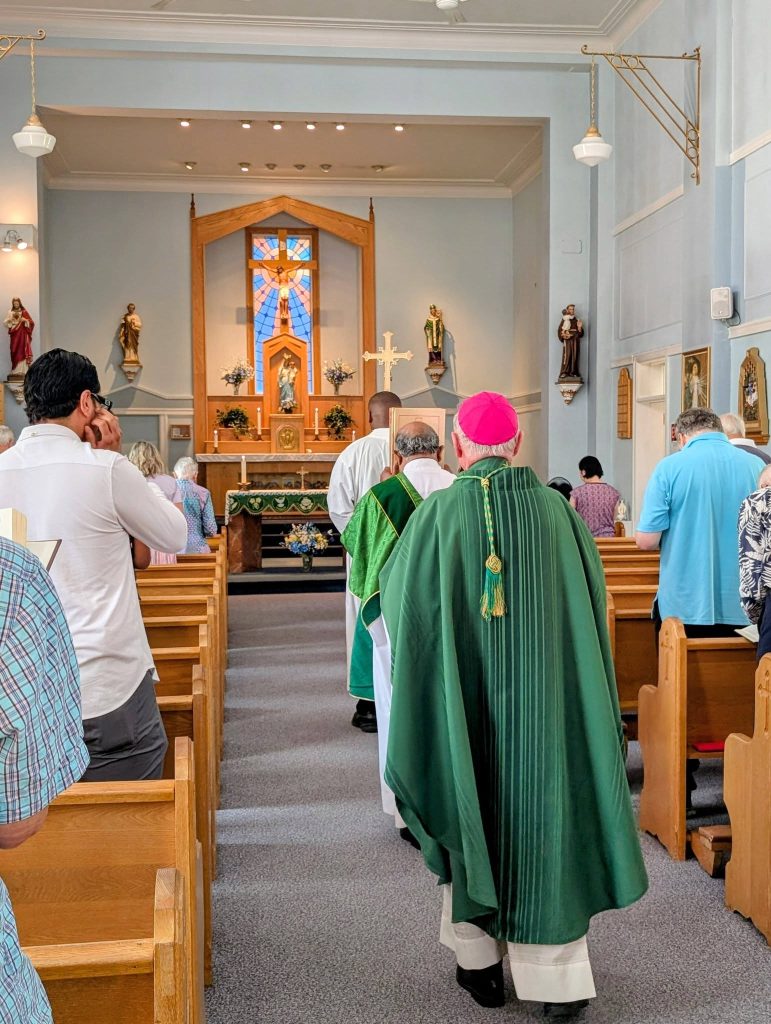
Archbishop Emeritus O’Brien is no stranger to this parish. He served as Pastor many years ago, before being appointed Bishop of Pembroke, then Archbishop of St. John’s, and later Kingston. He was a warm, friendly presence throughout the Mass. Matthew 10:37-42 served as the Scripture reading — a difficult one, where Jesus says: “Whoever loves father or mother more than me is not worthy of me; and whoever loves son or daughter more than me is not worthy of me; and whoever does not take up the cross and follow me is not worthy of me.”
In his homily, the Most Reverend O’Brien shared:
When we hear today’s Gospel, we might wonder why Jesus is insisting that we love Him above anything else, even our closest family. I think He’s showing us where our happiness lies; He wants us to see that there’s a hierarchy of values that must be respected…When we place Jesus first, I think we can see that all other things will fall into place. What can often happen in life is that we put our other legitimate needs, such as food, shelter and social interaction, as our ultimate commitment. Our human relationships certainly give great worth and they enrich our lives. But if we try to make these lesser, finite realities do for us what only God can do, we put a weight on them that they can’t bear. When there’s an anchoring in God, everything else falls into perspective.
The Parish has an excellent music ministry. Eight choristers sang from the loft and the musical selection came from two sources: Glory & Praise, as well as the Catholic Book of Worship II. Among the hymns were “Will You Come and Follow Me,” “There is a River,” and “Leave Your Fishing Nets.” “I Have Decided to Follow Jesus” served as the Communion Hymn. Near the end of the liturgy, one of the Parish’s new lay lectors was called up to receive a blessing.
After Mass, all were invited to the Parish Hall for coffee, tea, baked goods, fresh fruit and some hot sandwiches. A volunteer known for her dedication and dubbed an archangel by the parishioners present, Marie, has coordinated the coffee fellowship for over 12 years. Marie blessed the food, after which a good handful of parishioners — and soon enough the Archbishop Emeritus himself — helped themselves to refreshments, enjoying each other’s company during the last such social gathering of the summer.
Christopher Adam

Born in Montreal, Christopher Adam has called Ottawa home for the past twenty years. He received his MA from Carleton University, with a thesis focusing on twentieth century European church history, and a PhD in History from the University of Ottawa. Over the years, he has published widely and works in the faith-based charitable sector in Ottawa.